[00:00:00] Intro: Welcome to Private Banking Strategies Podcast with Vance Lowe and Seth Hicks, your secret weapon to protect your assets and never have to start over financially again. Vance and Seth help high net worth individuals, families, business owners, and investors structure and asset protected fortress for their families.
[00:00:21] Intro: Learn how to keep what you earn and use the velocity of money. To create your own private banking system. Join us on this journey as we explore the secret strategies of the rich and political elite and help you take total control of your financial security now onto the show.
[00:00:38] Seth Hicks Esq.: Hello and welcome to Private Banking Strategies Podcast with Vance Lowe and Seth Hicks.
Vance, how are you?
[00:00:44] Vance Lowe: I’m doing wonderful. I’m anxious to jump back into where we left off.
[00:00:48] Seth Hicks Esq.: I think we’re gonna pick up our conversation with the loan based distribution strategy for retirement. Can you talk to us a little bit about that?
[00:00:57] Vance Lowe: Okay. If you haven’t heard anything up to this [00:01:00] point, please listen to the first couple of videos.
[00:01:03] Vance Lowe: Because we’re taking this retirement methodology one step at a time, and we’re into the loan base now loan based strategy of how things are going to work for retirement or for future growth topics. So the core approach, I think, is the understanding that when we get money into these banking contracts with the life insurance carriers, the cash value becomes our accessible account.
[00:01:33] Vance Lowe: We can lend to our bank, our lending company and buy debt and loan out what that means. And the advantage of doing it this way, we’re using after tax dollars. When we borrow money out of this contract, we are allowed to put it back in. Let’s go through that definition. When we borrow from these contracts, we borrow against our cash value.[00:02:00]
[00:02:00] Vance Lowe: We do not borrow our own cash value. People please understand that because we do not borrow our cash value. It remains in the account. It earns. A guaranteed interest rate, whatever your contract states, they can’t change that. That will continue to earn and compound at least at that rate. In addition to that, you’re an owner to the insurance of the insurance company itself, and you participate in profits every single year on top of that.
[00:02:33] Vance Lowe: So the advantage is when we need to borrow money, it’s because we’re going to self-finance something. And we’re taking money out. We’re gonna borrow the cash reserve of the life insurance company against our cash value. So how much can we borrow equal to what we have in our cash value account? Because they want it, have it 100% collateralized.
[00:02:57] Vance Lowe: They’re not like banks. They can’t [00:03:00] lend money that they don’t have. So they dollar for dollar, we can borrow cash reserve. We can borrow it at a very competitive rate. This is money that life insurance companies lend out for communities in towns and communities and you a very stable return. This is what they do, kind of like banks, but only on a more secure basis.
[00:03:22] Vance Lowe: So we’re already making 3% on that money. We’re gonna minus anything above that, that the insurance carrier’s gonna charge us. But now we put the money to work. So I’m going into a little more detail here, folks, so that we can understand when put this money to work, maybe it’s to finance a car, but it would be better or more likely that we’re going to take over, we’re gonna purchase an existing car loan.
[00:03:47] Vance Lowe: So let’s say. One of our kids bought a Honda, cost him $30,000, and he’s into that contract two and a half years. So he’s got two and a half years left on a five [00:04:00] year contract. If we purchase that loan, we have to come up with, let’s say, 15,000. Might be a little more whatever, depending on what he’s actually paying or how he’s doing it.
[00:04:11] Vance Lowe: But we have to come up with $15,000. But what we’re gonna get in return is. The ownership of that loan. So your son is not gonna change at all, except who’s paying the payment or where he’s paying the payment is what’s going to change. Instead of paying it to Honda Finance, he’s gonna pay it to the family bank.
[00:04:31] Vance Lowe: And let’s say that payment is $600 and that interest with Honda Finance, Honda does a lot of financing at 3% or just a little bit below 3% and everybody. Is conned into thinking, oh, my loan amount, that’s all the interest I have to pay folks, you’ve got a rude awakening. There’s only one payment outta that five years that you’ll only pay 3% or whatever they said the loan interest rate is, and that’s the last one.
[00:04:57] Vance Lowe: Everything before that, we’ll be more. If [00:05:00] we’re halfway through the loan, we’re still on the double digits. And when we take over that we only had to put half the money in 15,000 or whatever it was to buy it, and we’re gonna capture the. $600 per month. When you amortize that interest rate, you’re well into the double digit and it’s worth it and you can work up all kind of advantages for you and that son, once he understands that I don’t get a better rate, I don’t get a better this.
[00:05:26] Vance Lowe: No, you not only don’t get a better rate, you’re gonna pay a higher interest because who’s gonna get that money? That’s gonna go into your account. We’re gonna credit some of that difference that we’re making and provide ownership into the family bank for you, and you can earn your way into the the family bank and start your own system.
[00:05:43] Vance Lowe: So now we’ve got two forms of income. We’ve got $15,000 as if it’s still in cash value earning the guaranteed rate. Now we’ve got it working on our loan, earning us double digit returns. Let’s say it’s 12%, which is [00:06:00] very common on the same money, and that $600 that’s coming in every month, we can accumulate that and buy more debt and exponentially compound.
[00:06:10] Vance Lowe: Money at work and or put it back into the policy and then take another lump sum out. So all this stuff compounds money doesn’t want to sit still. We don’t want money to sitting in our money warehouse just collecting the guaranteed plus the profits. Though. If we do that, what will it do for us? It normally always, I don’t know of a 10 year stretch since the stock market began that.
[00:06:39] Vance Lowe: Life insurance hasn’t beaten the stock market because there’s no taxes. Okay? There’s no taxes on the gains or the guarantees, so that’s a distribution format. We immediately put money to work if we’re not ready for a lifestyle change or retire. Then now our money can compound up [00:07:00] against us. All of our outflow that are going for financing can turn around and be inflow.
[00:07:06] Vance Lowe: We can wake up our assets, we can put it to work. A lot of people might turn around and say, I don’t have assets. So we would talk about home equity lines of credit. We would talk about all kinds of things, but there’s no taxes due. As the money comes in. This is all taxed advantage. There triggers no.
[00:07:23] Vance Lowe: Taxable events whatsoever. We’re only using after tax dollars Folks. So paying it back into the policy is better than holding the money in an account at a real bank, earning zero interest in that checking account. So we put it back, we save the interest, we get more of the profits. We want opportunity to move money and get credit for it each time.
[00:07:46] Vance Lowe: I love this stuff. It works all the time. I never come across the circumstance that private banking strategies will not outperform the herd mentality way of investing.
[00:07:58] Seth Hicks Esq.: And so in this [00:08:00] economy where no, there’s no taxable event, when the life insurance contract is structured properly and you put your money in and take it out, you’re effectively creating a multiple touch on the same dollar when you are able to cycle that through your private economy.
[00:08:18] Seth Hicks Esq.: Is that correct?
[00:08:19] Vance Lowe: Yes, especially if you can spin it. What I mean by that, let’s say we get $600 in, and now I put a bill on a credit card and instead of just letting the credit card payment die, or let’s say I put $600 on this credit card and I want that money back. I’m gonna take this $600. Now I’m gonna buy that credit card debt.
[00:08:42] Vance Lowe: And I’m gonna receive a payment off of that credit card debt, interest rate’s quite a bit higher, so I’m not only making $600 from the first thing every month. If I put the $600 to work, maybe I’m gonna make another 30 bucks or 40 bucks or $50 a month. Putting that money work. It’s exponential, folks, how [00:09:00] risky is it?
[00:09:00] Vance Lowe: Is that person looking back at you in the mirror? A shady character? If he is, we got a problem.
[00:09:06] Seth Hicks Esq.: There’s no risk in the strategy or the system. The risk is within the person actually following the strategy and the plan.
[00:09:13] Vance Lowe: See the mentality is a lot of times skeptical. People will say, why would I wanna put money in one park just to put it over in the other park?
[00:09:21] Vance Lowe: Why did that? I wouldn’t want pay any interest at all. How foolish is that? That’s like owning a grocery store thinking, because I’m the owner, I’m gonna get my groceries free for my family and loved ones. That business will fail. Every time the mentality has to be there, the opposite needs to occur. That person needs to turn around and say, you know what?
[00:09:41] Vance Lowe: I’m gonna own that grocery store. And instead of giving, I’m gonna make and demand that my family shop at the my grocery store or the family grocery store and pay absolutely full retail price. Now everybody’s shocked. Why in the world would I do that if I own the grocery store? Who [00:10:00] is going to get the profits?
[00:10:02] Vance Lowe: We are the family store. The family bank. If you steal now, look what you’ve done. You think you’ve get got yourself advantage? No. You’ve just forced all of your clients to subsidize that theft. So every cell coming from clients. You’re gonna net less at a much greater magnitude. Number one reason that new startup ventures fail is that they steal from themselves.
[00:10:26] Vance Lowe: So understand that we have a tax obligation, okay? If I pay myself the highest amount, am I going to have to pay taxes high at a higher rate? Yes. And I’m gonna use the word if you’re stupid. There’s all kind of advantages that, that you can take with taxes. If this organized, there’s all kinds of things out there that you’re able to do, especially when you’re in business, that you can deduct things and pay a whole lot less in income tax.
[00:10:53] Vance Lowe: So you have to be smart, you have to be knowledgeable for, you have to surround yourself with [00:11:00] experts who care about you and your success to get the results that you wanted.
[00:11:05] Midroll: Did that story feel like it was about you? Do you feel like you are generating a lot of revenue but are not moving forward as fast as you would like?
[00:11:15] Midroll: Do you feel you should be making more progress toward your financial goals? Do you feel stuck? Let us help you get unstuck. Are you ready to take action and get your own private bank? Please visit us at www.privatebankingstrategies.com.
[00:11:35] Seth Hicks Esq.: There’s a podcast that we did, which is a real illustrative podcast called The Twin Sisters, and it’s in the first 10 episodes.
[00:11:44] Seth Hicks Esq.: I think it’s five or six on our website@privatebankingstrategies.com. And it illustrates a well-structured tax-free retirement strategy through banking contracts that one sister implemented and her other twin [00:12:00] sister didn’t. And we often point people towards those podcasts because it’s such a good example.
[00:12:06] Seth Hicks Esq.: And for the spreadsheet people, I think we’ve got some. Attachments on those podcasts that actually walk you through the implementation played out. You think those are a good source for people to, to look at when they want to drill down and look at some details on the loan based distribution strategy?
[00:12:24] Seth Hicks Esq.: How much cash is accumulated after a lifetime of deposits and economy?
[00:12:31] Vance Lowe: It really is folks. The other thing you need to understand, and we don’t like to hear this because we’re the generation, the, and the environment we’re living in right now is what’s called a now generation, an entitlement generation.
[00:12:46] Vance Lowe: We want it now. Okay. The rich people don’t think that way. Rich people understand that the foundation, what a big windstorm comes up. There’s a lot of trees that fall over, and one of the [00:13:00] biggest species of trees, at least where I come from, is pine trees. Their root system, it spreads out on the top. It’s very shallow.
[00:13:08] Vance Lowe: They don’t have enough root systems to sustain lives, ups and downs in the storms of life, and they crash to the ground. This is the same thing here. You can’t afford to do the luxury items, the new fads that people want to do. Hey, I wanna get into crypto because I have a chance of getting a 10 x and risk all your money there without a foundation.
[00:13:31] Vance Lowe: If you have a foundation, that means, okay, worst case scenario, this will happen for me, and that has to be enough to sustain you over a long period of time. Read, go and look at that podcast because everybody needs cars. Everybody needs financing throughout their whole life. Start it. Start your kids on that right now so that they walk themselves through life.
[00:13:54] Vance Lowe: This is money that they’re already spending, folks. This is not in addition to what you’re [00:14:00] doing. None of it is. The only thing that we’re changing is who ends up with the money and then taking that money and creating more volume of return safely. Privately. Nobody can monitor that. Really. Nobody can look at it because there’s no taxable events.
[00:14:15] Vance Lowe: So yes, long term. Those strategies, those retirement strategies, if you have that, everything in banking will more than take care of you financially and pass more on to the heirs. This is multi-generational. The families are always set up as long as you don’t give them free access. If every anybody gets free access to money, it’ll be gone.
[00:14:37] Vance Lowe: And the reason you know that’s true is the banks don’t give free access to money. They always get it back with interest. The problem with banks is that they lend out money they don’t have.
[00:14:48] Seth Hicks Esq.: Let’s talk about now some of the different coordinated retirement. Income streams that you can utilize with your private banking strategies, and [00:15:00] we have clients that for various reasons and different circumstances, apply different streams of income.
[00:15:06] Seth Hicks Esq.: They may be a real estate expert or they may be whatever their expertise and income is. That’s. People develop their wealth.
[00:15:15] Vance Lowe: Yeah. Let me just throw some of these categories out. Okay. When we approach retirement age or lifestyle change, social security’s gonna come into play. You know, they try to extend that start date further and further, but there will be possibly some social security.
[00:15:30] Vance Lowe: That’s the one I probably wouldn’t count on. Then there might be pensions involved. You might have a large. Amount of money with your insurance carrier. Teachers, government workers might still have actual pensions that when they take their lifestyle change, they’ll have income coming in. Some of us in real estate Smart, we invested in.
[00:15:53] Vance Lowe: Income producing properties over the years, maybe got that property paid off and pretty much everything coming in could [00:16:00] be income, business distribution. A lot of our clients are self-employed. They own their own companies and they’re working towards a goal. It’s surprising how many people we do talk to though, Seth, that have no.
[00:16:13] Vance Lowe: Payoff goal for their business. They don’t know what the future end of their business is. So the business could produce large sums of money if we sell real estate. Now we’ve got large amounts of money flowing and it’s called windfalls. That’s how we categorize it. How can we set up for future windfalls, the sell of a business, the sell of real estate, uh, investments.
[00:16:38] Vance Lowe: Five. Decided I’m gonna take 10% of my. Money and put it in the market and it goes to 20% or it goes to 50% of, if I’m a really good steward, I’m gonna keep lowering that and putting assets that I’ve earned into a more secure basis. And let’s say at some point, okay, I’m ready to get out of [00:17:00] that risk. I don’t need to take that risk anymore.
[00:17:02] Vance Lowe: So we used to cash out, will there be taxes? Where can I place that stuff based on those. Questions, those six, those first six or five categories. Another one comes into play that we use as strategies a lot, and it’s called annuities, where we can get the money out of the banking system, which is so volatile and so risky right now.
[00:17:24] Vance Lowe: And place it in the most secure industry in history, which are, is the life insurance industry. As long as you are looking at top rated companies and we can put money to work there in safe havens and slowly move it as we need to, we can still have access. We don’t have to give up that access. Too many salespeople out there, I’m sad to say, will want to tie that money up.
[00:17:50] Vance Lowe: And charge surrender fees, big surrender fees, making that money have to stay there for a minimum of seven years to 10 to 15 years. [00:18:00] But if you do it right, you can put money there, you can get a decent return, it’s all gonna be taxable, and then start moving money over into your private banking economy and never pay tax again.
[00:18:11] Vance Lowe: So there’s a lot of strategies and breakdown for that stuff.
[00:18:14] Seth Hicks Esq.: Yeah, and I think that those dovetails of various streams of income are really important depending on how people have structured life wealth. You know, you highlighted some of the different ways that those will dovetail. How does the family bank help to buffer fluctuations in those other streams of income?
[00:18:36] Seth Hicks Esq.: Does, how does it affect, let’s say if I’m a real estate investor and I’m in COVID type long. Term vacancies and people not paying rent
[00:18:46] Vance Lowe: in recessions. What we can do here also is set up, we can take an asset, we can put it into a system which will provide your expenses or whatever is actually needed, the [00:19:00] critical needs to sustain life, to sustain your current situation for you and your family.
[00:19:06] Vance Lowe: Those vehicles are out there to be able to do that. To weather that storm when people put too many eggs in the same basket. If it’s all in real estate and we have a real estate recession, you’re gonna suffer for that. You’re not gonna be able to sell the real estate right now. You’re gonna hold onto it.
[00:19:22] Vance Lowe: And that income based. Isn’t gonna be where it is. If it’s vacancy though, you know that’s gonna even be more catastrophic. If we’ve planned for which we should plan for a 30% vacancy. If we’ve only planned for a 10% vacancy and it gets to 20% or even 30%, we’re gonna be suffering that way. What the family bank will do is maybe they can subsidize some of that.
[00:19:46] Vance Lowe: Through the lending process. Maybe if our debt structure is owned by the family bank, how hard would it be to refinance things wouldn’t be hard at all, where no one else would even touch the [00:20:00] refinancing because of the critical situation. They’re gonna hunker down and say, okay, there’s an advantage here because we have equity.
[00:20:06] Vance Lowe: If we foreclosed where we get the property. We’re gonna get our money back, plus we’re gonna make a profit. So it gives you, what do I call it? A, a hallway. And the hallway’s almost endless, but every so often there’s a door on either side. It lets you open up a door to your advantage,
[00:20:24] Seth Hicks Esq.: and then you have the liquidity to be able to take advantage of the opportunities.
[00:20:29] Seth Hicks Esq.: Yes, on the doors that open,
[00:20:30] Vance Lowe: there’s many vehicles. Folks. The very best, of course, is gonna be your private banking contract because you can put money to work and still earn interest rates you own. You can get profits, everything else and move it back and forth. There are others out there as well. People don’t understand how powerful credit cards.
[00:20:48] Vance Lowe: To literally do and acquire things because they’re so afraid of the interest rate. We’re so programmed to chase interest rates. We don’t even see the opportunity equity in a home, for instance, [00:21:00] everybody who owns homes usually is sitting on good pile of equity. They can’t touch it. Or if they try to, it’s a 30 day to 90 day process to get qualified.
[00:21:09] Vance Lowe: What if you got pre-qualified and didn’t need the money? It won’t cost you anything, but now you might have instant access to an opportunity. But by far, the absolute best opportunity comes with these banking contracts.
[00:21:22] Seth Hicks Esq.: Folks, if you’re enjoying what we’re discussing and this content resonates with you, go to our website@privatebankingstrategies.com.
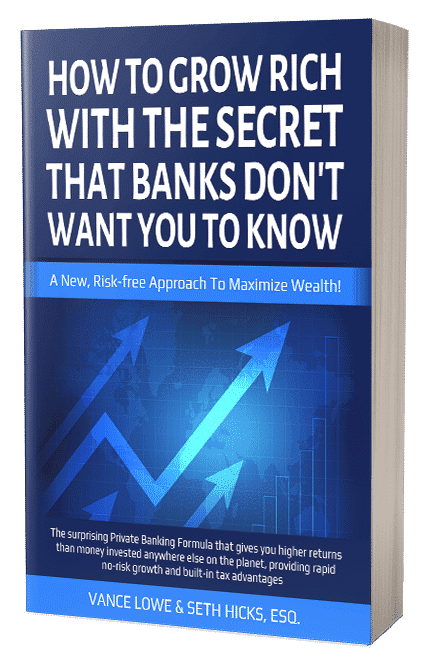
[00:21:30] Seth Hicks Esq.: And there Vance and I provided a book entitled How to Grow Rich with the Secrets. Banks don’t want you to know. And we begin to red pill folks on different issues that will help them take the banking equation back in their life. So if that book and this content resonates with you, you’re gonna have a unique opportunity through our emails that we send out weekly to you to schedule an exploratory call with advance.
[00:21:53] Seth Hicks Esq.: What happens in the exploratory call with someone who wants to know how this works for them?
[00:21:58] Vance Lowe: We’re gonna literally get you [00:22:00] prepared so that your head is right there in the game. And we’re gonna let you take this thing for a test drive. We’re gonna show you step by step, month by month exactly what happens, how you acquire debt, how you get volume of return back, and then you turn that volume into buying more debt.
[00:22:17] Vance Lowe: And people, I always like to ask ’em, okay, you’ve got mortgages, you’ve got a lot of credit card debt, you’ve got student loans and everything else. So the way you’re going today, how long? Is it going to take you to get outta debt? Some, yeah. Some just start crying. You know, they say we’re never gonna get outta debt.
[00:22:34] Vance Lowe: It’s always gonna be this way.
[00:22:36] Seth Hicks Esq.: There’s folks that are listening right now that are heavy in debt. Go to our website and the podcast resources and listen to the chiropractor. Podcast is a family that was hundreds of thousands closing in on between 500 and a million dollars worth of bad debt, and was able to turn that around with the use of life insurance contract banking.
[00:22:57] Seth Hicks Esq.: Folks, we are really glad you joined us today. We hope [00:23:00] this content’s proved valuable to you. If it has, like it, subscribe it, share it with other folks that you think would be interested in this private banking strategy, and, uh, come back and join us next time.
[00:23:12] Vance Lowe: Yeah, we welcome you back for next time.
[00:23:14] Vance Lowe: Appreciate it. Bye for now.
[00:23:16] Outro: Did that story feel like it was about you? Do you feel you should be making more progress toward your financial goals? Do you feel stuck? Let us help you get unstuck. Are you ready to take action and get your own private bank? Please visit us at www.privatebankingstrategies.com.
[00:23:40] Outro: Thank you for listening to the Private Banking Strategies podcast. Click the subscribe button below to be notified when new episodes become available.