[00:00:00] Intro: Welcome to Private Banking Strategies Podcast with Vance Lowe and Seth Hicks, your secret weapon to protect your assets and never have to start over financially again. Vance and Seth help high net worth individuals, families, business owners, and investors structure and asset protected fortress for their families.
[00:00:21] Intro: Learn how to keep what you earn and use the velocity of money. To create your own private banking system. Join us on this journey as we explore the secret strategies of the rich and political elite and help you take total control of your financial security. Now onto the show.
[00:00:37] Seth Hicks Esq.: Hello and welcome to Private Banking Strategist Podcast with Vance Lowe and Seth Hicks. Vance, how are you?
[00:00:44] Vance Lowe: Hey, I’m doing wonderful today. I’m anxious to talk about a new topic here that throws throughout things I’ve done in the past.
[00:00:51] Seth Hicks Esq.: Right? Yeah. It’s not a new topic for you. It’s something that you’re uniquely familiar with. You’re an expert at structuring, and that’s [00:01:00] retirement. Income strategies. You being a certified financial planner and a wealth manager and a earlier in your career before becoming a private banking and Strat strategies expert, you were helping people plan for retirement solely and completely.
[00:01:15] Seth Hicks Esq.: You know, I’ve heard it said that retirement planning is broken in America. Would you agree with that?
[00:01:20] Vance Lowe: It definitely is because of the whole premise is founded on a false foundation.
[00:01:25] Seth Hicks Esq.: What’s the, what is the false premise?
[00:01:27] Vance Lowe: Entitlement retiring. In general, the word retirement means to be put out of production.
[00:01:34] Vance Lowe: When we talk about retirement, it’s the flow of money. It’s trying to get, see, people will do stuff with money that they would never do with what money buys. No one would go buy a loaf of bread and put it in the freezer for five years. They wouldn’t buy a car and park it on the curb and not drive it for 10 years, but yet they’ll stick money in a, in what’s called retirement accounts and just leave it there forever and ever hoping it’ll be enough to [00:02:00] provide income.
[00:02:01] Vance Lowe: The reason I think you’re coming up with that quote is in the past when I was young, there were things called pensions. The employers would literally take care of their employees. They would take ’em to a point, and then they would put ’em into, uh, a lifetime income and let ’em retire from that business.
[00:02:20] Vance Lowe: The word retirement was originated in Germany, and it was to try to get the journey money. The people who had the craftsmen, who had the jobs and were the journeyman’s to retire so that their people underneath them could take over and get into that position and make more money. So people kept living longer, and so they came up with a retirement.
[00:02:48] Vance Lowe: And I think back in the day when it first started, it was at age 60 in Germany and America adopted that. We adopted that because. I [00:03:00] think a corrupt idea. Put the person out of production. If we don’t have his money yet or her money yet, then they will consume that money and we’ll take control of it. The problem is the banking system wants to generate and have control of everything.
[00:03:16] Vance Lowe: The way it’s working today, and we don’t even understand this, the average American doesn’t understand that they go out in the fields and pastures just like cattle and sheep and work and produce as high as 25 to one. They’re producing $25 for every $1 they get to bring home anywhere from five to 25. In that scenario, they bring those dollars home after taxes, everything else.
[00:03:42] Vance Lowe: What do they do with it? They spend it. It’s important that we understand that because it’s mind blowing to be able to continue that cycle, bring what we have home and consume it. Our whole life is if you’ll buy this, you’ll save. If you spend for this, you’ll save. Here’s your [00:04:00] savings. But nobody saves.
[00:04:01] Vance Lowe: Nobody actually takes the savings. The CPA says, if you only use my services, I’ll save you $5,000 in taxes. Do you know that never really happens eth, right? I’ve never seen someone write themselves out a check for the $5,000 of savings. It’s just gone. You go and get 60% off something. You didn’t save that money unless you write yourself out a check for that.
[00:04:27] Vance Lowe: So people do yourselves a favor. You could amass a tremendous amount of money in today’s society if you’ll claim the savings. Here’s the truth about retirement. If we look out there through across the United States, we’ve been probably through travel and everything through a lot of different towns, but I have never found a town that has ever hosted or.
[00:04:52] Vance Lowe: Executed a retirement. Economies don’t retire. Money has to flow. So there’s no [00:05:00] such thing as retirement. It would be a lifestyle change. So everything we talk about, I want everybody to understand when we talk about retirement income, this is because we’re trying to bring you in at a level that everybody pretty much understands a common.
[00:05:17] Vance Lowe: Place. Do we de believe in retirement? No, we do not. We believe in a lifestyle change. We think people are gonna transition, and the fatal mistake is if you take your money out of production and continue to consume, we think you should switch that from consumption to use in getting it back just like the real banks do.
[00:05:37] Seth Hicks Esq.: Well, what we’ll call traditional retirement planning. It’s standard procedure too. Invest in equities, invest in various stock market bonds, sorts of financial instruments that have, that are subject to government regulation, control and compliance. So how does, what are some of the [00:06:00] challenges that you’ll experience with traditional retirement planning and those sectors I just described?
[00:06:05] Vance Lowe: So let me categorize it a little bit. I call it, and I’m sure other people will too. It is called herd mentality when the masses of people do the same thing over and over again thinking that it’s right when in fact it’s not. So the common challenges are, of course. Taxes in the past as a a tax strategist.
[00:06:27] Vance Lowe: Lowering and paying as little as possible in taxes is very important. It’s a parasite. It’s there. It’s not for you. It’s there for other people to benefit from you. And we’re at a point now where our taxes are literally taking over. I just heard California, they wanna start charging taxes on savings. For crying out loud.
[00:06:52] Vance Lowe: So the taxes on withdrawals are very important. So if you follow the her mentality, you’re gonna pay the maximum amount [00:07:00] of taxes no matter what. Market volatility is another one out there. That’s a big challenge if they’ve got funds in the market. What’s really unique, you’re trying to get a return, maybe a percentage of return or an interest rate returns, but you get to take all the risk.
[00:07:15] Vance Lowe: The people who are holding your money, they won’t take any risk. They’ll make a lot more money than you do, and they’ll pay you into your account as little as they can get away with, but you’re taking the risk. Be aware that in the market there are all different types of risk classifications. The one that really gets.
[00:07:36] Vance Lowe: The people is, you see high earnings, and that’s gonna be in a very risky side of the table. What we don’t understand is that very risky side of the table. If you bring that to the forefront, there is conservative, moderate, and high risk to the high risk categor. They don’t explain that very well. Okay.
[00:07:58] Vance Lowe: They should. They’re [00:08:00] supposed to. So people look at these things and they say, I wanna be as risk adverse as possible, so I want the lowest possible. So they go over to this conservative side of the high risk and show you investment there, and people think, oh, I’m safe. No, they’re not. Not at all. So there’s that requirement of a minimum distributions.
[00:08:22] Vance Lowe: What that we’re talking about when people look at that is that if I’ve participated in government ERISA trust, which all of these are Roth IRAs. 4 0 1 Ks, IRAs, whatever a government program will provide, comes from a, a setup of a government trust owned and controlled by the government. So everything about that trust, when the government changes, it is retroactive.
[00:08:49] Vance Lowe: There’s no such thing as grandfather. So on Roth IRAs, should the government come in and decide, you know what, we’re gonna go ahead and, uh, we have to tax the gain. We already paid tax going in. They could [00:09:00] easily change that to tax going out, and they could easily do one more thing. Oh, you know what? Social security is falling.
[00:09:07] Vance Lowe: It is just going bankrupt. We’re gonna have to shore that up, so we’re going to see some of our other government trusts and put that money into Social Security to shore it up. We’ll be sure and give you credit, but we’re not only gonna take the tax money, we are going to take the entire account because it’s owned by the government that you participated in, but we will give you credit for it.
[00:09:28] Vance Lowe: That doesn’t sound good to me. Loss of compounding. For instance, if we want to be participating in an account, our money has to stay there. And if it’s not returning enough money, will that account ever compound? Will it ever double? Will the earnings go in and will I be able to get earnings off of that?
[00:09:48] Vance Lowe: Or every year am I going to have to pay taxes? All kinds of huge questions. Risk. I’ve talked about what I have, tax free access. All of these are kinds of things that we have [00:10:00] to plan if we’re going to set up a retirement philosophy. If you switch to a lifestyle change. Most of this goes away, folks. Most of this means, okay, I’ve done this.
[00:10:13] Vance Lowe: I’m tired of doing that. I wanna wit switch to something else, but I still want to have my money working for me, and I still want to get multiple touches on the dollar. Get those exchanges, keep those dollars flowing. And touching down so I can have volume of, of return, and I can have velocity still in my life.
[00:10:34] Vance Lowe: Most of this goes away. It’s just where do we hold the assets? How can we keep it working? Let me give you an example, folks, of how you might, could easily make that change if you’re into any of the. Herd mentality accounts. What if you switched it, put it, putting it into a banking strategy, and then lend that out and buy the debt of your family and your extended family.
[00:10:55] Vance Lowe: Huge amounts of income, huge amounts of interest coming in, [00:11:00] and your money that work for you, and you carve out the living off of part of the interest.
[00:11:05] Seth Hicks Esq.: So you’re describing a situation where families take control and have the financial independence and freedom they’re not governed with. For example, when we talked about required minimum distributions, if you’ve got your money in the government sponsored programs, 401k IRAs, and other similar type of ERISA plans that when you reach a certain age you have to take money out.
[00:11:33] Seth Hicks Esq.: You can’t take the money out before that age, and you’re gonna be taxed no matter what, no matter when you take the money out. Now, later or otherwise, it’s really just a matter of whether you’re gonna be penalized on top of, uh, the tax. And the government, as you said, could change the laws governing, uh, the distributions and the taxation, and change your whole financial expectation.
[00:11:58] Midroll: Did that story feel [00:12:00] like it was about you? Do you feel like you are generating a lot of revenue but are not moving forward as fast as you would like? Do you feel you should be making more progress toward your financial goals? Do you feel stuck? Let us help you get unstuck. Are you ready to take action and get your own private bank?
[00:12:21] Midroll: Please visit us at www.privatebankingstrategies.com.
[00:12:29] Seth Hicks Esq.: So the problem with traditional retirement planning as you were outlining was that you’re gonna be taxed on withdrawals, whether it’s now or labor. You’re being taxed, we like to say on the harvest rather than the seed, and that’s compared with your family bank, where the after tax dollars in your banking system.
[00:12:52] Seth Hicks Esq.: Never accrue another taxable event with ins and outs of your money.
[00:12:57] Vance Lowe: Correct. The, the biggest problem people have [00:13:00] when they retire is every time they turn around, they gotta pay taxes on every payment. Everything they do in retirement, if they’ve used the herd mentality and. Put all her stuff in these uh, vehicles, it’s still controlled.
[00:13:15] Vance Lowe: It, it is taxed, it’s also perplexing. And people, we need everyone to understand that when you see your 401k, when you see your IRA, and when you see your Roth, you see a total amount. If you think that is your money. You are sadly mistaken. That’s a critical error. The only money from that account that is yours is how much you can get if you had to liquidate it today, whether it’s fees, whether it’s taxes, whatever it is, that’s the amount of money that is your money.
[00:13:48] Vance Lowe: Please realize that difference. You are subsidizing for the IRS. You are paying the fees, you are paying the loads so the IRS can get as much [00:14:00] tax money as possible. Seth, you said this all the time to people that we counsel when it comes to risk manage and everything else is, do you think taxes are going down?
[00:14:12] Vance Lowe: Well, maybe today with the current government we’ve got, they’re going to help maybe stabilize taxes or anything else. But is your property taxes going down? Are your state taxes going down? Are the taxes according to all the other things that we do? Going down? Or they’re going up that they’re going up.
[00:14:33] Vance Lowe: So these are the things that people are faced with, and you’ve gotta have a lot of money. To be able to live a lifestyle that you want, if you’re gonna do it the herd mentality way,
[00:14:43] Seth Hicks Esq.: so people can buy into an illusory psychological security and thinking, well, my retirement account says 1 million, but really that’s, if they liquidated it paid taxes and it were just a third.
[00:14:58] Seth Hicks Esq.: They’ve really only got about [00:15:00] 60%, and then it also depended on what age they are. If they’re withdrawing too early or too late. You’ve got the penalties. Talk to us about fees and hidden drag that happen in ERISA programs.
[00:15:13] Vance Lowe: Let’s take your example of a million dollars. A million dollars are going to immediately put you in the highest tax bracket that year if you had to liquidate the whole thing, so they got you.
[00:15:24] Vance Lowe: You can’t put your money to work. You’re gonna have to pull it out piecemeal and I even today into banking, everybody has that mentality. We need to move this money, we need to get it over here. We need to set up the bank. We need to purchase your debt. We need to get money put into your money vault. We call it your money warehouse, which is a contract that we helped design and they still bought.
[00:15:50] Vance Lowe: They go, I can’t because it would put me in a higher tax bracket. So they would rather. Pay $3,000 a month on their mortgage that’s [00:16:00] going away from them, rather than to increase one taxable rate to another, thinking that the whole thing is going to be taxed at that rate, which is not, it’s only going to raise taxes on that remaining amount and whatever that’s going to be.
[00:16:17] Vance Lowe: People think that if I liquidated the full million dollars, it’s gonna put me in the highest tax bracket and it’s gonna cost me the whole thing. Maybe it depends on what tax bracket you’re in. Now, if you’re in a 30% tax bracket, yeah, you go to 35%. Okay? Hidden fees means what type of Arisa program. It may be owned by Uncle Sam, but you may have chosen vehicles that have surrender penalties.
[00:16:46] Vance Lowe: Chargeback fees if you may order the liquidation and all of a sudden there’s normal ticks up and down. If these things are in the stock market, what if you actually, they actually sell and take your [00:17:00] stuff out on a down day? It ticked down. You could lose 10% right there, right?
[00:17:06] Seth Hicks Esq.: So when you’re inside your family bank and you’ve been banking like that, you’ve got tax free access and the compounding guaranteed growth.
[00:17:14] Seth Hicks Esq.: And you’ve got no market correlation, so you’re not tied to the risk that may get that 10% depreciation in your account on a bad sell day,
[00:17:24] Vance Lowe: right? So people need to realize that 30% of that total is not theirs any way. Okay. Right. They own an a hundred thousand dollars account. At best, they have 700,000.
[00:17:36] Vance Lowe: Okay, so what we’re talking about is that whether there’s a penalty added to it, that penalty could be 10%. That could be another a hundred thousand. How long does it take us to make up that a hundred thousand and double the entire remaining balance again, once it’s under our control? We bought debt, we put it out there.
[00:17:58] Vance Lowe: And now the [00:18:00] outflow turns to inflow. Totally non-taxable. And we have, you know, a way of showing people how fast this money, when you put it to work doubles. And two and a half to five years is the average. Somewhere right in between there. So if we take 700,000 and we double it to 1,000,004 in five years, let’s go to the outside.
[00:18:22] Vance Lowe: Are we better off than have left that money in there? All the time. If you’ll break out of the herd mentality is failing, but you get to fail with company ’cause everybody else is around you. The people who succeed alone. Because they’re willing to do what’s right for them right now and explore these things.
[00:18:42] Vance Lowe: So that’s why we’re bringing this up. Retirement is much stronger than a family with children. You know, the tradition is, I want my kids to go to college. Why? Because that’s the sign of success. You make it if, if you get to go to college, you’re going to succeed. That might have been true in the [00:19:00] past.
[00:19:00] Vance Lowe: That’s no longer the case at all. Trade school. These people far exceed most graduates. You’ve got to look at your situation and we have to decide what retirement really is going to mean for that person, and then go down this checklist.
[00:19:18] Seth Hicks Esq.: Let’s transition our discussion into the logic behind a tax free retirement.
[00:19:24] Seth Hicks Esq.: Obviously, people want structured. Predictable living income and their retirement age, and that’s a given. But let’s talk about how you structure that properly and how the private banking system and strategies compare to traditional retirement strategies.
[00:19:47] Vance Lowe: We can do that. It’s an education is what it really is.
[00:19:51] Vance Lowe: I don’t know how deep we really want to get into that for outside public. But what we do for our clients is [00:20:00] we set up a system. That creates no taxable events and we concentrate on volume of return, which is what is the actual payments coming back in our control into our hands, physically on money at work.
[00:20:16] Vance Lowe: That’s called volume of return. The other big factor in wealth accumulation is velocity. How many times can I use a dollar over and over again? This is gonna be a long answer to this, but it’s the truth. It’s what needs to happen in order to convert back in the day when. The family was the power unit in America, which was before banking, but it was still during the time our nation started from nothing brand new country, and went to the number one wealth position in the world in.
[00:20:54] Vance Lowe: In that first a hundred years, we didn’t have any banks. The banking equation were, was [00:21:00] handled by the life insurance industry and they formed contracts that would allow them to capitalize, put money in, and then. Borrow money out and pay themselves back, borrow out, and pay themselves back and put money to work.
[00:21:15] Vance Lowe: The education back then was how to go out into the wilderness and survive. You know, we were settling America, we were going out into the wilderness, wild animals, wild criminals, robbers, whatever. We had to be able to defend ourselves and survive and produce. So we had the capability of setting up, going out and setting up what I call for everybody to understand your own town and being able to move money.
[00:21:44] Vance Lowe: Uh, we’ve given this illustration a lot, Seth. Somebody’s on a trip, they go into town, they buy a new tank, gas tank full of gas, and they’re gone. But they left $50. It cost them 50 bucks. Well that 50 bucks now is new money in [00:22:00] town. It can, that gas station owner can take that over to the grocery store, get $50 worth of food.
[00:22:06] Vance Lowe: Now that money’s over at the grocery store. But the gas station, he has $50 worth of food and I have $50 worth of gas. So it doubled right there. But now that guy takes the, uh, grocery store owner takes it to the warehouse because he needs more inventory. And every time they exchange that $50, it creates a new $50 worth of product or services.
[00:22:30] Vance Lowe: It can turn into several thousand dollars. How many times is that happening to our listeners out there right now? It’s not, that’s the logic of the tax free inside your system you are using after tax dollars folks, and as long as you can keep doing that, making that money move, you can still use it over and over again and you can create wealth that is not taxable.
[00:22:56] Vance Lowe: There’s no taxable events whatsoever.
[00:22:58] Seth Hicks Esq.: Whereas within [00:23:00] the IRA and the 401k type constructs, your money is effectively imprison. You can’t access it except this precise, sweet point, and then you’re still gonna be taxed and possibly penalized if you don’t. Observe all the compliance. So those are some of the key distinctions I think, that are evident with what you’re describing.
[00:23:19] Seth Hicks Esq.: And you’re offering a strategy that provides financial independence and control over your own finances with superior returns to markets, superior overall wealth growth and stewardship, and enjoying many of the protections of state law, which keep it asset protected. So there’s so many. Check the box.
[00:23:43] Seth Hicks Esq.: Superior attributes. It doesn’t. It’s confusing as to why more people aren’t aware of it and why more people aren’t utilizing it in America.
[00:23:52] Vance Lowe: I think biblical sayings out there, those who are left in ignorance become slaves. So when slavery, those [00:24:00] who gain knowledge are made free. And so we need to have this knowledge.
[00:24:05] Vance Lowe: We need to have the understanding of how money really works. Everyone thinks they know. The only thing they know is what they’ve been told. That has come from banks, and banks want to end up with all your money. They don’t want you to be independent. They want to control every single aspect of life.
[00:24:24] Vance Lowe: That’s the nature of our banking today. Here’s one more philosophy you need to understand. If you participate in any government ERISA programs, you have agreed to be bound by all of their rules, all their laws, and all of their future changes. If you agree not to participate in ERISA programs, you get to be free left on your own and be able to do what you wanna do, how you want to do it, and you can take advantage.
[00:24:56] Vance Lowe: Of detached laws out there without [00:25:00] crossing any boundary whatsoever. There’s a huge gap. Folks, we don’t think there is. You know, we think we get an advantage if we don’t pay taxes on a dollar today and pay it later. That’s not true. Okay, what if we want to use our own dollars, we have to pay tax, but what if we are smart and pay a lot less in tax that we might have to owe rather than just let our employers and everybody else dictate the amount of tax we pay?
[00:25:26] Vance Lowe: You can talk to us later about that, but whatever else is, taxes are something that can be controlled and be minimal to your advantage. If you act early and you don’t sell your soul to the government, and that might be blunt, but when we sign up for these programs, it’s exactly what we’re doing.
[00:25:45] Seth Hicks Esq.: Right.
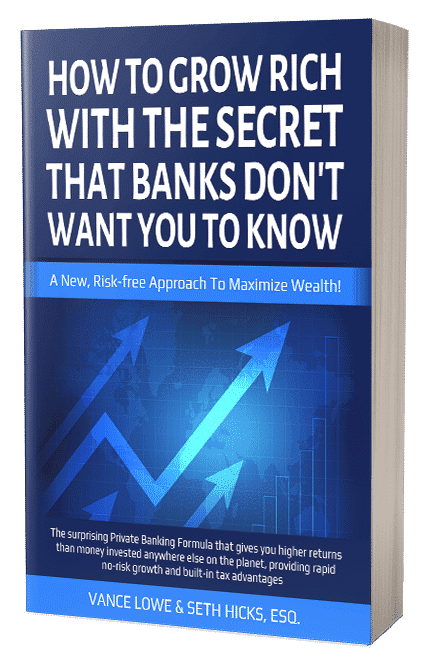
[00:25:46] Seth Hicks Esq.: Yeah. Folks, if this content is resonating with you, go to our website, private banking strategies.com and their book, their on our website. Vance and I have authored a book called How to Grow Rich with the [00:26:00] Secrets Banks Don’t Want You to Know, and we’ve talked a lot of today about. Things that the banking, traditional banking system, traditional retirement systems, uh, where they fail and things that are shortsighted, but a core of the herd mentality.
[00:26:15] Seth Hicks Esq.: So in our book, we highlight some of these issues and we start to red peel folks on how to take the banking equation back in your life. And so if this content resonates with you. Check out our book, and you can find that on our website. Put your email in and you’ll be notified by email of our weekly podcast so that you can keep listening, subscribe to our content share and like if it’s something you’re finding value in, and more importantly, if all of those things are.
[00:26:44] Seth Hicks Esq.: Resonating with you and you wanna learn more about it and how it will actually apply for you, how you can develop it in your own family. You can schedule an exploratory call with Vance and a link that’s in the emails we’ll send to you. Tell folks what we do in the [00:27:00] exploratory call Vance.
[00:27:01] Vance Lowe: We’re gonna set it up so that you can actually take.
[00:27:05] Vance Lowe: This strategy of everything we’re talking about for test drive. We’ll use your numbers and we’ll show you in detail month by month using simple math, simple logic. This is where it resonated. It resonates in the heart. You know, it’s not something we have to. I wonder if the interest rate will be this high or the earnings will be No, it has nothing to do with that.
[00:27:27] Vance Lowe: We’ll let you see what’s called yield, what yield actually means, and step by step. So we let you take it for a test drive. You can see for yourself whether you’re gonna be better off using the strategy, actually switching to it versus staying the way you are today.
[00:27:43] Seth Hicks Esq.: And that’s a step by step roadmap that if folks follow it to the T, it will.
[00:27:49] Seth Hicks Esq.: Produce the outcome that, that it shows. Well, thank you folks for joining us today, and we look forward to seeing you on the next podcast. Thanks very much, Mike. [00:28:00] Appreciate it.
[00:28:00] Outro: Did that story feel like it was about you? Do you feel you should be making more progress toward your financial goals? Do you feel stuck?
[00:28:10] Outro: Let us help you get unstuck. Are you ready to take action and get your own private bank? Please visit us at www.privatebankingstrategies.com.
[00:28:24] Outro: Thank you for listening to the Private Banking Strategies podcast. Click the subscribe button below to be notified when new episodes become available.