[00:00:00] Intro: Welcome to Private Banking Strategies Podcast with Vance Lowe and Seth Hicks, your secret weapon to protect your assets and never have to start over financially again. Vance and Seth help high net worth individuals, families, business owners, and investors structure and asset protected fortress for their families.
[00:00:21] Intro: Learn how to keep what you earn and use the velocity of money. To create your own private banking system. Join us on this journey as we explore the secret strategies of the rich and political elites. And help you take total control of your financial security. Now onto the show.
[00:00:38] Seth Hicks Esq.: Hello and welcome to Private Banking Strategies Podcast, Vance Lowe and Seth Hicks. Vance, how are you today?
[00:00:45] Vance Lowe: Well, today I think we’ve got some very critical and important information to give out to our listeners. Not only new people that are interested, but. Existing clients. We’ve seen some things that have [00:01:00] happened that easily could not happen, and so we wanna go over part of what we’ve been talking about before.
[00:01:06] Vance Lowe: Seth, you can identify a little better, but I’m raring to go. I’m ready for, to get this information out.
[00:01:12] Seth Hicks Esq.: Yeah. Fantastic. We’ve been talking about the smart risk framework and the engine of private banking, which is the ability to access your dry powder, your cash. In the form of a policy loan and put it to work for you.
[00:01:29] Seth Hicks Esq.: And we’ve talked about use of that capital with regards to paying off high interest credit card debts and capturing the debt in your own bank so that the loan is repaid into your own bank. And we’ve walked people through how to do that. And we’ve talked about investment based opportunities and what we haven’t really dug super deep into is.
[00:01:52] Seth Hicks Esq.: Consumptive use of policy loans. When you can do that, when you can’t do that, how does one think [00:02:00] like a banker in the beginning when they’re setting these things up? And why do you think like a banker, why was that one of Nelson Nash’s cornerstones for infinite banking is how to think like a banker.
[00:02:14] Seth Hicks Esq.: What’s the some of the fundamental things you’ve gotta do to think like a banker?
[00:02:18] Vance Lowe: That’s the uh, $64 question. One of the things that we have to. Make sure going in when we start the process is that a bank is not involved in any type of consumption. Consumption means we let go, we spend, it’s gone. What we are doing is we’re transferring the mindset and the person from working hard paying taxes.
[00:02:46] Vance Lowe: Ending up with what they get, spending it, and then having to go to work again and just do that over and over again and maybe getting a little bit of increase along the way if they’re prudent. That’s not what banking is. [00:03:00] Banking puts money to work and gets it back. Plus interest now takes the whole thing, lends out more money, gets it all back, and it is a exponential compounding.
[00:03:10] Vance Lowe: That’s banking. That’s the mindset you can never set up. Borrow money out of a banking strategy and say, I’m not gonna pay off myself back. You can’t go into a banking strategy and say, I have an emergency, so I’m gonna take this cash and I’m gonna spend it over here because it’s gonna be gone. What happens to the bank?
[00:03:35] Vance Lowe: The money’s gone. So I’m just drilling into the mindset here. Folks in Nelson Nash’s book. He specifically states there are five laws that you have to live and or overcome. Parkinson’s law is one of them, but the biggest one we’re finding is the use it or lose it law. We’re always learning new information and the successful people are able to digest, [00:04:00] internalize, and put into action new ideas all the time, where the majority average people.
[00:04:06] Vance Lowe: Here are the same ideas, but they’re busy. They’ve got their life to live, and they lose that idea, that wonderful. Thing that is exactly what they need to take ’em to the next level. And of course you’ve got that group that just long as I’ve got my beer and I’m can watch the Cowboys game or whatever team they’re rooting for, they’re happy life just passes ’em by.
[00:04:28] Vance Lowe: So here with people in the strategy, you’ve got to make the change. You’ve got to change from the old style of thinking, the way you used to handle money into a banker’s mindset. So I have, I hope I’ve covered that. Well enough for today.
[00:04:45] Seth Hicks Esq.: Sure. I think when people understand that the money they capitalize their private bank worth and then use every single dollar gets set up in a loan structure, and [00:05:00] we touched on consumptive use of that money, consumptive meaning something that doesn’t produce a return on the investment.
[00:05:07] Seth Hicks Esq.: And you said, we’ve talked about emergencies, we’re talking about low ticket emergencies. You, you often say if your HVAC goes out and every, there’s a situation where you need a small amount of money to fix. Repair or exigent situation, that’s different than emptying all the cash value when you’ve got no plan for repayment and no cash flow.
[00:05:29] Seth Hicks Esq.: So one of the first things that I think we’ve gotta help people understand is that you have to have cash flow within your earning power, within your existing salary or regular income or consulting income. Real estate investment or whatever the case may be, whatever the streams of income, you have to have enough money to fit that loan repayment,
[00:05:54] Vance Lowe: and I appreciate that.
[00:05:55] Vance Lowe: Seth, what you’ve just said is the layman’s term of trying [00:06:00] to avoid consumption. When you put money to work, when you borrow money, you have to be able to have a flow of money going back in to replenish that. That’s part of Parkinson’s law. We spend less. Than what we bring in and we have a major loan where we’re gonna pull out a major amount of money before we do it.
[00:06:21] Vance Lowe: We have to do that equation. We have to figure out, okay, if I put this money to work, am I going to be able to pay it back or will it not work? If you borrow a hundred thousand dollars and you pay back a hundred dollars a month, it’s gonna take more than a lifetime, especially if you put any interest on it.
[00:06:40] Vance Lowe: But you do have the latitude since you are the banker. To set up what will work for you as long as you’re making headway every month in payments, Seth, there’s a lot of people who go wrong when, for instance, we tell them, okay, we’re gonna [00:07:00] take cash value here and we’re going to purchase the loan payment from GMAC.
[00:07:08] Vance Lowe: They go, what do you mean purchase it? Aren’t we just paying it all? No client is not paying it off. Your lending company is going to purchase that loan, so we’re gonna, is gonna buy it. So the obligation is still there, it’s just gonna put less money to work. Good example, if I’ve paid down a loan and I only owe 10,000 and I have 10,000 in cash value and I wanna purchase that debt because it’s producing $500 a month in payments.
[00:07:40] Vance Lowe: That’s a 60% volume of return on that loan. We’ll cover that in another area. But what we’re trying to do is, okay, if I put money to work, I have to increase the cash flow coming back to me. Just like you had said earlier. That has to be there, that has to produce and [00:08:00] show us what that return is, so that money is not consumed.
[00:08:05] Vance Lowe: It is at work, the volume of return. Is bringing that money right back into our hands to reuse again. Every situation, every time we, excuse me, dip into this, we have to figure this out. We have to know what we wanna do. We have software to help figure it all out. You can choose virtually anything you want.
[00:08:29] Vance Lowe: You can put three of the four things that we need to know, the amount, the payment, the interest rate, and the length of time, and you can solve. Whichever one you need to solve. Hey, I know what my payment needs to be. I know how much I need to borrow and I can pay this thing for the next 10 years. So what’s the interest rate?
[00:08:50] Vance Lowe: Boom. It’s there for you and you can play with that until you get, okay, I’m comfortable here, but I think what Seth and I are really [00:09:00] going after is. You mentioned Seth, the catastrophe, all of a sudden something’s going on. A huge opportunity or a big crisis, big medical claim or something, and I gotta pull all this money out and I need to pay this off.
[00:09:16] Vance Lowe: That’s the old mindset. If you approach that with a banker’s concept, the banker’s gotta say, okay, what collateral is there? It’s still a loan. What collateral is there? How are you gonna pay this loan back? That always has to be the answer. If it’s not, you’ve just decided that the money’s worthless and you’re gonna go spend it ’cause you don’t want any return on that money, you’re willing to go back to square one and start all over again.
[00:09:44] Vance Lowe: Don’t do that. You don’t have to do that. If anything else, contact, you know us or someone that you know is really understanding how the flow of banking works to go through the alternatives, it’s a concept that will do that. Where we [00:10:00] look for money and things like that. Again, it’s all based on that Parkinson’s law.
[00:10:06] Vance Lowe: What money’s coming in. I might have income, I might have money from real estate. If I’m a consultant, I might have money there. I might have rental property. Like I said, in real estate, that’s all coming into my control. And I am bringing in more than I’m spending. So when this big hit happens and I gotta have a big loan, I have to structure the payback to fit within that.
[00:10:32] Vance Lowe: I can’t. Have a payment that is gonna cost me more than I have coming in. ’cause that doesn’t work. I can’t have a payment for this new wallet that equals what’s coming in because it’s too tight. There’s always the unknown. This is where the average American just starts compiling credit card debt because they live outside of the res.
[00:10:55] Vance Lowe: They don’t live Parkinson’s law, they, their eyes are big. They feel like they’re [00:11:00] entitled, I deserve this now. And so they purchase things they don’t need. They set up liabilities that they really can’t afford. And then when the medical bill hits the deductible hits or the unknown factor hits, I don’t have any money for that.
[00:11:16] Vance Lowe: They have to charge it on a credit card. And now you know there’s a total slave to the system.
[00:11:22] Seth Hicks Esq.: I think that you touched on a situation where if someone’s making decisions in a vacuum and they don’t have clear principles that they’ve set for how to govern their private banking, they can fall into the ditch of desperation and have and draining cash value when that’s not the prudent thing to do because they don’t have a cashflow based repayment system.
[00:11:48] Seth Hicks Esq.: If they don’t have any scheduled stewardship of servicing that loan, and that’s one way that you structure. But let’s talk a bit it for a second. Like the other end of the spectrum, let’s say [00:12:00] someone got cash value, dry powder and their banking, family banking system, and they have kids or grandkids that want to go to college and there is no cashflow on paying for college education.
[00:12:17] Seth Hicks Esq.: It’s just. Speeding it and we’ll just assume that going to college is what these folks wanna do, although you and I may differ and rather four year education has any value anymore. But regardless, let’s just assume for the sake of our hypo that that they’re going to college. And so how do they burn through $50,000 a year for four years and then take that on.
[00:12:41] Seth Hicks Esq.: And where does the repayment come into play and win, and how does that work?
[00:12:47] Vance Lowe: Okay, we’re now switching real categories and topics here. And this is the beauty of a strategy like this. I have plans for grandkids to go to college and I have money [00:13:00] in cash value policies, and that can be structured as a strategy where we used the buildup money in these contracts over that four year period with the understanding that kid is going to work.
[00:13:16] Vance Lowe: Right after college, he’s gonna get a job and he is going to pay his student loans back just as if we borrowed the money. So the only way you get to go to college is if somebody is financing it for you, the parents, or you take student loans and you can go to college. Okay? But they have to be paid back.
[00:13:37] Vance Lowe: But the structure can last a long time. You can set up a structure that fits your budget. So as long as the person goes back to work. Or gets a job and goes to work with the understanding that, oh, maybe even a major portion of my expenses, I have to forego a new car, for instance, I gotta keep my old car.
[00:13:56] Vance Lowe: I may have to rent longer, whatever it is, because [00:14:00] my focus is getting this money back in to my bank. Well, people don’t understand is when, if they have student loans, government loans, they’re obligated to pay those back. There’s an interest rate. They pay that back. The money’s gone. If the money went to the college, that money’s gone, and then the payment’s coming back to the government for you, it’s gone.
[00:14:21] Vance Lowe: And so by the time it’s paid off, eight to 10 years later, that person’s sitting at zero. The beauty here for at least my grandkids and most everyone else is doing this program, is that, yeah, I am obligated. I have to pay this back because the obligation is if I pay it back into the bank, then I get to use that money.
[00:14:41] Vance Lowe: I maybe even get that. Contract, that policy turned completely over to me. And that cash value, that interest, all that accumulation, all that growth is where I start. When I get that paid off. And it’s not zero, it’s at a hundred thousand dollars or $200,000 depending on how [00:15:00] much was in that contract to begin with.
[00:15:01] Vance Lowe: So it’s not a blow off if now, if we go back to the other scenario and use college education as that. Yeah. I’m gonna borrow the money outta the policies. And the parents make the mistake of not paying that money back then those policies are gonna be in jeopardy. They’re gonna be accumulating interest.
[00:15:22] Vance Lowe: We always recommend if we’ve got a loan strategy where we want put windfalls in. We at least pay the interest every year so that it doesn’t compound up against us in the loans. But it might be the parents. Look, there’s another strategy along that way. The parents might say, Hey, I’m gonna be retiring here pretty soon.
[00:15:43] Vance Lowe: Let, I’ll get my kids through college. Then I’m gonna take my 401k, pay the taxes, and I’ll be able to dump it in here. I’ll be able to dump $200,000 straight into this account, fill it back up. I’ve got a place for it now. So I think with people [00:16:00] and their problems and their goals, there’s always two sides.
[00:16:03] Vance Lowe: There’s always an avenue. Of escape of Escape opportunity. It’s not always negative. It’s only negative when we give up the value of that hard-earned asset. That hard-earned cash.
[00:16:17] Midroll: Did that story feel like it was about you? Do you feel like you are generating a lot of revenue better, not moving forward as fast as you would like?
[00:16:27] Midroll: Do you feel you should be making more progress toward your financial goals? Do you feel stuck? Let us help you get unstuck. Are you ready to take action and get your own private bank? Please visit us at www.privatebankingstrategies.com.
[00:16:48] Seth Hicks Esq.: You started to explain a situation where you’ve got a high education cost with annual tuitions.
[00:16:57] Seth Hicks Esq.: What if a family has 10 kids and they [00:17:00] all want to go to school and they’re. Offset by a year or two years, and we’re assuming $50,000 a year. That would be something where you’re potentially over leveraged depending on what the size of your bank is. Meaning do you have $10 million in there? Then you can support that.
[00:17:18] Seth Hicks Esq.: Do you have 500,000? Then you can’t support that, and we’re talking about over leveraging. In the context of education, I think it would be easy to over leverage quickly ’cause you’ve got no return on the investment. But over leveraging with a smart risk framework on real estate investments would be a different risk scenario.
[00:17:40] Seth Hicks Esq.: So what can you tell the audience about overleveraging and making sure to maintain appropriate capital reserves and loan to value ratios on your banking capital? I
[00:17:54] Vance Lowe: held a reality check. Sometimes I can’t believe people when they come in my [00:18:00] whole life is helping people transition into retirement or a second lifestyle change where they take their nest eggs and try to produce and live off of income.
[00:18:14] Vance Lowe: The reality check is here, folks, is there’s no such thing in life as retirement. It can only be a lifestyle change. But if we fall prey to a retirement, they have us now, we start consuming. It starts to be consumption. If they haven’t already got our nest egg, those who go to trade school are already in the trade.
[00:18:36] Vance Lowe: They become experts. They already are way ahead of the person who took four years off or sometimes eight years and then start. ’cause everybody has to have day one. Everybody has to start. Where we get in trouble is. We think too much. They’re gonna take the money. Money’s gone. There’s no cashflow to replenish that.
[00:18:58] Vance Lowe: It’s gone. So somebody has to [00:19:00] make that up and, or it’s lost and people spend a whole lifetime accumulating education money and it just goes for education and it is gone now. There is no money left. Everybody has to start over. Where the parents, $200,000 could have turned that in four or five year period to $800,000.
[00:19:22] Vance Lowe: Pretty easy doing banking. Now they’re much better off. They could take the college money, put it into banking, buying debt, leveraging it out safely without any market risk or economy risk, and provide tax-free income far above what the average. College a graduate could ever think of.
[00:19:45] Seth Hicks Esq.: So yeah, if education and consumptive loan are over, leverage it leveraged on your banking capital.
[00:19:53] Seth Hicks Esq.: It’s a trajectory that is not sustainable. So you have to have the smart risk framework and that’s gonna, [00:20:00] I think, change family to family. Expertise to expertise. Many of the families that our clients of ours have a, a niche or a way that they’ve developed an expertise. And so how private banking strategies are utilized within their expertise in niche is a case by case type of basis.
[00:20:22] Seth Hicks Esq.: But what we’re trying to illustrate is that if you don’t have cash flow based repayment and if you don’t have sufficient salary. Or windfall from sell to business or sell of real estate, that you have a plan on the repayment of your capital in your private bank, then you’re not applying it properly.
[00:20:44] Vance Lowe: And this comes from brainwashing of our current banks today. They don’t want us to know how money work, and we are creatures of habit. This is what I wanted to get into, we’re creatures of habit. So when. Conflict or static or frustration [00:21:00] hits our lives. We fall back because we haven’t made the change. We haven’t really become bankers.
[00:21:07] Vance Lowe: We, our mentality falls back to consumption. I can just do that ’cause I’ve always done it. You’ve never reached your potential because you always gave your money away and if you fall back on it. You’re gonna be far because you’re older. You don’t have the time to replenish the Hals. So if you switch to use and accountability to pay back, you don’t still appease.
[00:21:30] Vance Lowe: We say that because of in Nelson N’s book, if you haven’t got any book, get it. It’s devastating if you don’t live those five laws, if you don’t plan how to fix a catastrophe or a problem or a projected expense. And again, if. Individual’s making very low income. They’re barely making ends meet, and they have a wish to have their kids go to college.
[00:21:57] Vance Lowe: Okay, we’ve gotta figure out how to [00:22:00] do that. If they can go to college, would they be better off going to the actual trade school to learn that trade, their profession, and immediately get to work? College is not like it was set up to be a hundred years ago, 50 years ago. It’s totally changed and to a factory of getting people graduate certificates.
[00:22:24] Vance Lowe: That’s all. We can actually identify the good of college. They’re not problem solvers anymore. That’s what college was, is to teach people how to think and how to solve problems. It’s propaganda, it’s socialism, it’s entitlement. I’ve got all kinds of stories about how these kids come out. Thinking that this is what the world really is and it’s fake.
[00:22:48] Vance Lowe: So trade school elbow grease experience. And you’re there,
[00:22:54] Seth Hicks Esq.: right? Yeah. And that’s why the repayment schedule, the repayment [00:23:00] amortization that you structure from the beginning with the cash flow based repayment is the first step. And you build upon that. You could, like you’ve talked about, you could have windfall events, sell a business sell.
[00:23:14] Seth Hicks Esq.: Assets, whatever the case may be, where you’ve got dump ends and you can fill cash value in your, in your banking silo up, event based repayment, like we said. And those are the ways that you have to be thinking to be able to capture the investment opportunities when they come along. Let me ask you this now, let’s shift gears just slightly into how loans affect the cash value growth.
[00:23:41] Seth Hicks Esq.: So if I’ve got. A million dollars in my private banking silo and in life insurance, they’re growing and compounding annually year over year. But if I take that million dollars out and I deploy it into a, uh, apartment building that’s properly structured, smart [00:24:00] risk framework, I’ve got cash flow that easily meets repayment structure and fills my bank back up.
[00:24:06] Seth Hicks Esq.: What does the insurance company. How does it treat my million dollars? What do they pay dividends on? Does it grow at zero or does it grow at a million? And how do those dividends apply? Are there any guarantees? Can you talk to those things?
[00:24:22] Vance Lowe: Yeah, so let’s hit that. We can use round numbers. We can use a million dollars.
[00:24:27] Vance Lowe: We can use a hundred thousand. Whatever we want to use that is in cash value. The first thing everybody needs to understand. When you borrow money, it is a mechanism to be able to put the money back. That’s why the borrowing is there. It used to be our banking system, these contracts, the life insurance company was our banking structure.
[00:24:52] Vance Lowe: Before America ever had banks. That’s why they’re here. That’s why there’s that loan provision, but it means that [00:25:00] the people are smart enough. They want to use the money and put it back so when there’s a million dollars in there, here’s how the loan process works. Whoop, and this might surprise everyone because of what?
[00:25:12] Vance Lowe: The way the agent tries to explain it to you. When you go to borrow money, let’s say we’re going to borrow. $100,000 and you ask for a loan of $100,000, the insurance company is going to look at your account and they’re going to see that there’s $1 million in that account. They’re gonna say, great. Then they’re gonna look over at the cash reserve and they’re gonna take the money out of the company’s cash reserve and they’re gonna lend the cash reserve money to you.
[00:25:45] Vance Lowe: One, a whole million dollars is still in your account. You never are taking out your actual cash value. You’re borrowing the assets of the life insurance company. They normally lend [00:26:00] out or clients, when we borrow money, we’re gonna pay an interest rate. It’s just the advantage is when you have a contract, you become an owner and you get a preferred interest rate, and you get to be at the front of the line.
[00:26:10] Vance Lowe: No questions are asked, you wanna borrow money? Okay. If there’s cash value in there, the long process there, nothing about payback. So that’s how loans are processed. Okay. And so how does that affect the profits and the growth of the insurance? Contract. Our contract. All of these contracts have a etched in granite guarantee growth effect that you can depend on and know exactly if you follow your part, what will be in there as cash value minimal.
[00:26:44] Vance Lowe: In addition to that, guarantee is the profits of the company, and they’re called dividends Every year, dividends are declared, profits are declared and they’re divvied out. That goes into a situation where this insurance company [00:27:00] is what’s called recognizable or non recognizable loans. If it’s a non recognizable loan, nothing, absolutely nothing.
[00:27:08] Vance Lowe: If there’s a five and a half percent dividend, which is pretty much across board this last year, five and a half percent goes into your account and can never be reversed. What’s the guaranteed interest rate is added into your account can never be reversed. Okay. And it compounds up. The differences over the years, I don’t really see any difference whatsoever because the annual fees, the charges, and the expenses for a recognized company is less than a non recognized company.
[00:27:39] Vance Lowe: A non recognized company. Their fees and regulatory charges are higher.
[00:27:44] Seth Hicks Esq.: We’re scratching the surface. I think there there’s a lot to learn on a smart risk framework and how to structure loans. Folks, if this podcast is resonating with you, we want you to visit our website@privatebankingstrategies.com.
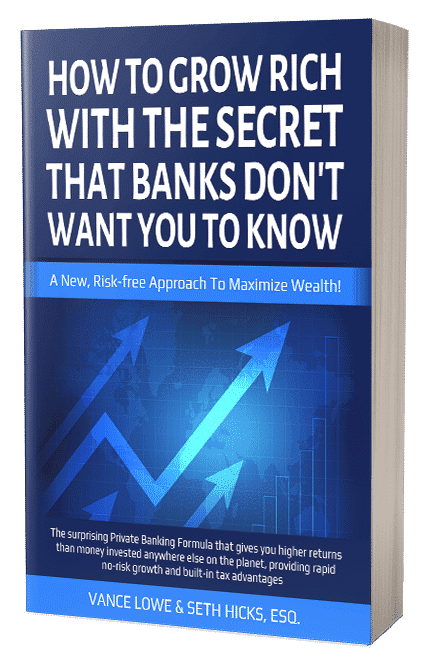
[00:27:59] Seth Hicks Esq.: [00:28:00] That’s private banking strategies.com. And there Vance and I have authored a book called Secrets the Banks Don’t Want You to Know. And then those secrets will red pill you as to why you want to be your own bank, why you want to implement private banking strategies and use the life insurance. Contracts properly structured as a a wealth stewardship and growth tool.
[00:28:26] Seth Hicks Esq.: Now give us your name and email and we’ll every week send you a notice of our podcast that we’re publishing, but more importantly, you’ll have access to Vance’s Calendar, Vance, tell ’em what you do when you start to walk them through the exploratory process.
[00:28:39] Vance Lowe: But we want to provide for everyone. We want you to go to the website, we want you to read the book.
[00:28:45] Vance Lowe: And we’d love for you to go ahead and read Nelson Nash’s book, becoming Your Own Banker. What we want to be able to provide for you is a test drive actually show you how much better off you could be switching to the strategy and the effort it would [00:29:00] take on your part. It’s absolutely surprising and shocking when people are actually spending less time and less effort, less effort.
[00:29:08] Vance Lowe: But doubling assets along the way than the way they thought they needed to do it the way they’ve been doing it all along. If you get, uh, the money back and get to reuse it and buy more debt, the debt you buy is putting money at work, and it’s incredible. The average volume rate of return is above 50% folks.
[00:29:28] Vance Lowe: You’re in a private economy, you’re using Matt after tax dollars. You can double assets over and over again and never trigger attachable events. So we wanna show you that in a test drive. So that’s what we’ll do. We’ll explain the timetable, what we expect, what we’ll do with you through that test drive, and then what you’ll learn and how you’ll set up and execute after that.
[00:29:53] Vance Lowe: All in that. Test drive session. We’ll record that session for you and we’ll send it to [00:30:00] you. Everybody you know, gets information that they forget really fast. We found that if we record and send you the sessions that you build, alert your own personal learning library. So that’s what we do. We encourage everyone to follow that structure and really do yourself a favor.
[00:30:18] Vance Lowe: Look at this thing. See how much better off you could be. If you switch from spending your money to using it and getting it back,
[00:30:26] Seth Hicks Esq.: and the more money that you make and earn, the faster that you can turn this equation, this private banking strategy into something that changes family legacy. So folks, we appreciate you joining us today.
[00:30:40] Seth Hicks Esq.: We hope you’ve enjoyed the content. If you like the content, share it with those who might find it valuable, like it subscribe so that you get these. Weekly podcast that we’re putting out for your benefit, and we look forward to seeing you on the next podcast, folks. Thank you very much. Bye for now and be safe.
[00:30:58] Outro: Did that story [00:31:00] feel like it was about you? Do you feel you should be making more progress toward your financial goals? Do you feel stuck? Let us help you get unstuck. Are you ready to take action and get your own private bank? Please visit us at www.privatebankingstrategies.com.
[00:31:22] Outro: Thank you for listening to the Private Banking Strategies Podcast.
[00:31:26] Outro: Click the subscribe button below to be notified when new episodes become available.