[00:00:00] Intro: Welcome to Private Banking Strategies Podcast with Vance Low and Seth Hicks, your secret weapon to protect your assets and never have to start over financially again. Vance and Seth help high net worth individuals, families, business owners, and investors structure and asset protected fortress for their families.
[00:00:21] Intro: Learn how to keep what you earn and use the velocity of money. To create your own private banking system. Join us on this journey as we explore the secret strategies of the rich and political elite and help you take total control of your financial security Now onto the show.
[00:00:37] Seth Hicks Esq.: Well, hello and welcome to the Private Banking Strategies Podcast with Vance Low and Seth Hicks Vance.
[00:00:43] Seth Hicks Esq.: How are you?
[00:00:44] Vance Lowe: I’m doing really good and I’m looking forward to this topic today. people need. To know if, if, if you just pick up a couple of these keys, you’ll be better off.
[00:00:54] Seth Hicks Esq.: And we’re gonna talk some about how traditional banks, how they use money, how they [00:01:00] treat money, and why they don’t have a, a, a money problem. Vince, why don’t traditional banks have a money problem?
[00:01:08] Vance Lowe: You know, that’s a good question that everybody should be asking because back in the day when banks started, people understood money.
[00:01:17] Vance Lowe: You know what, what we’re teaching is not new. We’re just bringing back what was wiped out, so to speak. If a bank overlent, you know, because it’s kind of easy to do. banks can lend out money that they don’t have or a backup for it. When they got caught doing that, back in the day, they were tarred and feathered and run out of town and or hung.
[00:01:38] Vance Lowe: A lot of people don’t know that, but our history is ripe with shyster banks and because we have laws in effect that look, you know, you can lend out depositors money that you have, but you can’t lend out anymore. You know, you can’t lend out fictitious money because if there’s a run on a bank, then the bank’s gonna fail.
[00:01:59] Vance Lowe: And you [00:02:00] know, people aren’t gonna get their money back because there’s no money in the bank. And so banks, were pretty smart. Remember, banks have been around pretty much since the history of man, and it was Jackson that said if commercial banking caught on in America, it will be the demise of our country.
[00:02:16] Vance Lowe: But in this situation, the banks got smart and they bought the politicians, of course, and they passed illegal laws that allow them to lend money that they don’t have. And what is that
[00:02:30] Seth Hicks Esq.: called, Seth? It’s called the fractionalized lending.
[00:02:33] Seth Hicks Esq.: A derivative lending.
[00:02:34] Vance Lowe: Let’s say we make a deposit of a thousand dollars, a bank could then turn around and lend, uh, as much as $10,000. I think they gotta keep 10% in reserve, but they can lend out $9,000. They don’t have. This is why if you try to go to the bank and ask for. $5,000 worth of cash. You’re probably being denied.
[00:02:58] Vance Lowe: You’ll strongly be [00:03:00] asked, why do you want this money? Because right off the bat, they will treat you like a criminal and ask you criminal questions. You want this money for drugs, don’t you? Is the behind the scene question, so to speak. That’s the feeling I get. But they’ve passed those laws too when you signed up for your accounts, your checking accounts, your savings accounts, and whatever account you have at the bank.
[00:03:26] Vance Lowe: You’ve told them that they have, when you request money from the accounts, they have up to six months to pay you money from your accounts. They don’t do that because people would be upset, but it’s normally just the day-to-day functions. You know, bill paying and things like that. If you put a big CD in an account and you said, you know, $25,000 and you went in there and said, you know what, I wanna cash out my cd.
[00:03:54] Vance Lowe: Well, you can’t do that or you’ll be penalized they held all the interest till the [00:04:00] end, and if you didn’t go to the end of that timeframe, you would lose the interest on that account. But they had the money pretty much that you could take it. Now they don’t even have that. actually, what happened was.
[00:04:12] Vance Lowe: A little old lady deposited money in a bank. She deposited a lot of money in a bank. She said, yeah, I just love your bank to the president of the bank. And he said, well, tell me why. He says, because I know if I deposit all this money in your bank, you are going to keep it safe for me and I’ll have access to it anytime.
[00:04:33] Vance Lowe: That’s what caused that president of that bank to hold a meeting, and the CDs were invented and the sole purpose for CDs to be invented was to stop from having quick access to their money. That’s a true story by the way. So banks, because they over lend, they back each other up. If they have actual credit in their bank, they, they’ve had more deposits in, they’ll [00:05:00] forward lend that throughout 24 hour period.
[00:05:02] Vance Lowe: So any money that they haven’t used in loans and credits, they move that forward to another bank and all the way around until eight o’clock in the morning, it’s back in their banks to use again. If there was a run, even if 10% of the people come in and said, look, I wanna cash out my account. They don’t have the cash, they don’t have it.
[00:05:21] Seth Hicks Esq.: The banks put their money to work by lending it. The reserves that come in the form of deposits in traditional deposits, they fractionalize and they keep 10% or less on reserve and they loan. The other 90% or more if it’s a bigger bank out in the form of home loans, auto loans, business loans, personal lines of credit, and other types of loans that traditional banks make.
[00:05:46] Seth Hicks Esq.: And they build a cash flow machine effectively from all the loan payments that are coming in from those car loan payments, home loan payments, business loans. And do they share any of that cash flow or the [00:06:00] profits with the people who are depositing their money in the banks?
[00:06:03] Vance Lowe: Absolutely not. They used to, it used to be a mindset that people would expect, if I’m gonna have money in your bank and you’re gonna lend it out, you’re gonna share the interest rate that you charge.
[00:06:13] Vance Lowe: Okay? And it was supposed to be a 50 50. But now banks don’t lend any of their own money, okay? They create money out of thin air and lend it out and collect all this interest. And then remember, the money always comes back to the bank and they use it over and over and over again, multiplying the return that they get.
[00:06:33] Vance Lowe: And last time I did these calculations, it was probably been almost 10 years now. It was almost 3000 to one, 3000% to the bank when money got a whole lot cheaper. It It was an excuse to lower the interest rate. They paid on checking and savings accounts and CDs and things like that. They took pages out of world banks and they got more and more, It makes them [00:07:00] vulnerable. To foreclosure. They don’t have the money. And if a bank doesn’t have enough money, they shut the doors. And now that’s where FDIC is supposed to come in. Tell us about that.
[00:07:11] Seth Hicks Esq.: Is
[00:07:11] Vance Lowe: our money safe?
[00:07:12] Seth Hicks Esq.: Well, there was a Harvard Economics professor who did, an analysis F-D-F-D-I-C, solvency.
[00:07:19] Seth Hicks Esq.: And published an article on it, and it was fascinating because, on its best, most inflated type of balance sheet, the FDIC has maybe a hundred billion in assets and probably more accurately and realistically it’s 25 billion. And that fluctuates at times. But based on his analysis, it was less than one penny.
[00:07:41] Seth Hicks Esq.: Of actual solvency because there’s $20 trillion in cash deposits in, uh, American banks that are FDIC insured 20 trillion, and there is only a hundred billion dollars worth of solvency in the FDIC. There’s no way that a hundred billion will shore up 20 trillion [00:08:00] in deposits. So his whole. Hypothesis was I’m not gonna leave, you know, my money in these traditional banks because there is effectively no effective FDIC insurance.
[00:08:13] Seth Hicks Esq.: So he opted for a safer place, like through whole life insurance contracts. So, yeah, it’s shocking. Frankly.
[00:08:21] Vance Lowe: There was a couple of banks that failed several years ago that the public knew about, and FDIC went in and shored that up, but it literally depleted that FDIC accounts to zero. This is where, this is part of when we were creating more money called bailouts, the United States.
[00:08:43] Vance Lowe: Our government said that we need to be able to print in order to avert disaster $16 trillion when we actually come to find out. That they actually printed $32 trillion. And [00:09:00] where did all that money go? That’s the game. In our time and in our history, we witnessed the biggest bank robbery ever known in the history of mankind.
[00:09:10] Vance Lowe: This was. Put upon the American people, and this is where people have heard about the Dodd-Frank Act and stuff like that. The banks are no longer responsible for your deposits. They will go to the depositors accounts to shore up the bank if the bank gets in trouble, all that type of stuff. So money’s not safe at banks.
[00:09:30] Seth Hicks Esq.: Right. I mean, that’s the fundamental conclusion is that traditional banks are not a safe place to store wealth. And whether it’s, you know, people. A hundred thousand dollars or a million dollars or, or God forbid even more, that’s not a place that you wanna store cash.
[00:09:46] Midroll: Did that story feel like it was about you?
[00:09:50] Midroll: Do you feel like you are generating a lot of revenue but are not moving forward as fast as you would like? Do you feel you should be making more progress toward your [00:10:00] financial goals? Do you feel stuck? Let us help you get unstuck. Are you ready to take action and get your own private bank? Please visit us at www.privatebankingstrategies.com.
[00:10:17] Seth Hicks Esq.: Let’s talk about some keys to solving the money problem. We’ve talked some about how money works and how most folks don’t really have a clue how it works. They may think they do, and as an example, the herd mentality, if everybody’s doing it, it must be right. Oh, how many times we’ve had wealthy clients that.
[00:10:33] Seth Hicks Esq.: Significant 4 0 1 Ks or other government sponsored retirement programs where they think they’ve got X amount when they’ve really only got about two thirds of that, and they think that they’re getting ahead by contributing to that government sponsored program. And until we can demonstrate. Actually you’re not.
[00:10:53] Seth Hicks Esq.: Then you’d be better off actually taking the cash that you can get out of it now, even suffering penalties and [00:11:00] redeploying it into your own private bank.
[00:11:01] Vance Lowe: I like to tell people, okay, you got a million dollars in a 401k.
[00:11:06] Vance Lowe: Who’s it with? Well, it’s with this fund and this fund and this fund. Okay, well, let’s say you got three funds out there and each one has $350,000. Okay. They have your money, not you. They are investing it. They are putting it to work. They’re controlling that money and on the average they could be doubling it every two and a half to five years.
[00:11:29] Vance Lowe: How often is your 401k doubling And I even have some people, well, it’s getting up there pretty good. Well, let’s really take a look at it and you go in and look at the earnings reports. And they’re flat. They’re not even two or 3%. The growth only comes from their deposits between them and the employer.
[00:11:49] Vance Lowe: Well, if I don’t do the 401k, I would lose the employer benefit. Well, yeah. Okay. But how would you like to take control of the money and you double those [00:12:00] assets on the average every two and a half to five years without taxes. How long would it take for you to go way ahead, and this is what the banking equation is all about.
[00:12:11] Vance Lowe: That’s a key. We need to understand who controls the money, makes all the profit,
[00:12:18] Seth Hicks Esq.: right? And that’s how you have to be open to changing your mindset about money and educate yourself. On how money works, and we provide a lot of content on how money works. Just like this podcast and articles that we’re publishing and emails that we send out folks, it’s easy to set up your own private bank.
[00:12:34] Seth Hicks Esq.: It’s really very easy. And once you set up your own private bank, you start implementing these principles that we’re discussing and teaching you. You have to discipline yourself to get the money back. You have to implement systems for repaying your own banking entity. You have to accumulate the cash value, put it to work, not let it sleep, and change who’s getting your payments and your cash flow so that it’s not going out [00:13:00] of your control and never seen again, but it’s coming back into your own private bank and you continually accumulate cash value.
[00:13:07] Seth Hicks Esq.: Put the money to work for you. And make money instead of the banks making money off of you.
[00:13:12] Vance Lowe: Let’s give a little example here. I like to illustrate the power of money that is not in your life. Now, for, for the listeners out here that are trying to be better off, we’re frustrated because we don’t get more value out of our money.
[00:13:27] Vance Lowe: Number one, if we start to value our money and, and don’t let it go. In other words, we don’t spend it. We use it and get it back is the way we want to do it. Many times when I first started, when I first switched to this strategy and it was teaching clients, I had some clients come in and they got really huffy and upset saying, why on earth would I want to charge myself interest? On the money I bought to buy a car for heaven’s sakes, why would I do that?
[00:13:58] Vance Lowe: That seems so [00:14:00] ridiculous. They don’t have a clue how money works. They don’t know that they’re living in a place where there’s almost outta control inflation, and again, due to banks. By the way, the number one contributor is fractionalized banking folks. The creation of money with this thing that they did on, uh, $16 trillion in the United States is really gonna throw a cartwheel to our future for our kids and our grandkids.
[00:14:25] Vance Lowe: Eventually they’re gonna have to pay the maker on that. But anyway, it’s moving money around. Having the ability to do that and being able to get credit each time it moves around. So if you move money to a car. You’re gonna move it back to the bank so you can move it to education. You gotta move it back to the bank.
[00:14:43] Vance Lowe: So you can do it for vacation, you gotta move it back to the bank so you can do this in a town. For a town to thrive, it has to coax and influence more money coming into town than is leaving town. So it wants to have all the amenities in town that are [00:15:00] needed for its citizens. Your family members. So that they can shop in town.
[00:15:04] Vance Lowe: What would happen if the citizens went in and pulled out $50 worth of groceries and didn’t pay for it? Town would become bankrupt. What happens if town switches and instead of receiving more income, they start losing more income? Town will become a ghost town. Okay? It’s what’s happening in your life.
[00:15:23] Vance Lowe: With money. You have to go back to a well. To create more money, pay everybody else, make them profit for you to exist. That’s not a good life. That’s slavery. That’s a pure definition of slavery to the system and not even knowing it.
[00:15:38] Seth Hicks Esq.: Putting the velocity of money and action for you in your banking system and being able to catch that tailwind that gives you a wealth trajectory that you can’t have.
[00:15:49] Seth Hicks Esq.: If you’re not doing those things. And so these are fundamental concepts and tools that help you change your future and achieve the financial security and the financial [00:16:00] freedom that everyone wants. And with a proven successful track record and with, uh, the safest place to keep. Keep your money and store your wealth not only to, to put it into motion.
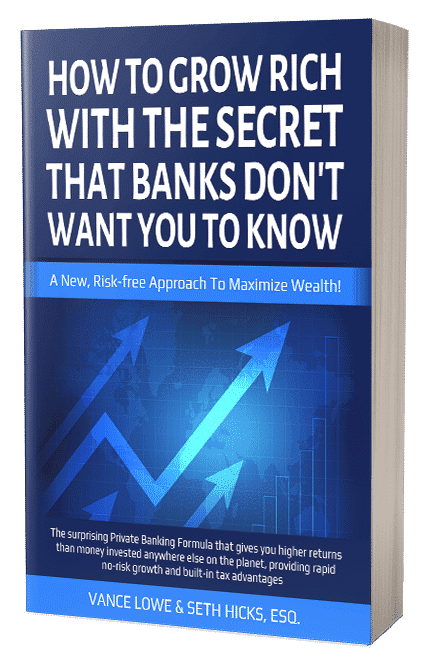
[00:16:11] Seth Hicks Esq.: If you wanna learn more, go to private banking strategies.com and there you’ll find a book offer for what the banks don’t want you to know. Secrets the banks don’t want you to know that will help you get wealthy. And so Vance and I have made. That book available to you for free. You can read it in A PDF, or you can also listen to it in an audio format when you put in your name and email.
[00:16:33] Seth Hicks Esq.: It’s also a way to stay connected to valuable content that we’re producing podcast, and more importantly, if those things resonate with you, you’ll wanna schedule an exploratory call with Vance and drill down and. These concepts and strategies will work for you in your financial circumstances, and he’ll take you through ultimately after a process of going into an eight year analysis where you actually understand and learn how to apply these [00:17:00] rules and concepts step by step, month by month, and effectively implement this in your life.
[00:17:05] Seth Hicks Esq.: And can’t describe how much it’s changed our lives, Vince, and how much it’s meant to so many clients, and it’s just a revolutionary concept for folks. So anything else you want to add?
[00:17:18] Vance Lowe: I think, you know, just do yourself a favor. You owe yourself the chance to find out more about it. What’s missing is the banking equation.
[00:17:27] Vance Lowe: Find out how easy it is to install this back in your life and reap the rewards of it.
[00:17:34] Seth Hicks Esq.: Amen. Thanks for joining us, folks, and we look forward to seeing you on the next podcast.
[00:17:37] Seth Hicks Esq.: Thank
[00:17:38] Vance Lowe: you very much. Bye for now.
[00:17:39] Outro: Did that story feel like it was about you? Do you feel you should be making more progress toward your financial goals?
[00:17:48] Outro: Do you feel stuck? Let us help you get unstuck. Are you ready to take action and get your own private bank? Please visit us at [00:18:00] www.privatebankingstrategies.com.
[00:18:03] Outro: Thank you for listening to the Private Banking Strategies podcast. Click the subscribe button below to be notified when new episodes become available.