[00:00:00] Intro: Welcome to Private Banking Strategies Podcast with Vance Low and Seth Hicks, your secret weapon to protect your assets and never have to start over financially again. Vance and Seth help high net worth individuals, families, business owners, and investors, structure and asset protected tax-free fortress for their families.
[00:00:21] Intro: Learn how to keep what you earn and use the velocity of money. To create your own private banking system. Join us on this journey as we explore the secret strategies of the rich and political elite and help you take total control of your financial security. Now onto the show.
[00:00:38] Seth Hicks Esq.: Hello folks. Welcome to Private Banking Strategies Podcast with Vance Lowe and Seth Hicks.
[00:00:42] Seth Hicks Esq.: How are you?
[00:00:44] Vance Lowe: I’m doing great today. I think we’ve got something that will be of great interest to our listeners, and I’m anxious to get started. Yeah, I, I am
[00:00:52] Seth Hicks Esq.: too. We’ve got a topic today, folks, that sounds really formal and technical because it references an internal revenue. [00:01:00] Code. But what we’re gonna talk about is a superior way to create your private banking strategies.
[00:01:06] Seth Hicks Esq.: And we’re gonna be talking about what’s out there, known as a seven, seven oh account, a seven 70 account for, uh, a financial wealth management strategy. And it sounds really formal, sounds really complicated, but it’s really not, is advanced.
[00:01:21] Vance Lowe: Not at all. It’s been around for a long, long time.
[00:01:24] Seth Hicks Esq.: So there’s a reason that it’s known out there as a seven 70 account.
[00:01:29] Seth Hicks Esq.: Help us understand why is it called a seven 70
[00:01:32] Vance Lowe: account? Well, years ago, right after they put in the modified endowment laws. So this takes us back to the late seventies. This product came up. It was known as the 7 7 0 2 law. The internal code for the IRS when they came in and said, okay, we’re going to tax the growth on life insurance policies.
[00:01:56] Vance Lowe: This whenever the IRS sets up. You know, a new law, [00:02:00] they try to set up a way around it. That’s why the IRS is so complicated. They do 4 0 1 Ks, but this is how you can do this or, or whatever else. So that 7 7 0 2 law was, I think, formulated at that time. As long as you obeyed the rules, you could continue to do the old style banking with correctly, put together life insurance contracts, because that’s what our banks were back then.
[00:02:30] Vance Lowe: See, people don’t understand, Seth, that we didn’t look at a world without a bank. Look at our country, our, our economy. Well, how did people exchange things? Where do they store their money? What do they do? They went all the way from, you know, putting money under the mattress to doing credit back and forth inside of town.
[00:02:48] Vance Lowe: They were all taught their own personal economies, but the smart ones, many of the people from school were taught, look, there’s these contracts with live insurance companies. You just send the money to them [00:03:00] and that’s bulletproof. No taxes, you know, till banks started getting introduced or, or anything against the, the average person in America.
[00:03:09] Vance Lowe: So with the 77 0 2 law, it told people it made more palatable. That if they put too much money in these contracts, they were gonna get taxed. So it was kind of a compromise to be able to be taxed if you put too much in, but have it regulated and let the IRS actually come into those contracts if you became a modified endowment.
[00:03:33] Seth Hicks Esq.: So Internal Revenue Code 77 0 2 basically outlined how life insurance policies, particularly the whole life insurance policies would receive unique tax benefits. IE, they are not taxed as they grow and compound every year at what’s historically right now, about four to 7% annual growth, which you can’t find anywhere else over the long term.
[00:03:57] Seth Hicks Esq.: I, I challenge folks to even find that [00:04:00] in their financial management. Portfolios and your stocks and equities and we, that’s a whole kind of a rabbit trail, but four to 7% year after year sustained is not what, how they’re performing. But, so this 77 0 2 allows the, the money inside these contracts to grow and compound year after year with no taxable event whatsoever.
[00:04:21] Vance Lowe: Correct. There’s a, uh, concept in the human mind, and you really understand that with horses and cattle. You ever seen a horse or a cow poke their head over the fence to eat the grass on the other side? Right? Because the grass is greener over there. And this is the same concept here with people, and they’re re resurrecting it, so to speak, because the grass is greener on the other side.
[00:04:48] Vance Lowe: Oh, I want to go try something exotic because it’s much better. Why would I wanna do the same? Plain Jane thing that’s guaranteed when I could maybe [00:05:00] get into crypto and make millions on a few dollars invested or get in the stock market and really hit it big because I know one person that did that once, and yet this has always been in America.
[00:05:14] Vance Lowe: It’s never failed in America. It’s never gone bankrupt. They’ve never had to shut it down. And it always beats the stock market. Why isn’t everybody flocking to it? Oh, because it’s the pasture. There’s no forest around here. I can’t see it because there’s too many trees in the road.
[00:05:32] Seth Hicks Esq.: You’re referencing something that is, uh, a powerful truth and that is that these life insurance contracts have been the cornerstone of individual banking for hundreds of years.
[00:05:44] Seth Hicks Esq.: But with the creation of the Federal Reserve and the IRS and these folks taking over the financial industry of America, they, they’ve kind of pulled the wool over American eyes and they tried to eradicate this type of banking from [00:06:00] consciousness. Thanks to folks like r Nelson Nash, who have brought it back to the forefront.
[00:06:05] Seth Hicks Esq.: We can capitalize on this Superior
[00:06:09] Vance Lowe: wealth management. What, what should people get a clue over and understand? Is that one of the most preferred collateralization tools that a bank goes after? Is your cash value? Do you have any cash value? We’ll collateralize that then, because they’ve never lost this arc, they know the value of these contracts and banks.
[00:06:31] Vance Lowe: That’s where they put their safe money, what’s called Tier eight a tier money. So they still do it.
[00:06:37] Seth Hicks Esq.: So the 77 0 2 of the Internal Revenue Code provides for these banking contracts to be utilized as. Effectively private banking tools. And so we as individuals can recapture money flow. We recapture interest payments, all of the, the cyclical cash flow that banks [00:07:00] generally make off of people.
[00:07:01] Seth Hicks Esq.: Now you re divert into your own banking system and it’s. Effectively a loophole for people who know about 77 0 2, and that’s why it’s been used by politicians throughout this time period. And wealthy entrepreneurs, Ray Crock, JCPenney, I mean, you can name others, but why are those type of folks using this and other people don’t even know?
[00:07:26] Vance Lowe: It is amazing the human being, just like animals take the path of least resistance. You know, if I can get down life this way and what is everybody else doing? So we call it the herd mentality and unfortunately, the herd mentality is set up for financial failure. Always has been, always will be. If it’s already announced, if everybody’s doing it.
[00:07:48] Vance Lowe: You can bank that it is the wrong thing to do. Anything that’s announced publicly like that is not the thing that the wealthy involve themselves in. Couple other [00:08:00] things that we ought to mention here. S This law is viable It, it talks about the true banking concept. However, it’s abused. Just like we’re seeing on the internet.
[00:08:12] Vance Lowe: They’re trying to fit all kinds of products against it or to it. Things like universal life indexed, universal life, which don’t have the guarantees you need, and dealing with companies that are not bank friendly. I still hear stories of, well, I got investigated for money laundering because I borrowed and put put back and I borrowed and put back too often, and my insurance company turned me in for money laundering.
[00:08:42] Vance Lowe: So there’s just because somebody says, Hey, we can do a 7 0 2 or seven 70, I don’t know why they’re calling it seven 70, but it doesn’t mean they’re experts of putting it together and using the correct companies.
[00:08:56] Seth Hicks Esq.: Right. So effectively, you know, some of the key features of [00:09:00] this is we’re gonna have tax free growth in this type of account, and it’s not gonna be tied to any market risk whatsoever.
[00:09:06] Seth Hicks Esq.: That’s unlike your index universal life that you just mentioned, or other folks out there that are trying to say you can run a private bank on those other type of products. Tell us just a little bit about that. We’ll sidebar for a second because we want to make sure people know what contracts not to use.
[00:09:21] Vance Lowe: Absolutely. One of the best places that you can go if you don’t know about us and feel comfortable with us is the NNI, which is the Nelson Nash Institute. They’ll guide you to not only what companies are favorable, but you can get a lot of good information there, as well as on our website. And Seth, I think we’ve got a free gift for those who are gonna stay to the end, uh, of this.
[00:09:44] Vance Lowe: You can talk about that a little bit, but it’s important for us to know. The difference between banking guarantees versus market averages or potentials. One of the big drawing cards [00:10:00] with what’s known as universal life or indexed universal life is quote, the potential. Okay. It ties it into the market, and then now we’re going after average rates of return and they do hypotheticals.
[00:10:14] Vance Lowe: If you got this in your account, it would be all the way up to here. You could really make a lot of money. It’s not the case. It’s never been the case. I know because I’ve been involved in UL for a period of time. Back when they very first come out in the seventies, every single one of those clients were left hanging dry.
[00:10:35] Vance Lowe: They were not able to get their death benefit or any cash out, they lost their contracts. I’m not saying that that’s gonna happen to everybody today. Hopefully it won’t because a lot of people you know are depending on that.
[00:10:48] Midroll: Did that story feel like it was about you? Do you feel like you are generating a lot of revenue but are not moving forward as fast as you would like?
[00:10:58] Midroll: Do you feel you should be [00:11:00] making more progress toward your financial goals? Do you feel stuck? Let us help you get unstuck. Are you ready to take action and get your own private bank? Please visit us at www.privatebankingstrategies.com.
[00:11:18] Seth Hicks Esq.: We’ve talked a little bit about the intricacies on those contracts and why they laps.
[00:11:24] Seth Hicks Esq.: Why people can’t continue to pay them at the end of their terms. Tell us why they fell.
[00:11:30] Vance Lowe: Everything is calculated on what’s called current rates not yield. Okay. Not guarantees. Does UL have guarantees? Yes. Okay. So everybody feels, oh no, my, my product has a guarantee and, but you can make market rates up to a maximum amount if the market runs away, that you don’t get that.
[00:11:50] Vance Lowe: You want to get up to X, okay, but it can come back down and wipe all that out the next year all the way down to the guarantees so they can put [00:12:00] money in and out. See, the disaster is that this is a life insurance contract and the risk of life insurance is met and negated when you pay the premium. They are obligated to fulfill the death benefit and the contractual guarantees Universal lives completely changes that.
[00:12:20] Vance Lowe: And now the risk is 100% on the client. Oh, if the market’s bad, well it’s done this, yeah, you could make this amount here, but I don’t care what anybody says. My opinion, and I think it worth something, maybe at least to myself, but. It is not a permanent life insurance contra. It’s term like the A fancy A L Williams concept, buy term, invest the difference, and they went out and looked and sold the most expensive term life insurance.
[00:12:51] Vance Lowe: It was so expensive compared to what you get back then, and then suggested you invest the difference. Because look what you could make, and again, we’re back [00:13:00] to average rates, returns, which are. Again, fictitious as to the actual results people receive in accounts. So we’re talking about yield here, folks.
[00:13:11] Vance Lowe: Banks do yield. Whatever money goes into your account can never be reversed. So when you said six to 9% average rate return in these contracts that’s in the contract, they can’t pull it back. And let’s say your internal return is 6%. That could never be lower. Well, I guess overall it could be, but it can’t go in and lower your account.
[00:13:35] Vance Lowe: In other words, what I’m telling you, we, we need to make sure everybody understands that the dividends are not guaranteed. We’re just so fortunate enough that all of our companies have never, ever missed paying dividends every single. So those are the profits, these contracts, and again, that’s important.
[00:13:54] Vance Lowe: Ask yourself, do any of the people with the UL or the IOLs [00:14:00] own the company? The answer is no. So the profits are not made by the clients, and what they do get is not guaranteed above maybe a 2%, maybe a guarantee. I’ve seen the average down to about one point a half to 2%. Maybe with inflation going up, they may do it a little bit higher, but I doubt it.
[00:14:19] Seth Hicks Esq.: So the seven, seven oh accounts you, you mentioned as some call them infinite banking contract. These a whole life insurance contracts, carefully structured. We’ve got a guaranteed rate growth. It hasn’t missed to perform in the Great Depression. Nope. Or in the great recession, 2008. Nope. What about the Civil War?
[00:14:41] Seth Hicks Esq.: Yep. Probably higher
[00:14:42] Vance Lowe: than they do today.
[00:14:45] Seth Hicks Esq.: So you’ve got this predictable rate of growth now with no market risk. That is very much unlike an IRA or a 401k. Tell us why
[00:14:55] Vance Lowe: the purpose, Seth, is that this phenomenon that I talked about, [00:15:00] the grass is greener someplace else, I wanna move over that. It’s more exotic.
[00:15:03] Vance Lowe: It’s not plain Jane. Don’t fall for that folks. You have to have a foundation when you have a foundation, and if you’ve got extra, okay, maybe you want to take a little bit and put it somewhere else for diversification. Maybe you’re the lucky one who wins on that, but you get total privacy. You get total financial freedom and control of your own assets.
[00:15:28] Vance Lowe: No one out there has your money except the life insurance company. Okay. And they invest and they lend money to what’s called defense investments. I don’t mean armies and navies, I mean toothpaste and tires and city council buildings and shop centers where people have to have these things to live life.
[00:15:51] Vance Lowe: They invest in very conservative things, so they have also the very best employed [00:16:00] in their companies. Far above what banks have the absolutely best minds when it comes to money and lending and making profits, actuarial, knowing exactly right to the number, how many deaths are gonna happen every year, keeping out an updated mortality factor.
[00:16:21] Vance Lowe: They update that every 10 years, but they’re never off. IRA 401k folks, it’s a government program and that should be enough said. There’s never ever been a government program that has benefited a citizen of the United States. It has only taken from them.
[00:16:39] Seth Hicks Esq.: We’re seeing so much of that now with, uh, doge being, you know, implemented and auditing all of these various aid factors.
[00:16:48] Seth Hicks Esq.: There’s so much waste. That’s one of the fundamental concepts, is that we come out from under government control and taxation and utilize the. Things like the 77 0 [00:17:00] 2 of the Internal Revenue Code, which allows free compounding, tax free wealth creation, and so there’s the 4 0 1 Ks and the IRAs, they’re taxed, and so if you try to get your money out of your 401k, well.
[00:17:13] Seth Hicks Esq.: For your 59 and a half, you’re gonna pay penalties and you’re gonna pay tax on what you’re pulling out. And same thing, if you try to leave it in too long, you’re basically imprisoning your money and subject to taxation. The the taxation is on the harvest rather than the seed. And you’re gonna ultimately pay a lot more in tax on the liquidation.
[00:17:34] Vance Lowe: Everybody’s doing it, so I need to do it
[00:17:36] Seth Hicks Esq.: right,
[00:17:36] Vance Lowe: thinking that there’s an advantage there, but there’s not, there never has been. Father of 401k announced. And under consternation of himself that I should have never, ever employed this. I’ve never should have put this in. It’s probably the worst thing I did to American citizens.
[00:17:53] Seth Hicks Esq.: He called it a monster. And in fact, that’s the access points for liquidity in these, is that you [00:18:00] simply have full liquidity to the cash value that you’re accumulating and building and that we’re talking about. You’ve got complete control.
[00:18:07] Vance Lowe: Everybody’s gonna interpret that their own way. Lemme tell you how easy this is, guys.
[00:18:12] Vance Lowe: When you need money and you want money out of your private banking system, your policy, there’s a toll free number and you’ll be asked two questions. How much do you want? Oh, where do you want it sent? Now they’re out of questions. What happens at a bank when you want to take money, cash out of your own checking account?
[00:18:30] Vance Lowe: It’s a series of questions, especially if it’s over 5,000 bucks. What are you going to use this money for? Is always asked.
[00:18:38] Seth Hicks Esq.: You hear clients’ stories more and more often about trying to get cash out of the bank for whatever purposes to buy a watch or to buy metals or whatever the reason may be that it’s their money.
[00:18:50] Seth Hicks Esq.: They want to take cash out, but then are hit with a lot of resistance from the bank as to getting their cash out. And that all comes kind of back down to something that we talk about [00:19:00] frequently in the Dodd-Frank Act and how your deposits in centralized banks are really not your deposits. They’re the banks.
[00:19:06] Seth Hicks Esq.: Deposits and they give you an IOU in the form of your statement. And if there’s ever a long or catastrophic type failures where banks are dominoing in insolvency, those deposits are gonna get wiped out. They’re gonna be bailed in on. And that’s all pursuant to the Dodd-Frank deck. We’ve got a lot of content on that, folks on our website at www.privatebankingstrategies.com.
[00:19:30] Seth Hicks Esq.: Tell ’em about the, the book that we, that we authored for these folks. Yeah,
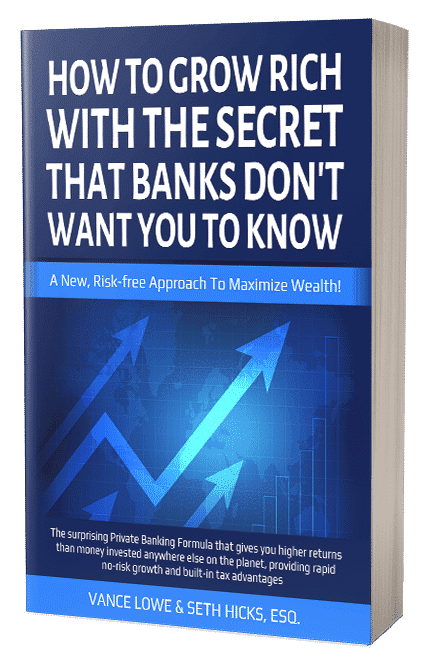
[00:19:34] Vance Lowe: yeah. We’ve got a free book. We appreciate you staying until this time. We encourage you to get this book. You can download it. You can download it, the e-version or the audio version. Listen to it. We show you a little bit of what we’re doing, how we’re doing it, and if that will resonate with you, then you can do a little bit more.
[00:19:56] Vance Lowe: And I think this is also a free gift. Before I go into that, I’ll [00:20:00] let Seth talk about that. Everybody I hope is filling a little bit of a breath of fresh air with our new president and the new things that are happening back there. But let me tell you. It is going to really come down on the banks. Where do you keep your safe money?
[00:20:19] Vance Lowe: I would advise us all to do like the banks do. The banks, especially the bank owners, do not their money in their banks. They keep it in these life insurance contracts. They’re probably the number one biggest client of life insurance companies. Billions and billions of dollars every single year are dumped and pumped into insurance.
[00:20:42] Vance Lowe: So. Tell ’em about the, uh, other free offer we got and the test drive.
[00:20:48] Seth Hicks Esq.: Yeah, I will. Just one more comment on these banks and their annual premiums. Last time I think that I looked into it, Wells Fargo and Bank of America were both [00:21:00] 20 billion plus in annual premiums that they pay on life insurance premiums.
[00:21:05] Seth Hicks Esq.: Just like the. Contracts that we’re describing and structuring so they understand the value of this. And it also bears repetition for folks like Ray Crock, JC Penny, John F. Kennedy. Multiple, multiple millionaires and billionaires have used the life insurance contracts that are carefully structured to create wealth, grow wealth, keep their wealth.
[00:21:28] Seth Hicks Esq.: And implement the strategies that we’re talking about. It’s smart money. So folks, we teach on all these various concepts. We have a ton of content on our website@privatebankingstrategies.com and the book that Vance and I put together for folks so that you can be red pilled into this type of thought and understanding of what’s going on in our banking world.
[00:21:49] Seth Hicks Esq.: That book is made available to you for free. You can listen to it in an audio format or you can. Read it. If you wanna read it in A PDF, you can listen to over a hundred podcasts that Vance and I have [00:22:00] developed. And ultimately what we want you to do is schedule an exploratory call with Vance so you can learn how this will work for you.
[00:22:07] Seth Hicks Esq.: If our podcast resonates with you, if our book resonates with you, then you’re the person that needs to schedule that exploratory call with Vance and take it through the eight year roadmap. As Vance likes to call it, where he teaches you exactly how to pay, what to pay, who to pay on an eight year trajectory, and shows you what your life is like with private banking strategies, and then what it would be like without in terms of numbers.
[00:22:32] Seth Hicks Esq.: And it’s a great, great tool where you get to take everything on a test drive and see how it’ll work for you. So Vance, any other things you would add to that?
[00:22:42] Vance Lowe: No, I just think that guys, you owe yourself the knowledge and the understanding if money is actually different. If you could switch from spending money to using money and getting it back just like the banks do, wouldn’t you wanna know about that?
[00:22:57] Vance Lowe: Can you think of some things that might [00:23:00] change if all of a sudden you were much better off day by day, week by week, month by month than you were the month before?
[00:23:09] Seth Hicks Esq.: Again, we hope to see you on the next one, and we look forward to sharing this content with you guys again. Thank you very much.
[00:23:16] Seth Hicks Esq.: Bye for now.
[00:23:17] Outro: Did that story feel like it was about you? Do you feel you should be making more progress toward your financial goals? Do you feel stuck? Let us help you get unstuck. Are you ready to take action and get your own private bank? Please visit us at www.privatebankingstrategies.com. Thank you for listening to the Private Banking Strategies Podcast.
[00:23:44] Outro: Click the subscribe button below to be notified when new episodes become available.