[00:00:00] Intro: Welcome to Private Banking Strategies Podcast with Vance Low and Seth Hicks, your secret weapon to protect your assets and never have to start over financially again. Vance and Seth help high net worth individuals, families, business owners, and investors structure and asset protected fortress for their families.
[00:00:21] Intro: Learn how to keep what you earn and use the velocity of money. To create your own private banking system. Join us on this journey as we explore the secret strategies of the rich and political elite and help you take total control of your financial security. Now onto the show.
[00:00:47] Seth Hicks Esq.: Yeah. Welcome to Private Banking Strategies folks with Seth Hicks and Vance Low Vance. How are you? I’m doing great. Looking forward to this next session. Yeah, this is a multi-part series. [00:01:00] We’ve talked about starting with how to be successful with private banking strategies. And then the second part was understanding the problem as we framed the problem and talked about how to, to, to look at these issues to be successful.
[00:01:14] Seth Hicks Esq.: And this third part of the multi-part series is putting the banking equation back in your life. And it’s a exploration of how the banks always get the money back. And when we say that, what does that mean, Vince? How do the banks always get the money back?
[00:01:31] Vance Lowe: Well, in this podcast we’re gonna generalize a little bit.
[00:01:34] Vance Lowe: We go into more detail with other videos and things that we have, and podcasts. The theme is how to be successful at this. Being. Being able to do this on, on our own. So putting the banking equation back in our life simply means that banks and the operation of banks, they always get the money back if the banks can always get the money back.[00:02:00]
[00:02:00] Vance Lowe: We can too. Right? It’s only a strategy and folks, I know people really want to think of this as being complicated, sophisticated, and difficult, but it’s not. It’s really as simple as make, uh, as stating this, finding out how the banks always get the money back. They always have a string attached to all the money and it always comes back.
[00:02:26] Vance Lowe: But we have to set up and run the same system. Banks would rather us use them, and we’re not saying at all, and we never say that we, we still don’t need regular banking. We do for bill pay and a whole bunch of other stuff. We have to live in the world, in the system. But where we store our money and how we use the banking concept, we can make the profits instead of the other banks.
[00:02:55] Vance Lowe: And that’s why we’re exploring this. So when the banks [00:03:00] receive the money, Seth, what do they do with it? Well, do they burn it? Do they spend it? Do they hide it in their vaults? They get a lot. Yeah. They don’t burn it
[00:03:08] Seth Hicks Esq.: and they don’t spend it and they, they don’t bury it. They, they always get the money back because they’ve got a cyclical flow and a, a strategy to put that money to work.
[00:03:19] Seth Hicks Esq.: How do they put that money to work? They make loans with interest and they actually make loans with money that you and I deposited in their banks, that they don’t pay us anything for. So what a business model that they have and we can actually implement it ourselves. It
[00:03:38] Vance Lowe: is and, and banks are the absolute best at understanding and using money to its full potential.
[00:03:47] Vance Lowe: Folks, we’ve always heard, we hear government all the time talk about, uh, interest rates and our economy and whether it’s tight or whether it’s loosened up, and it’s all reflected from the interest [00:04:00] rate that the banks are required to charge. Whether that frees money up for us to borrow. Or not, and it, but it’s still a borrowing system.
[00:04:09] Vance Lowe: There’s, I, I’ve never have found a day yet, and I hope I’ve never missed it, where banks give away free money. Have you, Seth? No. Hey, come in and get $25,000 on us. No, that doesn’t happen. Also sad to say that the branch presidents of banks, they don’t go get to go in and take money out of their bank. They can’t go say, Hey, I need an extra $5,000 this month reaching the till and take that.
[00:04:39] Vance Lowe: If they do, they’re gonna be prosecuted. Just like a bank robber. Right? Okay. Right. Everybody’s there for a purpose. Nobody’s there that knows how the banks make money. That’s been a shocking revelation over this last 20 years that right. You know, they, [00:05:00] they, they do really good, but everybody’s trained into their individual positions, so banks always put the money to work.
[00:05:08] Vance Lowe: That’s their job in the, the situation in America now, in our economy, that they put money to work. Sometimes they make it harder, sometimes they make it a little easier based on, on, on policy. So before branch banking, let’s go back in history. Let’s talk about that a little bit. I mean, it’s hard to imagine today, Seth, that you know, there’s not a a branch on every corner.
[00:05:36] Vance Lowe: Back in the day, there was no banks. People had to. Travel for days in order to get to one bank to make a deposit. And that was if the bank hadn’t been robbed, right? Because we talked about Willie Sutton bank robbers and everything else. You know, they would always rob banks and they were pretty successful at it for, for a long period of [00:06:00] time.
[00:06:01] Vance Lowe: But the hideous part about banks is banks would overspend. I remember reading in history books of bankers being tarred and feathered in towns when they lent out more money than they had available. Because if a, a loan went south, you know, a loan went bad, then the, the depositors couldn’t get back their money, and that happened.
[00:06:24] Vance Lowe: Banks failed over and over again. All throughout history, banks have failed miserably to deliver their promises. Yet, even today, everybody thinks the safest place to put your money is in a bank. Well, you know, it’s not. So before branch banking, how did we handle the banking equation?
[00:06:47] Seth Hicks Esq.: For hundreds of years before branch banking was indoctrinated into culture, banking was done through life insurance contracts for hundreds of years, and.
[00:06:59] Seth Hicks Esq.: [00:07:00] They’re specifically designed life insurance contracts and effectively that type of strategy and, and structure was intentionally eradicated by centralized banks. After the creation of the Federal Reserve and the IRS in 1913 and the basically the hijacking of the American economy through those two institutions, centralized banking became a huge cog.
[00:07:28] Seth Hicks Esq.: That will. And so just like you said, I mean from the sixties and the seventies, everyone has been brainwashed to think that’s where you store your money, as in the local bank at Maine. And first couldn’t be further from the truth. It
[00:07:44] Vance Lowe: couldn’t, and they were very hideous about it. I remember in kindergarten, now for me, that’s centuries old, but in kindergarten, the bankers would come in.
[00:07:58] Vance Lowe: And set up a savings [00:08:00] account for every single student, and they would provide the pennies for the first amount being deposited into the bank. We didn’t even have to come up with anything, and they taught us what yield was. These accounts will yield X amount of interest for you. There was no such thing as average rate of return back then.
[00:08:26] Vance Lowe: It was yield. Yield is absolutely critical, folks, because yield means money put in the account that cannot ever be reversed by the e economic situation. Okay? So that’s what they touted. They, they brainwashed everybody into the, the banks were the most safest place on the planet, but up to that point. They were the worst.
[00:08:51] Vance Lowe: It was you put your money in bank, you had almost a 50% chance of losing it back when I was in kindergarten, back in, you know, the fifties tell [00:09:00] you how old I am, banks were fighting tooth and toenail trying to get the money away from the life insurance companies. At that point, almost 80% of the wealth of America was still in these life insurance contracts, even.
[00:09:16] Vance Lowe: Today, there’s probably more wealth in these contracts than at banks because it’s the safe haven. Everything here we talk about guarantees, etched in granite, locked in. No economy risk, no market risk whatsoever. You can bank on this. This is your yield. This is a safe haven for you. And Americans lived by that law early on and they became wealthy.
[00:09:48] Vance Lowe: They didn’t have to have exotic investments. They, you know, if, if they in invested in land or gold or silver or things like that, in other schemes, they could lose a [00:10:00] lot of money. This was the safe haven.
[00:10:03] Midroll: Did that story feel like it was about you? Do you feel like you are generating a lot of revenue but are not moving forward as fast as you would like?
[00:10:13] Midroll: Do you feel you should be making more progress toward your financial goals? Do you feel stuck? Let us help you get unstuck. Are you ready to take action and get your own private bank? Please visit us at www.privatebankingstrategies.com. So
[00:10:32] Vance Lowe: families from the beginning were taught self-reliance, how to survive in the wilderness, how to reproduce things in order to keep them alive, how to be safe and run their own private economies.
[00:10:47] Vance Lowe: In other words, most people educated people back before 1900, back in the 18 hundreds could literally go out in the wilderness and be the [00:11:00] instigators of starting up a new town. They had that knowledge and what it took, and this is why most families had big, big families, multiple, you know, half a dozen kids or more, is because every one was an economic unit.
[00:11:17] Vance Lowe: So being able to bring this banking equation back in our lives is what we’re talking about. Having us have control. Having our bank put the money to work is a whole world of difference. It’s not complicated to set it up and run it, and it, it’s definitely private, but you can, you can service your family, your extended family, and never create a taxable event running this system.
[00:11:45] Vance Lowe: And so the key point is though, in order to get the money back, in order to put principle to work, a bank has to be involved. Wouldn’t you rather it, you own the bank than somebody else own the bank. Nelson Nash’s book, [00:12:00] Seth. There’s a car financing story where one person used CDs and another person used this strategy.
[00:12:08] Vance Lowe: Could you explain the differences in who ended up with a better amount?
[00:12:13] Seth Hicks Esq.: Sure, yeah. The it’s, uh, podcast called the Twin Sisters. And one twin sister decided to engage, uh, uncle Nelson to help her use the private banking strategy, infinite banking concept strategy. And the other sister decided she wanted to use CDs to store her money.
[00:12:35] Seth Hicks Esq.: They both put away $5,000 for seven years and then. Stopped contributing, uh, to the C one, to the cd. The CD sister stopped contributing after she had banked 35,000, and the other sister stopped contributing to her life insurance contract premiums once she had. Capitalized it for seven years with 5,000.
[00:12:59] Seth Hicks Esq.: So [00:13:00] they, they used it primarily to, to finance the purchase of automobiles, and then they would repurchase automobiles and allow that money to, to grow and compound. And so the CD sister had, uh, $250,000 in available cash in her CDs, and she needed $50,000 a year to draw down. She was outta money. After 50 th uh, five years, 50,000 For five years, she didn’t have any more money.
[00:13:26] Seth Hicks Esq.: The sister who used the private banking strategy, she had, I believe it was over $900,000, almost a million in cash value, that she also drew down 50,000 a year for the rest of her life. It didn’t run out, and she also had a death benefit that she left to her heirs and beneficiaries. That was over a million dollars.
[00:13:48] Seth Hicks Esq.: And that was all just originally implemented to purchase automobiles through their own banking strategy. The
[00:13:56] Vance Lowe: difference at the time of, I guess 65 was [00:14:00] about $700,000, but they both did exactly the same thing on the same days. They bought the same cars, they bought everyth, paid themselves back all during that time.
[00:14:12] Vance Lowe: So, but their $700,000 difference in this illustration. So folks, if you don’t have Nelson’s book, he’s, this stuff’s that book is full of, of these type of examples that are true. In real life, the difference was that the CD sister did not own the bank, and so the profits were received by the banks and the extra interest in everything else was received by the bank, where the insurance sister.
[00:14:46] Vance Lowe: She owned a portion of the bank. She got profits every year. She got the guaranteed profits every single year. That compounded up. That’s what created the difference. That’s why [00:15:00] life insurance was around before the stock market. Life insurance produces a steady amount of income. It produces a steady amount of growth unparalleled through the history of the United States.
[00:15:13] Vance Lowe: It stays pace with the stock market. I get, you know, brokers and everything else that try to argue with that, but they really can’t. Once we pull out the actual effect and the account, they can come up with average rate of returns and come up with any number they want, but that has no meaning to what is actually put into the account.
[00:15:35] Vance Lowe: So the banking equation and what we’re trying to talk about here and Seth’s example. Was, if you own the bank, you are gonna make the profits, you are gonna make the interest. All of that is inside your own economy, and you trigger no taxable events. Where the CD sister, she gets a 10 99 every single year.
[00:15:59] Vance Lowe: She had to pay [00:16:00] tax on the growth. However, if we’re gonna be fair south, we gotta tell ’em that the CD sister started out a whole lot better in the first couple of years. Her account balances were a lot better in, you know, in the first five to seven years. But after, I think year seven, when they stopped.
[00:16:17] Vance Lowe: Investing. The IBC sister caught up and never went behind
[00:16:23] Seth Hicks Esq.: from that point. Yeah, there’s really no comparison. We’ve got the illustrations that break down those numbers on the podcast called The Twin Sisters on on our website, and you should take a look at it folks, and really see the staggering difference between those two methodologies.
[00:16:41] Vance Lowe: Okay. I think with this information folks, it will give you a better heads up on how to be successful with this concept. Now, we may add, and I think we will, we, we can add how to set it up and, and run it, how you, uh, run it successfully to get the money back. Right now [00:17:00] that set up for those people who have, you know, kind of committed that they want this in their life.
[00:17:08] Vance Lowe: One of the things that we, Seth, you can explain this to him, but as you look at these podcasts and you read the book that Seth mentioned, you can set up an exploratory, and that exploratory is just gonna give you an outline and we’re gonna set you up to take this strategy for a test drive. So I think that’s important for you to actually see if this will work for you or not, before people decide.
[00:17:36] Vance Lowe: Hey, yeah, I’ll commit to, to get in if they can see the results up front on their own
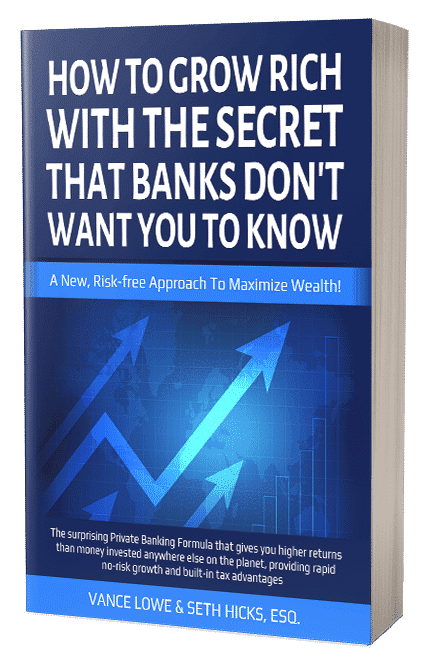
[00:17:41] Seth Hicks Esq.: numbers. What Vans is talking about is connecting with us through our website, private banking strategies.com. That’s private banking strategies. Com and on our website you’ll be given the opportunity to download our free book called What The Banks Don’t Want You to Know, secrets the [00:18:00] Banks Don’t Want you to know and you can put in your name and your email address and we will continue to provide you with valuable.
[00:18:07] Seth Hicks Esq.: Email content on these type of topics and more that help you to understand why you need private banking strategies in your life. If our book, which is available in written form by PDF, or also an audio version, if that resonates with you, and this podcast, which there’s approaching a hundred podcasts on our website, archived.
[00:18:28] Seth Hicks Esq.: Available under the resources tab. If those things resonate with you, then the next step is for you to schedule, uh, a call, an exploratory call with Vance, and you can access that through our emails that we send to you. His, uh, calendar link is available through the emails. That’s how you schedule the call and you can see how.
[00:18:48] Seth Hicks Esq.: This will apply in your own economy, in your own finances, how you take it on a test drive as, as Vance said. And ultimately, we lay out an eight year roadmap that shows you exactly what to [00:19:00] do over eight years, step by step, to take the financial banking equation back in your life and achieve financial freedom.
[00:19:08] Seth Hicks Esq.: So grateful folks that you’re with us on this journey, and glad to bring this content to you. Vance, any closing remarks? No, I just, I, I, I hope
[00:19:19] Vance Lowe: we’re, we’re being clear. On our message. We love to be in America where we tout ourselves as true Americans, but we’re also independent. We believe in the constitution.
[00:19:33] Vance Lowe: We believe that what we have to say is, is truth. It’s the light at the end of the tunnel. And folks, all you have to do is, is test it out. All you have to do is take a look and you might find the answers that you’ve been missing.
[00:19:49] Seth Hicks Esq.: That’s right. Well, thank you folks. Thank you for joining us, and we’ll see you next time on the Private Banking Strategies Podcast.
[00:19:57] Seth Hicks Esq.: Okay, bye
[00:19:58] Vance Lowe: everybody. Thanks. [00:20:00]
[00:20:00] Outro: Did that story feel like it was about you? Do you feel you should be making more progress toward your financial goals? Do you feel stuck? Let us help you get unstuck. Are you ready to take action and get your own private bank? Please visit us at www.privatebankingstrategies.com.
[00:20:23] Outro: Thank you for listening to the Private Banking Strategies Podcast. Click the subscribe button below to be notified when new episodes become available.