[00:00:00] Intro: Welcome to Private Banking Strategies Podcast with Vance Low and Seth Hicks, your secret weapon to protect your assets and never have to start over financially again. Vance and Seth help high net worth individuals, families, business owners, and investors, structure and asset protected tax-free fortress for their families.
[00:00:21] Intro: Learn how to keep what you earn and use the velocity of money. To create your own private banking system. Join us on this journey as we explore the secret strategies of the rich and political elite and help you take total control of your financial security. Now onto the show.
[00:00:48] Seth Hicks Esq.: Welcome to Private Banking Strategies with Seth Hicks and Vance Lowe. Vance, how are you this morning? I’m doing great. Was under the weather for a little bit with a cold, but it looks like I’m winning. [00:01:00] Fantastic. Yeah. Well, it’s, it’s, it’s great to be here again and we’re glad to have our audience with us.
[00:01:05] Seth Hicks Esq.: And today we’re gonna talk about how to be successful with private banking strategies, and we’re gonna go through some. Some topic outlines and go through things that we’ve discussed before. We’re gonna consolidate it all into a multi-part series here for folks, and we really want people to implement the, the laws and the strategies that, that are developed here so they can take, take control of their financial freedom.
[00:01:31] Vance Lowe: I agree. I think we’ve got a lot to talk about. I think it’s really exciting that we can drill down. We can go as as deep as we need to. We’re not gonna cover some of the things that we produce for our prospects. That go through our system because it’s, it’s already there, but we’re gonna hit mainly the highlights, but we will give a few examples and illustrations, I think, to, uh, drive
[00:01:58] Seth Hicks Esq.: home what we’re talking [00:02:00] about.
[00:02:00] Seth Hicks Esq.: So we all want people to be successful with private banking strategies and, and we want to change mindset. I think first Paradigm is helping people understand that you’ve, you, we have a different mindset. How money works and how money flows, and we want to implement money laws and people implementing money laws requires a change in mindset.
[00:02:25] Seth Hicks Esq.: Wouldn’t you agree?
[00:02:27] Vance Lowe: I, I really do. And that’s, that might be easier said than done for our, for some people. Uh, I believe that life is, you know, an ever learning journey. And I’ve been looking and working into this private banking strategy for 20 years now, and I still feel like I’m what’s called a conscious incompetent, which means I know I don’t know everything.
[00:02:50] Vance Lowe: There’s a lot to learn. There’s a lot of things to do. I think Nelson Nas, the father of private infinite banking strategy named it, well [00:03:00] when he put the word infinite into this whole concept, this whole strategy, and so I think. We can literally test ourselves about how much we know about money in, in order to be successful.
[00:03:13] Vance Lowe: We’ve come this far in life. Some of us are older, some of us are younger, and we’re at a certain point in life, and we have to sit back and ask ourselves, are we successful to this point? Are we where we wanna be? And you know, I ask clients that all the time, chef, I think you do too. What kind of response are we getting when we go down that trail?
[00:03:41] Seth Hicks Esq.: Yeah, I think there’s always room for growth and, and some folks are, are implementing the strategies and doing extremely well, expanding their banking system. They’re implementing these laws that we’re gonna discuss. And practicing it in a disciplined framework, and they’re the most successful. And then [00:04:00] there are others who, oh, yeah, I, I, I remember you talked about that.
[00:04:03] Seth Hicks Esq.: I forgot about that. And they’re not, they’re not principles that you can forget or a brush off to the side. I mean, like one of the first laws we wanna talk about is the 10% law. Would you describe what the 10% law is and what that means? Because I think without that, there is no cornerstone to build upon, I think the
[00:04:24] Vance Lowe: most.
[00:04:25] Vance Lowe: Important start to understanding money and the principles of money and going forward and through this journey in life as we feel whether we’re successful or not is based upon. The correct interpretations, and I’m gonna probably hammer this throughout this series, that we may think we know something because of our world experiences in the past, but it’s not necessarily correct.
[00:04:53] Vance Lowe: We have to ferre it out. We have to be able to internalize. The information [00:05:00] and pull out the correct interpretation in order to be successful. And that’s with anything. You can be a surgeon, you could be a doctor, you can be a lawyer, you can be anything. But without that correct interpretation, you can’t get the results.
[00:05:15] Vance Lowe: You’re looking for the final results. And so let’s go into this first law. I think it’s absolutely critical. We’ve all heard it, you know, some of us who I, I, I, I question people who said, well, I’ve, I’ve never heard that. I’m, I’m wondering, it’s based on a lot of Christian beliefs, but the 10% law is so critical when we do our first exploratory call with the clients.
[00:05:38] Vance Lowe: Or, you know, with prospects, we tell them all about this 10% law, and that if you are unwilling to live this law, we’re pretty much done. We can’t get you where you need to be. You can’t bake a cake. You can’t build something without following the blueprint or the [00:06:00] recipe or whatever else. You can’t leave a major ingredient out and hope for success, you know, for the successful outcome.
[00:06:06] Vance Lowe: Right. So the 10%, well, let’s even give an example because a lot of people know this, but they can’t live it or they feel they cannot live it. So let’s, let me paint a picture. Seth, I’ll use you for instance. Let’s just say, you know, our monthly income after taxes are $10,000 and we want to live this 10% loss.
[00:06:28] Vance Lowe: So the first thing we do is we carve out. A thousand dollars or more. 10% of, and by the way, is the minimum. If you can do more, you do more. Alright, so we’re gonna put a thousand dollars over here on the table. We got $9,000 left and we’re gonna live off that $9,000 throughout the month and we start dwindling down this pile of money and we get to the end of the money.
[00:06:52] Vance Lowe: But there’s one more bill. And it’s a kind of a freak bill. ’cause we always have these unexpected bills and it’s due [00:07:00] today and it’s for a thousand bucks. What do people
[00:07:04] Seth Hicks Esq.: end up doing? Well, they take the thousand dollars that they, that they split apart and they pay that bill. Okay? And they
[00:07:12] Vance Lowe: pass up folks, listen to this.
[00:07:15] Vance Lowe: You pass up one of the best opportunities for investment you could ever imagine. The whole purpose of paying yourself that a thousand dollars was to free it up, right? So, right. We’re freeing it up. We’re not tying it up. We’re gonna free it up because we want to put that money to work 10% of our income that month.
[00:07:37] Vance Lowe: We want to produce income. That’s our goal. That should be everybody’s goal is to put their money to work to replace what they have to go out and earn. And we can do that in a formula. That’s why this is so critical. In this case, it’s the guy in the mirror we’re, we kind of have to split ourselves or our own, you know, family private unit, [00:08:00] the guy looking in the mirror at us, and then there’s us on the outside and the guy in the mirror is in a contra world.
[00:08:07] Vance Lowe: He’s living in our house, eating our food. Doing everything driving our cars, but he’s doing it free. In Nelson Nash’s book, he’s got the grocery store story and he says, if you take the food out the back. The grocery store’s gonna fail. Well, the guy in the mirror is robbing us blind. He’s doing all of this stuff free.
[00:08:29] Vance Lowe: He’s not accountable for anything, but now he’s outta money. He needs a thousand dollars right now. You on the outside have a thousand dollars to put to work, don’t you think the two of you could get together and you could lend him that money? The question is, Seth, for these people, what’s the difference between just giving it to ’em and lending it to ’em?
[00:08:51] Seth Hicks Esq.: Well, you want to be able to keep the money within your own family economy, so to speak. You want to be able to always get [00:09:00] the money back that you’re now, that
[00:09:02] Vance Lowe: that’s the thing. And now folks, we’ve almost completely identified how banks always get the money back. It’s because of the lending process. Now all we have to do is, is we don’t care about how fast we get the money back.
[00:09:18] Vance Lowe: What we care about is that we put a thousand dollars to work. We could come up with any type of payment that would fit our budget. Right, right. Yeah, we could. We could do that. Now the only question is do you want your earnings high or low? Everybody says high. We could charge 25 or even 50% interest and double that return every two years, income tax free and still.
[00:09:46] Vance Lowe: Keep the payment where you need it to fit inside your
[00:09:50] Seth Hicks Esq.: budget. Let’s color in some of these ideas that we’re talking about. The, the first thing you said is of a $10,000 monthly income, we take 10% or a [00:10:00] thousand dollars, and we separate that and we pay ourselves first. Is that what I’m hearing? Absolutely.
[00:10:07] Seth Hicks Esq.: First, not
[00:10:08] Vance Lowe: second or third.
[00:10:11] Seth Hicks Esq.: Doesn’t matter if there’s emergencies, doesn’t matter. If there’s a shortfall, we separate that money and we pay it to ourselves. How do we pay it to ourselves? Well,
[00:10:21] Vance Lowe: I mean, if we, we actually have cash on the table, we can move money to the coroner. If we have cash in account, we take a thousand dollars, we free that up and we put that in a different account.
[00:10:33] Vance Lowe: So that we have now isolated that thousand dollars with the intent of immediately trying to put it
[00:10:39] Seth Hicks Esq.: to work. Now, here’s the follow up question. What then, what do we do with that thousand dollars that’s in the special account, or sometimes we might call it a clearing account or on the corner of the table.
[00:10:53] Seth Hicks Esq.: What do we do with that thousand dollars or at the end of the year or the $12,000 or the end of two years, [00:11:00] $24,000. If it accumulates that high, what? What do we do with that money then?
[00:11:04] Vance Lowe: Well. We know that we finance everything in life. We, whatever we purchase, we can pay cash, we can pay for time or anything else, but it’s financed and most things wear out.
[00:11:16] Vance Lowe: So by putting the debt or putting our our money to work, this 10% to work is actually buying this, this debt, this, these things that we need. We may have a car payment and for us to purchase that loan. Is more profitable than making just the payment because now the payment is going to come back to us. The interest is gonna come back to us against that loan and any of the profits.
[00:11:49] Vance Lowe: In addition to that there, there are places to store that, but we’ll get into that a little bit later. But this 10% is the root of everything. This is why we’re taking the time today to [00:12:00] really get you to understand and appreciate this 10% law. So I think if we don’t do that, we don’t just set ourself apart for one month.
[00:12:12] Vance Lowe: If we do the math, Seth, you know we have in our book what banks Don’t Want You to Know the rule of doubling. Doubling a penny and and the masses that it creates in such a short period of time. This is the effect of paying ourself the 10%, 10% equals 10% of a monthly income over a year. We actually have now created more than a full month’s.
[00:12:38] Vance Lowe: Worth of income that we should have out working for us. And that should be compounding. We can compound assets when we’re finance self financing and purchasing our own debt. We can double money very, very quickly. Two and a half years to, to five years is, is the norm, not seven years or 10 years. [00:13:00] And if you keep that up for a 10 year period of time, you now have more than an annual.
[00:13:06] Vance Lowe: Worth of income plus all the compounded growth over that 10 year period of time. Most people can be completely financially independent in 10 years by doing the 10% law. And every month you go by, you postpone that. You lose those last few months and you, you know, it just, it’s a never ending battle.
[00:13:29] Seth Hicks Esq.: Right.
[00:13:29] Seth Hicks Esq.: So what’s the next step after we’ve set apart that 10% of our, of our income and paid ourselves first? What? What’s the next step?
[00:13:39] Vance Lowe: Well, everybody’s heard this, but I’m hearing some people trying to say they’ve never heard this before. We all know under the principle of money that we should never spend.
[00:13:55] Vance Lowe: Principle itself. So Seth, identify, print. What is [00:14:00] principle for us? When about money, what is the
[00:14:03] Seth Hicks Esq.: principle? Well, the principle is, is the the core amount that we use to purchase something and pay it back effectively.
[00:14:15] Vance Lowe: Okay, let me give this another example so that people have got a little bit more depth. In that principle is the money that you put into your personal checking account, after all taxes, fees, and charges and everything else that you have worked for very hard.
[00:14:33] Vance Lowe: Many people go to work for someone else and it could be. As high as 25 to one, we’ve gotta make $25 for everybody else for you to net $1 in this system of ours, the way the banks have it, because we’ve gotta make everybody else a profit. We gotta prove our worth every day and go through this same process.
[00:14:55] Vance Lowe: Day in, day out, weekend, month in, year in and year out. [00:15:00] And so the money that we bring home is principle. And a lot of people don’t understand that. They think, oh, well no, that money’s got to be used because we have to live. But it is the principle and we don’t. Have to spend it the way everybody is spending it and it, Warren Buffets, the Donald Trumps the successful families that are more private, but some of them, you know, do advertise.
[00:15:30] Vance Lowe: Not advertise, but tell people what it takes and they all come in and say, you can never ever spend your principle. Warren Buffett has two rules to that rule. Number one, never spend principle. Rule number two. Never break rule number one. So it’s that critical because when we do, we lose the momentum, we immediately go back to square one.
[00:15:56] Seth Hicks Esq.: So we take, okay, so if, if, if we defined [00:16:00] principle as after tax, after expense. Left over and we’re saying, never spend that. What exactly does that mean? Then never spend that because you’ve gotta spend that for your, your house, your automobiles, your food, and, and we’re not talking about leisure consumption type things.
[00:16:18] Seth Hicks Esq.: There are necessities, food, water, shelter that have to be paid for. And so what does, what does that mean? Then? What’s, what’s left over there after, after taxes and expenses, what do you, where do you put that and, and how do you pay for the things you need? I think this
[00:16:36] Vance Lowe: is the number one question people are always gonna have, and they, they get to this point and they give up, so to speak.
[00:16:42] Vance Lowe: Look, you know, I’ve gotta use my money just to live, and then if I’ve got anything left over, you know, I can save that. But that is incorrect. And this is where we have to bring in what we call a banking equation. When our country was brand new, we didn’t even have [00:17:00] banks. We had a system of independence, a fierce system where every family was its own unit, was its own economic unit, so to speak, and was able to survive and thrive out in the wilderness where there was virtually nothing.
[00:17:19] Vance Lowe: So in principle and saving and not spending principle, the banks. Have this down to fine art. The big question is, is whether banks are cheating or not. And they, you know, they do things unfairly. We believe that because a lot of ’em are very close to insolvency. But the true nature of a bank is they always get the money back.
[00:17:42] Vance Lowe: And we’re trying to tell people how they do that. They never, ever spend principle, all the overhead on a branch office, the new building, all the chairs, the furniture, the equipment, the electronics. Are all financed [00:18:00] within their own system in order to get the money back. That’s what we have to do. But we have to have a banking equation because on one person or, or, or one point, the person in the mirror, he does two things.
[00:18:14] Vance Lowe: He consumes, he spends money, but he goes to work to replace his habit. So to speak, and that’s a cycle. He’s, he, it’s a continual cycle that locks him into being, having to work. If we were to put a banking equation in our life and entered all of our new income every single month, all the new money from all the sources, if we’re employed, it comes from our employer and automatic deposit.
[00:18:42] Vance Lowe: If we’re self-employed, it comes from our self-employment. If we’re retired or if we have investments, all of those. Monies that are paid to us as profits that are coming into our control. Instead of being put into a personal checking account, we need [00:19:00] to put it into our banking system first into our bank, and then let our bank put that money to work we can borrow from our bank and use the new income to pay back those loans.
[00:19:15] Vance Lowe: And that’s what we’re talking about preserving. Principle, you can use principle all the time. I mean, you need to, you have to, but you have to have a way to get it back and get it back with interest. So you’ve got to have and run a personal economy. That would be rule number two, you know, in this scheme of thing, because when I watch people and over the last.
[00:19:40] Vance Lowe: 40 years of helping people manage assets and money. I’ve just found it that people feel like they know what they want to do and how they want to do it, but they always end up spending the money. If I need this, I’m gonna go buy it. I deserve it. Any number of things. So most of the time, [00:20:00] this is why I kind of use this terminology, that if you learn about how to become your own private banker, you learn how to speak Martian because it’s so alien.
[00:20:10] Vance Lowe: To the way people treat money and what, and the way they think about money. It’s, it’s so different. Once you catch on, once you learn how to treat money properly, it always comes back to you with interest. Always. Right.
[00:20:25] Midroll: Did that story feel like it was about you? Do you feel like you are generating a lot of revenue but are not moving forward as fast as you would like?
[00:20:36] Midroll: Do you feel you should be making more progress toward your financial goals? Do you feel stuck? Let us help you get unstuck. Are you ready to take action and get your own private bank? Please visit us at www.privatebankingstrategies.com.
[00:20:56] Seth Hicks Esq.: So we have a banking system that we [00:21:00] implement where. That 10% that we carve out is coming back into the cornerstone of our banking system.
[00:21:07] Seth Hicks Esq.: And that compounds and grows, much like the penny doubling every day that we illustrate in our book. That same principle is at work within your banking system and strategy. And then if you have the, like I asked the, the food, shelter, water type necessities, you use your banking cornerstone to finance those.
[00:21:31] Seth Hicks Esq.: Purchases and servicing that and you, and you have the system paying back your own bank. Is that, is that, is that a good summary?
[00:21:40] Vance Lowe: That’s true because you know, a lot of people who think they know about money will say, well, that can’t be true because you’re spending money or the money’s going away from you.
[00:21:50] Vance Lowe: That’s because we don’t have the banking equation. We know everybody can’t refute. The banks always get the money back. They always get the [00:22:00] money back. Because it doesn’t go out of their banks unless there’s a tie to it. Unless it’s a loan, it’s the bank that gets the money back with interest without having this banking equation in your life.
[00:22:14] Vance Lowe: This is why we preach this. This is why we try to help set this up in everybody’s life. You’ve got to have your own bank. And we call it a banking equation because it will be the bank that always puts your principle to work and always gets it back. Seth says One other thing with the, uh, 10% picture this.
[00:22:35] Vance Lowe: If we set up this banking equation, this banking account, and move all of our money into there, it’s not sitting down on a personal account or in a business checking account tempting us to spend it if we, if it’s not necessary. Okay, it’s sitting up there in the bank, waiting to be lent out for the typical [00:23:00] things of the month, but also for non-typical things, an accident, taxes, any number of things.
[00:23:07] Vance Lowe: Uh, money multiplies so much faster because now we have a little bit better control and we’re more accountable than just throwing our money in our personal accounts. And when it’s out, we’re out. We go back to work. You know, live month by month.
[00:23:25] Seth Hicks Esq.: Right? So once we have those systems established, what, what is the next step?
[00:23:30] Vance Lowe: The next one, which is number three, and I want to go back and say the first one and the second one along with this one, are mental processes that the average individual has chosen not to do. We wonder why we can’t be successful with money we’ve chosen, you know, the 10 percent’s too hard. Everybody spends principle, it’s called, you know, that’s a herd mentality type thing.
[00:23:58] Vance Lowe: The last one [00:24:00] here is we all know we should be following a well-defined financial plan that is updated regularly. We need to follow it without fail. You don’t have an airplane, leave the ground, you don’t have a ship. Sell from the harbor. You know, you don’t take a trip across the nation without a map, you know, without some sort of plan to get you from point A to point B.
[00:24:27] Vance Lowe: And yet we struggle through life. We do not use a financial plan. We know nothing about where we’re at, nor how we’re gonna get to where we want to be because we’ve chosen, we’re too busy in life. To follow a plan. We have a very, very simple plan to be able to follow. It’s a plan that each individual literally puts together.
[00:24:50] Vance Lowe: Once they understand how everything flows, it doesn’t even take ’em 20 minutes a month, you know, to open up, to execute the whole strategy, the [00:25:00] whole private banking strategy look on their plan and says, yes, I need move the money from here over to here. Oh, this month I need to purchase this debt. It’s that simple, and it’s amazing how people go from, and, and Seth, you can, uh, maybe make a comment on that.
[00:25:18] Vance Lowe: It a person who’s so far in debt, they feel like they have to take out bankruptcy. They finally get back employed and they, they turn around and throw their hands and say, I’m never gonna get outta debt. And within a, a shorter time as 50 to 60 months. They now own all their debt to the outside world.
[00:25:38] Vance Lowe: They’ve paid everything off and nothing changed other than these three principles.
[00:25:44] Seth Hicks Esq.: Yeah, it, it’s quite, it is quite phenomenal. Once it’s, it’s firing on all cylinders and people get it. So those are the three fundamental laws of money. Money laws, as we call it. We’ve also talked on numerous podcasts and, and some of our [00:26:00] content about money principles that we find in Nelson Nash’s book.
[00:26:03] Seth Hicks Esq.: Would you like to touch on some of those? Yeah, let’s do that,
[00:26:07] Vance Lowe: because these are absolutely critical because it’s the way we feel, the way we think, and the way we use money. Okay. There are five. I guess principles are things that we literally have to defeat. These are things that are always going against us a little bit, and we’ve got to understand them and we’ve got to be able to man up, so to speak.
[00:26:33] Vance Lowe: Overcome each of these little obstacles. The first one’s called Parkinson’s Law. This is a famous individual back in World War ii after we won the war. Our economic system was really trying, you know, cratering and he made a name for himself and we’re not gonna go into that ’cause we’ve already, you know, gone through these laws.
[00:26:52] Vance Lowe: But the main one we’re trying to pick up here is that Parkinson’s law deals with. [00:27:00] Luxuries a luxury once lived, becomes a necessity. How many things in our life do we not need? How many TV subscription programs do we not need? How many cell phones do we not need if we’re trying to pay ourself this 10%?
[00:27:19] Vance Lowe: Most people live dollar for dollar throughout the whole month. Say they don’t have anything, but yet they have to have all the luxuries. So he talks about that, but his main one is living within your means. In other words, we always need to bring home more money than we’re spending every single month, more than the 10%.
[00:27:41] Vance Lowe: ’cause we always have those ebbs and flows and non-typical months. So that’s a loss, Seth, that we need to, uh, reiterate to people who are thinking about doing the strategy. If we can’t live the 10% law, wait till you can, if we can’t live Parkinson’s law, [00:28:00] don’t even start until you can. ’cause that right there will stop you dead in your tracks.
[00:28:06] Vance Lowe: You’ve got to be able to bring home more money. I’ve got people, you know, we’ve got in high risk investments. They’re risking everything because they want a huge windfall. They stop work, they’ve done all kinds of things and they wanna set up this. Strategy in their life, but they don’t have a flow of money.
[00:28:26] Vance Lowe: Okay. A town, I wanna put this in and we will reiterate this as time goes on. A town does not have a retirement date, right? A town is totally organized to attract new money into town, and once money, new money gets into town, that money bounces all over town. Gas station, the dealership, the banker, the dentist, mechanic, restaurants, it’s only $1, but it bounces so many times all over town and [00:29:00] creates more money.
[00:29:01] Vance Lowe: Most people listening to this have never experienced that, and we’re gonna show ’em how to get more than one use out of dollars. So the next one, the Golden Rule says not what we think in biblical times, where you know. Do unto others as you would have them do unto you. In this instance, it means he who has the gold makes the rules, okay?
[00:29:27] Vance Lowe: If you have the gold, they will find you and you make the rules. Government doesn’t get to dictate to you. Banks don’t get to dictate to you what you have to do with that money.
[00:29:40] Seth Hicks Esq.: Well, I mean, a perfect example is, and we’ll probably, you know, get off in the weeds a little bit, but like big pharma, big pharma pays for much of the FDA research and sponsorship and big pharma.
[00:29:55] Seth Hicks Esq.: Uh. Wants to sell drugs and that may or may not be in your and my best [00:30:00] interest. And so the narrative becomes one that is paid for, and it’s because the big pharma has the gold. And so they’re making the rules with the FDA with regards to what type of treatments are available on the market, and they don’t want inexpensive, easy to access treatments that cut them out of the gold.
[00:30:22] Seth Hicks Esq.: Flow that they’re, that they’re accumulating. So I think that’s a perfect rule. You know, example of the golden rule. I mean, you can apply it in, in number of contexts, but that’s, that’s the, that’s the point. I mean, with banks, for example, they, they set. All the, the rules with regards to what the terms of your banking relationship is, and we’ve talked about this, the Dodd-Frank Act, which all the centralized banks are implementing, and that’s the Dodd-Frank Act effectively makes your deposits the bank’s money and they can use it as they see fit and they lend it out and they [00:31:00] pay you nothing for that.
[00:31:01] Seth Hicks Esq.: In fact, you effectively have negative interest rates with inflation and fees and charges, but so. Fortunately with the bank scenario that we don’t have to play in with the banks, and that’s why we’re creating these strategies for folks where they can bank and take it back into their own hands, so right.
[00:31:22] Vance Lowe: So that’s the golden rule. You know, he who has the gold, you pretty much get to make the rules. The next one is an affliction in America that’s very, very high and unchecked, so to speak. We think we know more than we know and we, we call it the arrival syndrome, especially about money. We think we know.
[00:31:45] Vance Lowe: What to do in this situation. I know what to do in that situation. If that ever happens to me, I know what to do. Oh, I’ve heard about that before. Life insurance. Oh, I, I can rat hole that information when it comes to [00:32:00] money and investment. Dave Ramsey says this, or Susie Orman says that we know. And so the arrival Syndrome has been the number one principle we’ll call it for failure.
[00:32:16] Vance Lowe: To achieve a goal than than most the others, simply because we think we know what we’re doing and we’re wrong. It’s not what we don’t know, and we’ve preached this Seth in all of our podcasts. It’s not about what we don’t know that is hurting us. It’s about what we think we know that’s incorrect. That hurts us.
[00:32:39] Vance Lowe: We have stakes. I call ’em stakes in the ground. We’ve put these stakes in because that’s our experience. My dead dad said, you know, pay cash for everything. That’s the best way to get through life. Okay? And then you put those stakes in the ground and you pass up all kinds of opportunities or wonder why you can’t get ahead with money.
[00:32:59] Vance Lowe: [00:33:00] Because these are holding you back folks, when you learn and start seeking about this strategy, try to pull up all the stakes. Don’t let anyone, anything hold you back. Learn something new about money. So that arrival syndrome, it, it can go to anything. You know, I remember the old or an advertisement, you know, the.
[00:33:23] Vance Lowe: Person needed brain surgery. And the surgeon there was all wrapped up in the robe and, uh, the nurses and everybody looked at him and said, are you a doctor? And he goes, no, but I, I stayed at a Howard Johnson’s. You know, it’s something so stupid, but it really is. You know, we take an idea, look what happens in government right now.
[00:33:49] Vance Lowe: Look, look how the world is right, is wrong and wrong is right. Everything is so upside down and so turned over. It’s because of the arrival syndrome is so ru [00:34:00] running rampant with all of us, right? Yeah,
[00:34:02] Seth Hicks Esq.: and I, and I think we have to constantly be learning, always be learning and if, and using what we’ve learned and that brings us to like the next money principle that Nash outlines the use it or lose it principle, use it or lose it.
[00:34:17] Seth Hicks Esq.: How does that apply to private banking strategies? Use it or lose it. I’ve learned through life,
[00:34:24] Vance Lowe: you know, through life. We all. Develop habits. Some are good and some are bad. When we’ve identified bad habits, if we want to eliminate those bad habits out of our life, you just can’t cut it out and then go because it leaves a hole.
[00:34:42] Vance Lowe: The best way to get rid of a bad habit is to replace it with something good, a good habit that fills the void. What we’re talking about here is money. We’re gonna teach you the, the true principle of, of the use of money, and it’s different [00:35:00] and you have to use it. ’cause I watch people start a program and life happens.
[00:35:08] Vance Lowe: They get busy and they fall back. They just fall back to way they normally pay their bills and everything else and they never reap the reward and they wonder why. But if we learn something and we use it and we put it to work, it will become muscle memory. Both of us throughout our life have done a lot of sports and a lot of things that require a tremendous amount of muscle memory.
[00:35:33] Vance Lowe: It’s not practice that makes perfect. It’s perfect Practice. Makes perfect. Right. And once we realize that this, use it or lose it, and when it becomes muscle memory, then when a big crunch happens, when we don’t know where to tune it be, it just becomes automatic. And so we’ve got to, to use the new stuff immediately and continually, [00:36:00] or two weeks, you know, Hey, that idea was absolutely fantastic.
[00:36:03] Vance Lowe: I’m gonna go home and change my life. But two weeks later, nothing happened and we forgotten it. So that’s the use it or lose it. What’s the last one?
[00:36:12] Seth Hicks Esq.: Seth? Willie Sutton Law. Willie Sutton, the bank robber. Willie Sutton was a, uh, a bank robber who ultimately got caught and he was being interviewed and the interviewer asked him, uh, well, why did you rob the, the banks?
[00:36:28] Seth Hicks Esq.: Why did you, why did you do this? And he said, duh, that’s where the money is. So he knew where he could. Manipulate and steal because that’s where the money is and how do we apply that? And with private banking strategies,
[00:36:47] Vance Lowe: he who has the money, somebody will try to steal it. And that’s what we need to take away from that.
[00:36:53] Vance Lowe: Willie Sutton is in there because that’s where the money is. So if you have money, somebody’s gonna try [00:37:00] to steal it. Now we have. A government, Willy Sutton, who would that be? Seth,
[00:37:06] Seth Hicks Esq.: right? Well, you’ve got the IRS. You’ve got all sorts of government agencies that are trying to get their piece of the pie for the money that you make.
[00:37:16] Seth Hicks Esq.: Could be state income tax, property taxes, sales tax, you name it, luxury taxes. Vehicle registrations, boat registrations, anything that you want to own that the government is trying to tax and regulate. So the moral
[00:37:35] Vance Lowe: of that, along with all these other principle and laws are if you set up, learn how money really works and run your own private economy, you will incur.
[00:37:49] Vance Lowe: No taxes you, you don’t incur a taxable event, is what I’m trying to say, to be taxed according to the current laws. This is, [00:38:00] again, something they don’t want you to know. Knowledge is power. Power is freedom.
[00:38:06] Seth Hicks Esq.: Privacy. Yeah. And that comes from the Internal Revenue Code 77 0 2, which effectively creates this tax free economy and tax free haven with the, the banking strategies that we’re creating.
[00:38:24] Seth Hicks Esq.: So the money in. And as it accumulates and grows and compounds and as you take it out, whether it’s for purchasing debt, purchasing investments, or for retirement distribution has no tax taxable benefit, no taxable event.
[00:38:41] Vance Lowe: So folks, you know what’s really important is that we, as we learn things, we come away with the correct interpretation, and that, again, is a symptom of the arrival syndrome.
[00:38:56] Vance Lowe: You know, we don’t wanna just think we know what the [00:39:00] answer is and go our merry way because it’s probably wrong, especially when it comes to money. And I really enjoy Seth. When people realized that, wow, my decision about this is not only wrong, it was 180 degrees wrong it, in other words, it couldn’t
[00:39:19] Seth Hicks Esq.: be a worst choice for me to make.
[00:39:22] Seth Hicks Esq.: It’s revolutionary. It really is the, the principles and strategies and when the light bulb comes on in the mind and changes the paradigm, it, it really changes not only the immediate person’s life, but their ex, their family’s life, their children’s lives. And it creates a legacy that really flows through and changes, you know, their, their family history.
[00:39:44] Seth Hicks Esq.: So it’s, it’s, it’s a great pleasure to bring this type of. Content and strategy to folks, and we’re glad that folks have joined us. I’m gonna give everyone a little bit of a what they do next with us. You can find more content about private banking strategies at www dot [00:40:00] private. Banking strategies.com.
[00:40:02] Seth Hicks Esq.: That’s private banking strategies.com, and there on the website you’ll find all sorts of resources, including all of our podcast archive there that you can watch, which are labeled and itemized the best of our abilities to help you find the content that you’re looking for. But we have probably closing in on a hundred podcasts now.
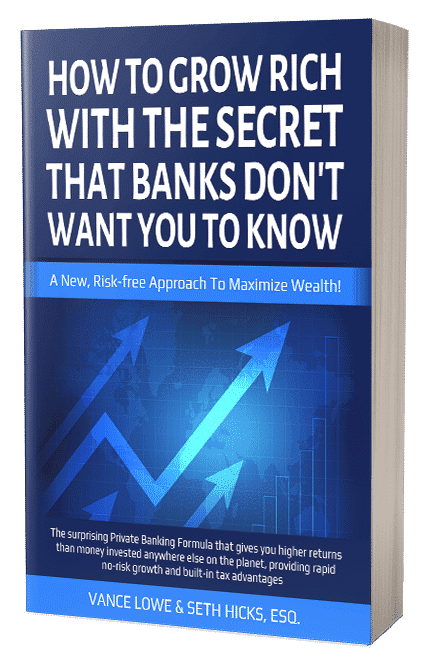
[00:40:24] Seth Hicks Esq.: We’ve got also a book that we’ve written called What the Banks Don’t Want You to Know, secrets Banks Don’t Want You to Know. That will effectively help you create financial freedom and take back the banking equation in your life. Now, when you hit our website, you can put in your name and email, and that book will become automatically available to you by PDF and by audio, so you can listen to it on the go.
[00:40:46] Seth Hicks Esq.: And if those things resonate, our book resonates. This podcast resonates. The next step is to schedule an exploratory call with Vance and dig into the. The meat and potatoes of how this strategy will apply [00:41:00] for you and to your life. And ultimately, we can create an eight year roadmap that Vance had described earlier in the podcast, which tells you step by step what you need to do as far as where you put the, put your money, move your money, what debts you pay, what debts you purchase, and makes it, uh, absolutely idiot proof.
[00:41:19] Seth Hicks Esq.: So that’s kind of our process and, and we’re, we’re. Just grateful to, to have folks like you joining us. So thank you everybody for your, your time. Any closing remarks, Vance?
[00:41:31] Vance Lowe: No. That’s, uh, the first part of a series. So our, our next part’s, uh, coming up, uh, we want you to, uh, stay tuned for that. We’re gonna go into what’s next, which is called the Problem.
[00:41:44] Vance Lowe: You know, nobody can fix anything about money unless they know what the actual problem is. And that’s what we’re gonna get into next.
[00:41:50] Seth Hicks Esq.: Fantastic. Alright, well join us folks. Come back, get the second part of this, uh, multi-part series and we’re, we’re making it plain. Thank you everybody. I. [00:42:00]
[00:42:00] Outro: Did that story feel like it was about you?
[00:42:04] Outro: Do you feel you should be making more progress toward your financial goals? Do you feel stuck? Let us help you get unstuck. Are you ready to take action and get your own private bank? Please visit us at www.privatebankingstrategies.com.
[00:42:24] Outro: Thank you for listening to the Private Banking Strategies Podcast.
[00:42:27] Outro: Click the subscribe button below to be notified when new episodes become available.