[00:00:00] Intro: Welcome to Private Banking Strategies Podcast with Vance Low and Seth Hicks, your secret weapon to protect your assets and never have to start over financially again. Vance and Seth help high net worth individuals, families, business owners, and investors, structure and asset protected tax-free fortress for their families.
[00:00:21] Intro: Learn how to keep what you earn and use the velocity of money. To create your own private banking system. Join us on this journey as we explore the secret strategies of the rich and political elite and help you take total control of your financial security now onto the show.
[00:00:47] Seth Hick Esq.: Hello and welcome to Private Banking Strategies Podcast with Vance Lowe and Seth Hicks Vance. How are you today?
[00:00:55] Vance Lowe: I’m doing great today, Seth, how are you doing?
[00:00:58] Seth Hick Esq.: Doing real well. Glad to bring another [00:01:00] topic to folks that we often get, you know, broad level or high end questions of why, why do people do private banking strategies, why people implement these strategies in their lives.
[00:01:14] Seth Hick Esq.: Uh, and so I’d like to kind of talk, uh, to our audience about. 30,000 foot overview, something we like to call the seven pillars of private banking strategies. Things that you can use as cornerstones and, and take to the bank, pun intended, your own bank.
[00:01:33] Vance Lowe: Uh, Seth, before we actually get into the peel pillars, let’s, um, kind of dissect why we’re getting that question all the time, why people use it.
[00:01:43] Vance Lowe: One of the main reasons I’m finding out is they’re totally dissatisfied. Their money flow, they work hard, but most people feel like they’re in a rat race. What is your take on that?
[00:01:56] Seth Hick Esq.: Absolutely, yeah. I mean, people all the time [00:02:00] tell me, Hey, you know, you can’t keep up with the cost of inflation. They’ve got expenditures and outflow of of cash that they earn, and at the end of the month or the end of the period, they don’t seem to have, uh, anything to show for it.
[00:02:14] Seth Hick Esq.: And, uh, their quality of life is decreasing. And that’s a primary motivating factor.
[00:02:21] Vance Lowe: Yeah. With government encroaching more on our private lives, our, our individual liberties, and you know, uncle Sam trying to get every penny they possibly can. The only thing we have left is what’s called Faith and Hope.
[00:02:35] Vance Lowe: Right? And people are starting to hear this and we’re really getting, um, a response here because if people will take the time and be willing to learn. Something new. I think they can solve their issues with this strategy. So I think that’s some of the main reasons they’re there. They know if they spend a dollar that they’ve gotta [00:03:00] go back to work and replace that dollar.
[00:03:02] Vance Lowe: What they’re starting to realize is that they gotta make everybody else money along the way, just. Replace that dollar, so, right. Yeah. It’s a rat race. So,
[00:03:13] Seth Hick Esq.: and I think that’s the, you know, that’s why we have the very first pillar of private banking strategies is asset protection. Because when you can protect your assets and, and keep what you make, you’re able to grow what you make.
[00:03:27] Seth Hick Esq.: And in the private banking strategies system, you’re. You’re in a system that’s that, that is a tax-free economy, compounding and growing.
[00:03:39] Vance Lowe: What about, you know, the asset protection side with their accounts at bank? You know, how safe are they?
[00:03:47] Seth Hick Esq.: Well, in 2012 in the Obama administration, they enacted what’s known as the Dodd-Frank Act.
[00:03:56] Seth Hick Esq.: And the Dodd-Frank Act was a earthquake in the [00:04:00] financial banking industry, and most people didn’t even know that it happened. And it was a, a planned takeover effectively of depositors money. So when you go to the bank and you deposit money into the bank, the the bank. Actually controls and has that money for their own use.
[00:04:23] Seth Hick Esq.: And so long as not everybody goes back to the bank at the same time to withdraw their money, the the system works okay. But if there’s a. Uh, a, a banking crisis like we saw recently with Silicon Valley Bank, or there’s been numerous other banks that have failed IndyMac Bank over history, and people rushed to get their deposits out and, and they’re not there.
[00:04:46] Seth Hick Esq.: Their bank lockouts and people lose money. Cyprus was a country that had bail on depositors money, which is what the Dodd-Frank Act effectively enables. It enables banks to bail in on depositors [00:05:00] money if they’re insolvent. And the depositors are left with pennies on the dollar or with bank stock, and so neither one of those are.
[00:05:10] Seth Hick Esq.: Uh, acceptable in my estimation. For most people, they just don’t realize it. But when they actually swallow that red pill and understand that banks actually do have the right to bail in on their deposits and that their deposits are not theirs, in the event of a banking crisis and insolvency, they, they come to terms with there’s gotta be a better way and there is a better way.
[00:05:33] Seth Hick Esq.: It’s a way that’s been around for hundreds of years, and I’ll hand the mic to you for a minute to describe what that banking methodology has been for hundreds of years before branch banking hit our society.
[00:05:47] Vance Lowe: Yeah, so there, there seems to be a, a huge lack of education and information in our country, but our country in the past have been known for free education [00:06:00] and the ability to learn almost anything.
[00:06:04] Vance Lowe: I call it the war of 1900. When the Federal Reserve was born, they literally took over our country and because. We had a, a young budding company that just went from nothing to a powerhouse overnight, and there was a power here and a way that the American people could excel far beyond any other nation in our history.
[00:06:30] Vance Lowe: To get to the root of that was all the way down to the individual family. Each family had enough education. So that they could survive. Just think of, you know, the, uh, pilgrims, uh, you know, the settlers. They could throw everything they owned in a covered wagon and go west and survive. ’cause they had the learning, the knowledge and the training to be able to do that.
[00:06:53] Vance Lowe: Part of that was all about economy. Another word for economy would be how [00:07:00] you set up your own. Town, these people would have to go out, you know, sometimes they would be three or four families. Sometimes it’d be a big wagon train or whatever, and they would start their own settlement, their own civilization, and they could put that together and create it and become extremely profitable, very powerful, because they understood the economics of how money worked.
[00:07:26] Vance Lowe: Or literally how to run an economy. And that is what was taken out of our education. They’re those three things that were taken out, which was the Federal Reserve caused to happen. First was second was we call it the Ponzi scheme, the, uh, social security to get people re reliant on government. And then the third was control of our education system to start changing the way we think.
[00:07:57] Vance Lowe: And the way we go forward. So let’s probably beat [00:08:00] that to death. But that’s the big cause of our problems today of, of, of where people are heading. The Federal Reserve, were never Americans. They’re socialists and communists, and they wanted this country and by all shapes and means they probably have it and we don’t know it unless we fight for our own freedoms.
[00:08:21] Vance Lowe: So. And that’s why Seth, I think you and I have dedicated ourselves to try to educate people to these seven pillars because this is the foundation of bringing people back into their own personal freedom state. So asset protection is at the top of the list. We’ve got to be assured that what we have and we hold is ours, right?
[00:08:46] Vance Lowe: The government today says, no, nothing you own is yours. That’s the way they’re treating us. Okay. But we do have deeds, we do have autonomy. We do have laws protecting us [00:09:00] as long as we, you know, up uphold those laws. So once we settle on the asset protection, what’s the next event that we have to look at?
[00:09:14] Seth Hick Esq.: The audience might be going, well, why do you have asset protection with private banking strategies? What is it and why is it asset protected compared to traditional branch banking? And so just from a high level, your cash assets kept in a bank are, uh, are subject to being taken if there’s a bank insolvency, uh, next there is a federal.
[00:09:40] Seth Hick Esq.: FDIC insurance up to $250,000 in account of a per account. And people go, well, you know, that’s, that’s my insurance policy. But when you actually do a deep dive on the FDIC and its solvency, you’ll find that it’s on the very best calculation balance sheet. It [00:10:00] might be worth a hundred billion, and there are 20 trillion in cash deposits in American.
[00:10:07] Seth Hick Esq.: Deposits in banks. Mm-hmm. So a hundred billion can’t cover 20 trillion. And so if there’s a catastrophic bank events and failures, the FDIC will not be able to make good on, on those, uh, promises to ensure. Deposits $250,000 or any deposit. And that’s not just my opinion there of other economists. There’s one, and there’s a Harvard Economist that’s published paper on that.
[00:10:34] Seth Hick Esq.: There’s, there’s other peer review tested articles that are, um, out there for people’s, uh, analysis that demonstrate the FDIC is insolvent and that centralized banks can bail in on your money. So then the next question is, well, where do I put it? And that was, goes back to the question that we were asking of, of when the Federal Reserve was created, which happened to be the same time the IRS was created.
[00:10:59] Seth Hick Esq.: And how does [00:11:00] the Federal Reserve, you know, operate if you wanna do a deeper dive? There’s a great book called The Creature from Jekyll Island that, that we recommend. Clients read that helps explain the Federal Reserve and also, you know, some of the sinister, communistic socialistic ideals that that.
[00:11:20] Seth Hick Esq.: Spawned of the Federal Reserve and the IRS now. The alternative is using something that’s been around for hundreds of years prior to this, which is banking through life insurance contracts and life insurance contracts are completely distinctive from branch ranking.
[00:11:38] Midroll: Did that story feel like it was about you?
[00:11:41] Midroll: Do you feel like you are generating a lot of revenue? But are not moving forward as fast as you would like. Do you feel you should be making more progress toward your financial goals? Do you feel stuck? Let us help you get unstuck. Are you ready to take action and get your own [00:12:00] private bank? Please call private banking strategies at (817) 200-4777 or visit us at www.privatebankingstrategies.com.
[00:12:15] Seth Hick Esq.: What’s the difference between a life insurance contract that you use to bank? And you know, Wells Fargo on the corner of Main and First,
[00:12:23] Vance Lowe: well, the life insurance company was the financial part and Blood of America. We didn’t have banks and so, but we did have life insurance. Life insurance came over, I think on the Mayflower.
[00:12:37] Vance Lowe: I don’t, you know, I’m not sure when it came, but it came from England. First and was set up to handle that. It’s, it’s called a banking equation, because there’s much more than just money in itself. Back then it was, you know, deeds, precious metals, things like that. And an agent would take care of that for a fee, and then pretty soon new [00:13:00] companies started to form as the need arose.
[00:13:08] Vance Lowe: And the policy holders were the owners and they set up their own system, their own banking, you know, so that they could handle that. And they stored their money in these accounts. These accounts had rock cl, iron Cloud guarantees on a death benefit on earnings. The availability to access your money and put it back.
[00:13:30] Vance Lowe: So they would literally self-finance everything in these contracts because they understood the economy of money. Today we don’t. We think we should spend money. Our job is to change you from spending money to using money. They then used their money wisely and they got it back with interest, plus the interest that it was making inside the contract.
[00:13:55] Vance Lowe: They came out very, very well. These were wonderful [00:14:00] opportunities and contracts. It was very healthy. Everybody understood the flow of money and the safe haven was the insurance companies. Bring that forward today. They carry a dispensation because these insurance companies were here up and running full blown before the IRS, and so they carry dispensations if they have, according to my understanding, if they have.
[00:14:27] Vance Lowe: Accounts if they hold their accounts at banks, which I’m, I’m sure they do, they have a dispensation that does not affect them in any way. You know, Dodd-Frank Act laws, things like that. Can that change in the future? Maybe. Maybe government can make that happen. They did come in and make one big change back in the late seventies, but that’s been it.
[00:14:49] Vance Lowe: I think even government is reluctant to do that because they know the financial safe haven and where all the experts live are in life insurance companies, and [00:15:00] that’s where. Banks and government store their safe money as in life insurance company, so they don’t wanna disturb that. And that was the secret of America’s success, was we understood how to do that, how powerful the family was.
[00:15:18] Vance Lowe: We didn’t pay taxes back then. We, we made money. Government actually made a profit. Can you imagine that, right? Instead of being a deficit of what, three or $4 trillion now they actually had a profit. Right back when the IRS was, was first put in,
[00:15:37] Seth Hick Esq.: and one of the reasons that the life insurance companies, their solvency is diametrically different than centralized banks is because of something called fractionalized banking.
[00:15:51] Seth Hick Esq.: And derivative lending and the centralized banks engage in fractionalized lending. That means when you bring in a hundred thousand dollars and [00:16:00] deposit it in the bank, they take 10% at most and keep that in reserve, and they take the other $90,000 that you just handed them and they loan it out to other people.
[00:16:11] Seth Hick Esq.: At interest and they make money off the, the money that you just brought in and they don’t pay you anything. They don’t, you’re not a partner in that. You don’t get any interest payments, you don’t get any dividends from that bank. In fact, you get fees and you get, you know, hassled when you want to get your money out.
[00:16:27] Seth Hick Esq.: But that. That’s called fractionalized banking and derivative lending. Insurance companies cannot engage in that. They’re regulated state by state, not by the federal government, and they all require a one-to-one cash reserve. So they have to have complete liquidity for death benefits, complete liquidity for, uh, your money When you come to get your money, say, Hey, I want my wire money wired here.
[00:16:50] Seth Hick Esq.: It’s, it’s there. And so. You know, we don’t have any trouble, uh, getting money out of banks. They don’t ask questions from your life insurance [00:17:00] company, rather, they don’t ask questions when you. Pull your money out. They don’t ask questions for purpose of funds or any type of financial prying, uh, like your typical banks do nowadays.
[00:17:12] Vance Lowe: Yeah. You only have to answer two questions. They’re gonna ask you how much do you want, or do you want it sent? Right. Also, one more thing on that is that life insurance companies do it. The, you know, handle money the correct way. Everything with the life insurance companies called Annualization annualized.
[00:17:33] Vance Lowe: So we, you know, a lot of times if we have term policies, we’ve paid monthly premiums, but however, if you pay an annual premium, you avoid the modal fees, which are six to 8%. And in addition, if these are these participating, uh, mutual whole life insurance contracts, when you pay the annualized premium, they pay you the earnings and the cash value into your account.
[00:17:59] Vance Lowe: Upfront within [00:18:00] the first two weeks, everything is upfront. When you borrow, they’re gonna charge you interest upfront and then pay you back for the unearned interest. Well, the banks have corrupted that. They’ve gone into the arrears. They don’t wanna give you any credit for anything until the end of the year.
[00:18:17] Vance Lowe: When you pay interest, you may prepay interest, but they do not pay back the unearned interest, especially on mortgages. So they really do it a corrupt way, that 10 to one ratio. If it’s a hundred thousand dollars, they keep $10,000 and they get to lend out $800,000 because it’s a multiple of 10, a factor of 10, and that other money comes from thin air, and that’s where the problem comes from.
[00:18:47] Seth Hick Esq.: And that’s critically important thing to understand of, of why banks will fail ultimately. ’cause with the printing of money and the increase of, uh, its inflationary policy, [00:19:00] printing of money will never, uh, solve economic, uh, problems. You know, and that’s, that’s the difference between Kensey and Austrian economics.
[00:19:10] Seth Hick Esq.: And so. It’s printing your way out of, of debt and out of, uh, crisis is a recipe for failure. It always has been. And it always will be. And right now our national debt is about $35 trillion and rapidly increasing by the second. And the monetary policy is to just print your way out of it and that won’t, that won’t work.
[00:19:36] Vance Lowe: Oh, Seth, I think last year we crossed a threshold. Our gross national production cannot pay the interest on that debt now, and now you really have a spiraling effect. So unless you can be independent. And set up your own system and not participate, you’re gonna have a problem. Banks are gonna fail. [00:20:00] A lot of things are gonna happen.
[00:20:01] Vance Lowe: Venezuela’s a good one, you know, to, to look and see. We’re following that path almost to the T so Argentina. You know, those are all countries that you could bring a whole wheelbarrow full of, of money to the bank and it wouldn’t buy a loaf of bread. So
[00:20:21] Seth Hick Esq.: one of the cornerstones, like we said, asset protection, and we kind of dived into that and discussed how the difference between centralized banks like Wells Fargo, bank of America, chase.
[00:20:32] Seth Hick Esq.: JP Morgan Chase, all of these big box banks or even other banks that are regulated by central banking policies, operate on derivative lending, whereas your life insurance companies, they don’t. And so your money is, is safe there and fully accessible and with, with, without questions. So once it’s in. That system Vance, the, the private banking strategy system within a whole life insurance contract [00:21:00] that we structure in a very particular way is, are there any taxes on the, the money in your life insurance contract?
[00:21:08] Vance Lowe: This seems to be an unknown factor that I’ve always grown up with, and most people don’t know the answer to this question, but the answer is no, it is not taxable. The gains inside the contract are tax. We’re gonna call it taxed advantaged. The IRS will try to go after anything they think they can get away with.
[00:21:32] Vance Lowe: The law says that money inside the contract, you know, it’s not reportable. The insurance companies do not file any form with the IRS or do anything of that nature. If we’re following, you know, certain modern day guidelines, that money is literally. Just private. Nobody knows where it’s at except the life insurance company and you.
[00:21:59] Vance Lowe: So the gains [00:22:00] on it and there’s a guaranteed rate of return that is not taxable. You can pull that out totally tax free. You can figure out a way to make it taxable after you’ve pulled out your. Basis, we’ll call it. In addition to that, you get profits of the life insurance company and what that profit is, it is a return of premium and that is not taxable.
[00:22:26] Vance Lowe: And again, uncle Sam or the IRS will say, well, there’s gotta be a point where we can start robbing you again. And yes, there is, but then these contracts have another key feature that stop that dead in the water. You can borrow the gains out loans are not taxable, and you figure out a formula there. You know, I’ve got lots of people in full re retirement living off of their policies, living off the income their policies provide, [00:23:00] and absolutely no taxes whatsoever.
[00:23:02] Vance Lowe: So yes, you gain privacy and tax freedom. We call this, you know. The money going into this contract is after tax, so we’re paying tax on the money, on, on the premiums that are going in, but the volume of growth is the harvest. So the seed is what we paid tax on the harvest coming out. All this growth totally.
[00:23:30] Vance Lowe: Can be non, non-taxed.
[00:23:32] Seth Hick Esq.: Right? And, and, and it’s actually the Internal Revenue Code 77 0 2, which specifies that these contracts are, are not taxable. That’s why the ultra wealthy politicians and politically elite use these for that tax benefit. Like I said, internal Revenue Code 77 0 2 says. That the money once inside the policy is not taxable.
[00:23:58] Seth Hick Esq.: So the insurance [00:24:00] companies don’t raise their hands and, and, uh, file, uh, 10 90 nines or w twos or any type of tax form, and it’s a financially private transaction. Which is totally different than something like a 401k or a 4 0 3 B or any other government sponsored retirement program where you’re, you’re putting money in after it’s taxed and then you’re, they say, well, it’s gonna be tax deferred growth, but when you take the money out, you’re, you’re taxed on.
[00:24:31] Seth Hick Esq.: And you’re taxed on a higher sum, and you’re taxed on the basis of whatever income bracket you’re in, which many times is higher. So you pay more taxes. And you also, if you, you don’t have liquidity with the government sponsored retirement programs. If you take it out too early, you’re taxed, uh, and penalized.
[00:24:49] Seth Hick Esq.: If you take it out too late, you’re penalized. There’s a suite. Spot in the middle that you have to take it out and then you’re taxed. So compare that with the private banking [00:25:00] strategies and there’s no, there’s no tax when you, you’ve, you’re taking the money out. There’s no tax on the death benefit, and it’s a completely.
[00:25:10] Seth Hick Esq.: Tax-free economy that you’re able to grow and compound in. That’s stark difference that a lot of people, you know, need to understand about this. So what we’ve been talking about with asset protection and tax-free economies within your private banking strategies is, is a fundamental. Cornerstone of why people choose to implement these strategies.
[00:25:33] Seth Hick Esq.: And there’s seven full pillars, Vance, that we need to talk through, but we’ve kind of come to a, an end for, for this first part, we’ll probably it’ll be either a two or a three part series of why we. Choose private banking strategies and, and, and what it does. So this will be a part one. And if in the meantime, if you, you’re waiting for the next publication, you wanna learn more about it, you can do that folks on our website at uh, private banking [00:26:00] strategies.com.
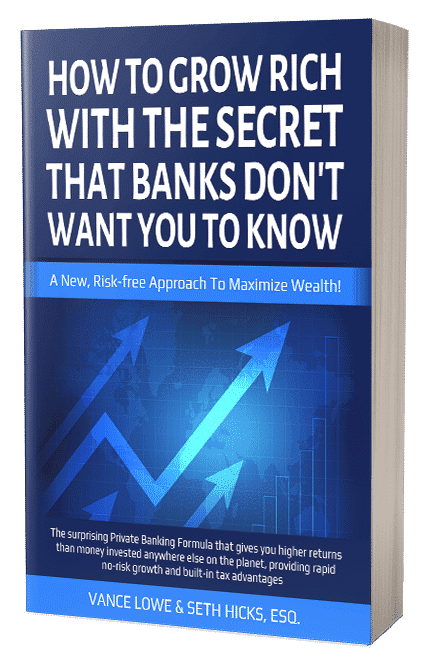
[00:26:01] Seth Hick Esq.: It’s private banking strategies.com and there you can exchange your email for a red pill book that Vance and I have written the titled What The Banks Don’t Want You to Know. And therein you are gonna discover some, some concepts and some ideas like we’re talking about here that may revolutionize your whole thinking if that resonates with you.
[00:26:22] Seth Hick Esq.: Continue to listen to the podcast, continue to. To digest some of the information that you’ll get by email and eventually if those things are, are resonating with you and making sense, we want you to set up an exploratory call with Vance and you can do that through links that we provide and emails, and that’s really our process for walking people into private banking strategies.
[00:26:48] Vance Lowe: Yeah, I just really ha enjoyed talking about it. I enjoy any time someone will listen and, uh, want to, to learn a little bit more. So I’m looking forward to [00:27:00] discussing, uh, these, uh, next few pillars.
[00:27:03] Seth Hick Esq.: Awesome. Well, thank you folks, and we’ll see you on the next episode.
[00:27:07] Outro: Did that story feel like it was about you?
[00:27:11] Outro: Do you feel you should be making more progress toward your financial goals? Do you feel stuck? Let us help you get unstuck. Are you ready to take action and get your own private bank? Please visit us at www.privatebankingstrategies.com.
[00:27:31] Outro: Thank you for listening to the Private Banking Strategies podcast.
[00:27:34] Outro: Click the subscribe button below to be notified when new episodes become available.