[00:00:00] Outro: Welcome to Private Banking Strategies Podcast with Vance Low and Seth Hicks, your secret weapon to protect your assets and never have to start over financially again. Vance and Seth help high net worth individuals, families, business owners, and investors, structure and asset protect. Tax free fortress for their families.
[00:00:21] Outro: Learn how to keep what you earn and use the velocity of money to create your own private banking system. Join us on this journey as we explore the secret strategies of the rich and political elite and help you take total control of your financial security now onto the show.
[00:00:48] Host: Hello and welcome to Private Banking Strategies with Vance Low and Seth Hicks Today. Vance is outta the office. It’s just Seth and I. Seth, what’s going on?
[00:00:55] Seth Hicks Esq.: Hey Eric, glad to be here. Man, excited about this topic, especially [00:01:00] in light of recent bank failures, and I think we’ve got some important information to bring people.
[00:01:07] Host: A lot of headlines, a lot of things going around, a lot of people getting nervous, and that just is the way it is these days. There’s always something on the news, but I don’t think lately, you know, all the stuff that they’ve been putting on the news just to do scare factor and all that jazz, it’s just kinda been not made up by any means.
[00:01:22] Host: But they kind of overplay things, but not this time. When you’re talking bank failures, that’s not overplaying anything. That’s a, that’s a really serious issue.
[00:01:32] Seth Hicks Esq.: Yeah, the, the Silicon Valley Bank failure, $209 billion. It’s a, it’s a mid-tier bank. It’s the second largest bank failure in American history with WAMU being the first in 2008.
[00:01:47] Seth Hicks Esq.: It went down with about $309 billion in assets. So it’s a big deal, and that’s why at private banking strategies, the number one pillar is asset protection, and [00:02:00] one thing we focus on is helping people keep what they make. Mm-hmm. If you earn all this and you lose it because your bank steals it from you, or because of taxes or a multitude of other reasons, what good has it done?
[00:02:14] Seth Hicks Esq.: You?
[00:02:15] Host: Yeah. Yeah. And for those that are just joining us, there are seven pillars early on in their podcasting career events, and Seth did a great job of describing the SE seven pillars. So go back and listen to some of those original podcasts. But today, I think asset protection is really the theme.
[00:02:30] Seth Hicks Esq.: Absolutely. So that’s why it’s the number one pillar of private banking strategies is you want to protect your assets, keep what you make. And we’ve been talking about this for months and years in relationship to bank bail ends and the Dodd-Frank Act. And people often think, you know the money. I put in my bank is my money and when I need it, it’ll be there.
[00:02:57] Seth Hicks Esq.: And actually that’s not the case. [00:03:00] Dodd-Frank Act, misnamed the Consumer Protection Act. It’s misnamed because it has nothing to do with consumer protection, has everything to do with bank protection effectively. I’ll summarize it in saying that the money that you put in those banks. Are effectively, it’s, it’s at risk for the bank to bail in if they become insolvent.
[00:03:24] Seth Hicks Esq.: Mm-hmm. And your bank statement is effectively an IOU. So you, you know, you think, well, there’s my money, it’s on my statement. That’s, that’s an IOU. And if the bank becomes insolvent, they have the ability through the Dodd-Frank Act to bail in on depositors money to make. The bank solvent, and in return you’ll get pennies on the dollar or you’ll get bank stock and an insolvent bank.
[00:03:48] Seth Hicks Esq.: Uh, neither one of those sound good to me. How about you? Yeah, no, I’m no bueno. Nobody wants to have a bank take their money out from underneath them [00:04:00] and after charging them with fees and negative interest rates for the past two decades, it, it’s just not the right way to do it. Let’s dig in here a little bit, Eric.
[00:04:09] Seth Hicks Esq.: We’re gonna go. To some fundamentals on why the banks are not solvent and some philosophical reasons in banking as to, uh, why that is. Now, a lot of times we have folks come to us that may be very wealthy and they think that they’re pretty sharp when it comes to money. They’ve made a lot of money. But in effect, they don’t really know how money works.
[00:04:35] Seth Hicks Esq.: They may think they do, but when you start breaking down these components and getting into the details of how banks make money and how they’re making money off of you, people aren’t aware of it. So. Effectively, you know, we try to teach people to be their own bank. Mm-hmm. And implement the same principles that banks institute only in their own [00:05:00] family economy in the banking industry.
[00:05:02] Seth Hicks Esq.: We’ve talked about this before, Eric, so you’re familiar with it, but branch banking is. Effectively a new phenomenon of American culture. Before the sixties, banking was done through life insurance policies and had been for hundreds of years, but in the seventies, branch banking became the norm. They even took it into public schools.
[00:05:26] Seth Hicks Esq.: And you may remember when you were a child, them encouraging you to open up a savings account with your local bank. Do you, did you ever have that happen to you?
[00:05:35] Host: Yeah, I, I remember when we were. When we were kids, it was, I think it was probably in fifth or sixth grade, right? The end of grade school. They had somebody come talk to us about different things.
[00:05:42] Host: ’cause we did a, like a, we ran an economy in our sixth, it was sixth grade class now that I remember. We ran our own economy for a week. We all had our own little private businesses. We had all that. And there was a, somebody that came in and talked about the importance of savings accounts and making sure you’ve got your money in a safe place and yada, yada, yada.
[00:05:57] Host: But yeah, that was in sixth grade, way back when. [00:06:00]
[00:06:00] Seth Hicks Esq.: And one of the reasons that that was brought into school systems is because they wanted people to use the branch banks, and the banks wanted control of the money. And there’s, there’s a famous quote that says, I, I don’t care who makes the laws. I, I, I wanna be the banker who, who has the money?
[00:06:20] Seth Hicks Esq.: Mm-hmm. Who effectively is above. The lawmakers, and we see that in our own society now that the bankers are effectively pulling politician strings. There’s lobbyists, there’s all sorts of financial ties and cords that dictate policy and dictate legislation and dictate laws and, and people who are in office and it’s upside down in effect.
[00:06:46] Seth Hicks Esq.: And so schools. Uh, we’re complicit in allowing the banksters, I like to call them, coming in and brainwashing kids and brainwashing Americans into thinking [00:07:00] that we have to use branch banking. But in effect, you don’t. And, and we’re, I’m gonna tell you why it’s a good idea in these next coming slides to create your own bank and get out of a system that is doing nothing for you.
[00:07:15] Host: Yeah, and for those that are listening in on this podcast, understand that you can go to the YouTube channel and you will see a presentation of this. Seth and I are just gonna talk through the slides. He is gonna explain a lot more and he’ll explain it so you can continue to listen to the podcast. Don’t turn away from this.
[00:07:29] Host: However, if you wanna see some visuals, they will be on the YouTube channel.
[00:07:34] Seth Hicks Esq.: So why do banks want control of your deposits and loans? Let’s take a look at how they function and, and why you want to be. The bank. Banks operate on what’s called the fractional reserve system. Fractional reserve banking means that when someone brings a hundred thousand dollars deposit into the bank, the bank only has to keep a fraction and we’ll call it 10%.
[00:07:58] Seth Hicks Esq.: Which is actually [00:08:00] generous. And if it’s a large bank, they don’t even have to keep 10%. They may have to only keep 5%, but for our purposes and simple math, we’ll call it 10%. So your a hundred thousand dollars deposit, they take 10,000, put it in reserve, they take the other $90,000 of your money, and they begin to loan it out in the form of home loans, car loans, business loans, and every other type of loan product that.
[00:08:28] Seth Hicks Esq.: That they have, that’s not money that they worked for. It’s not money that they earned. It’s simply money that you brought into them, probably because they’re convenient and on the corner nearby where you live, and then effectively get to make money off of you and they don’t pay you anything for that. In fact, they generally charge you fees for housing your money at their bank, right?
[00:08:50] Seth Hicks Esq.: Yeah. Back in
[00:08:50] Host: the day you used to get a toaster, but I don’t think they do that anymore.
[00:08:55] Seth Hicks Esq.: Yeah, I We’d gladly hand out. Toasters for [00:09:00] 90% of every deposit that we could go then loan on. Yeah. Right.
[00:09:03] Host: Seriously.
[00:09:04] Seth Hicks Esq.: So every bank makes, you know, money off of these deposits. And effectively that’s the way it’s been since branch banking was, was instituted.
[00:09:14] Seth Hicks Esq.: That’s called Fractional Reserve Banking. Um. It’s implicitly and inherently flawed, and it only works so long as people have confidence in the bank. And as soon as their confidence wanes and people begin to storm the bank for their deposits, all of the deposits are not there. And that’s exactly what we just saw in the Silicon Valley Bank failure.
[00:09:44] Seth Hicks Esq.: The signature bank failure in New York and the prior bank failures like IndyMac. I was actually in Southern California at that time, and there were mounted patrol and tanks in Thousand Oaks, which is a suburbian area [00:10:00] around the IndyMac Bank on Thousand Oaks Boulevard. And there were people very upset that they couldn’t get their money out.
[00:10:06] Seth Hicks Esq.: There was total lack of confidence and Indy Mac failed and people didn’t get their money out. So that’s how it plays out. Now look at this graph here called the velocity of Money and it. Represents a hundred thousand dollars deposit into a bank, and then a bank loaning a mortgage loan out at 6%. Someone selling that house.
[00:10:32] Seth Hicks Esq.: And let’s say that everybody banks at Wells Fargo and this particular map of transactions, they deposit their sales, proceed back into the bank. The bank loans out for car loans, for construction loans, and the car dealer and the construction company, all bank at Wells Fargo. Wells Fargo is getting. A massive velocity on that very first initial a hundred thousand dollars put in their bank, and it’s multiplying [00:11:00] exponentially with every time they can turn it in a loan.
[00:11:03] Seth Hicks Esq.: And so it’s critical that they have your bank deposits, and that’s why initially it was inbred into the culture. So. With every cycle of the dollar, they’re making another touch on the dollar, another, another profit on the dollar. And we effectively can take back control of that money and do the exact same thing in our own private banking system.
[00:11:28] Seth Hicks Esq.: And that’s called the velocity of money getting more touches on the same dollar than you can when you just spend a dollar and it’s gone. And that actually is much more important than an interest rate that. Is what’s been sold to people. Hey, look at this interest rate. It’s 6%, it’s 5% over 30 years, and that’s, it’s actually a fallacy.
[00:11:51] Seth Hicks Esq.: And when you can use your own money and you can pay yourself 15%, you can pay yourself 20% in your own banking transactions. If you’ve got the [00:12:00] velocity of money working in your favor, that interest rate becomes insignificant. And in fact, when you’re the banker, you want a higher interest rate. If you’re the banker, you’re.
[00:12:10] Seth Hicks Esq.: You want all of the interest compounding and growing in a tax free system, which is what the private banking system does for you.
[00:12:19] Outro: Yeah.
[00:12:25] Outro: Do you see yourself in that story? Do you feel like you are generating a lot of revenue but are not moving forward as fast as you would like? Are you ready for help? Please call private banking strategies at eight one seven two hundred. Four seven. Seven seven or visit us at www.privatebankingstrategies.com.[00:13:00]
[00:13:00] Seth Hicks Esq.: Now, here’s a slide where we talk about. Someone that would, I would fundamentally and philosophically differ from as we talked about, Eric, this is, uh, a slide that references a gentleman named Terry Burnham, who’s a former Harvard economics professor. Typically a a left leaning institution and a left leaning in thought type of philosophy.
[00:13:28] Seth Hicks Esq.: Whereas with our systems, we’re generally. Right-leaning and, but what Terry thought through and presented, and this was a number of years back, was his proposition that banks were not a safe place to store cash money because of a number of reasons. One, that he saw that the printing of money was increasing and he saw that the curve on that.
[00:13:55] Seth Hicks Esq.: Printing of money was unsustainable and that banks [00:14:00] ultimately with fractional reserve lending would become insolvent. And the next line of thought. Fallback is to the FDIC. The FDIC insures American deposits, and they insure up to $250,000 and they have a sticker on the bank glass door. When you walk in the door, Hey, you, you wanna make sure that your bank is, you know, FDIC insured.
[00:14:25] Seth Hicks Esq.: Mm-hmm. Right. I mean, is that, was that not drilled into your mind, Eric, as well?
[00:14:29] Host: Oh yeah. Oh yeah. I mean, you see it on every, every little window. It’s there.
[00:14:34] Seth Hicks Esq.: Well, the FDIC will make it all good and make it all right, but when you actually look at the numbers, and that’s what Terry did and he presented the fact at the particular time, Terry’s calculations were the end of 2017.
[00:14:51] Seth Hicks Esq.: They had 92 billion to cover 7 trillion, which was 1.30 cents of every dollar. Fast forward to the current day [00:15:00] 2022, end of 2022, last quarter, 20 trillion on deposit, 24 billion on hand to cover those, and you’ve only got a 10th of a penny, geez, to actually cover those deposits. That’s a five years, five year.
[00:15:14] Seth Hicks Esq.: That’s a five
[00:15:15] Host: year change.
[00:15:15] Seth Hicks Esq.: That’s crazy. So you’ve got an effectively, less than a 13th in five years is what has, uh, happened as far as solvency goes. So 24 billion to cover. 20 trillion less than 1.30 cents on the dollar. What are my options? I don’t, I don’t even, I don’t not aware of any options. I don’t know of any options.
[00:15:36] Seth Hicks Esq.: Well, that’s what we’re, that’s what we’re bringing to the table, and that’s what we’re trying to educate folks on, is that there are options and you’re never gonna get your money back if, if you’re bailed in on, in a large banking crisis. It’s, it’s absolutely not gonna happen.
[00:15:52] Host: Well, here, here’s the thing.
[00:15:53] Host: This is what struck me when we were talking about this last time, and now that, and you’re showing me this, it’s just, it’s all flooding back. Do you [00:16:00] remember the movie? It’s a Wonderful Life. Sure. Yeah. So George, George is the, the protagonist, right? He, he’s the main character. He works at the bank, he owns it, and there’s a crisis, right?
[00:16:10] Host: And so then there’s a run on the bank and everybody’s like, where’s my money? And he is like, well, your money’s in in Susan’s house and in Terry’s farm, and blah, blah, blah, right? All the money’s loaned out like you’re talking about. But here’s the thing. George works his hardest to scratch up some money to help people out.
[00:16:26] Host: That’s not real life. That is a movie. From this SVB bank, what we saw is everybody involved in the bank, sold their shares, took millions of dollars, knowing that the bank was going under, they immediately took as much money as they could get their grubbing hands on. And then took off, right? I mean, just said, okay, this bank isn’t gonna work out.
[00:16:48] Host: Sorry, everybody and everybody else’s money was already tied up. And movies are cute, but reality is people are greedy. And I, I’m sorry. The whole thing with the, that bank failure. [00:17:00] Angers me beyond belief because nobody was trying to help out the people that were members of the bank, they were helping each other out.
[00:17:07] Host: And their richest members who of course would scratch their back later making sure that they all got their money out and let everybody else just fly in the wind. I.
[00:17:15] Seth Hicks Esq.: Absolutely. I mean, you, we know that from larger institutional depositors, they were making moves before the bank was placed in receivership.
[00:17:27] Seth Hicks Esq.: Yeah. So they’re getting private phone calls, they understand what’s going on. They’ve got their finger on the pulse. But the little guy who’s just is unaware and working his, his, his regular routines day in and out, he, he’s oblivious to that and he’s the one that gets. Burned. She’s the one that gets mm-hmm.
[00:17:46] Seth Hicks Esq.: Taken to task and is totally, you know, burned out of that. Yeah. And so we’re talking to the little people. We’re talking to the people who, who you know have, um. Something to lose. I read an article [00:18:00] about this Israeli hedge fund group, and they were like almost incredulous that people weren’t more aware that Silicon Valley Bank was going down and they’d pulled hundreds of millions of dollars out of this bank.
[00:18:14] Seth Hicks Esq.: Well before this ever. Mm-hmm. Came to fruition and they were diversifying those funds with other relationships they had and, and, uh, making sure that they didn’t lose their investors’ money. And so this is a way that you can take the banking equation back in your life. The small guy, the mom and pop, the regular red-blooded American can take the banking equation back and shore up their assets, their cash deposits, and make sure that they’re actually asset protected.
[00:18:44] Host: Yeah. And, and, and you said it great with the individual, the normal red blooded American, the one that keeps spinning in my head because maybe ’cause I’m in the situation is a small business owner. Now, I don’t have any employees. I am my own business. I am my own employee. But there were small [00:19:00] businesses that had accounts there that.
[00:19:03] Host: That their money was, the amount of money they had in there was over what was quote unquote insured by the FDIC. Those small businesses are now gonna suffer, and the employees of those small businesses could suffer or get laid off because they don’t have the funds. So it’s, I’m thinking mainly about business owners in this situation, that it’s just not safe.
[00:19:20] Seth Hicks Esq.: Yeah, there’s a massive trickle down effect and there’s commentary right now with experts analyzing what the ripple effect of just these couple of banks in the past weeks, what it could be. And you’ve got, like you said, I mean the ripple effect rolls down into Yeah. Uh, employees. It wor rolls down into, into pensions.
[00:19:40] Seth Hicks Esq.: It rolls down into things that people think are secure. And they’re not, and there, there is a better way to bank, there is a better way to take yourself out of fractionalized banking. And effectively, this is the philosophical. Opposites between [00:20:00] Kinsey and economics and Austrian economics. And it’s why throughout history, fractional lending is always going to lead to bank failure.
[00:20:09] Seth Hicks Esq.: It’s the main cause for inflation and creating money just out of thin air is, is unsustainable. Yeah. It’s always gonna be unsustainable. There’s no way that you can print your money, print your way out of crisis, and you could print more money and spend more money. That’s been the philosophy for quite a while now.
[00:20:31] Seth Hicks Esq.: Spend more money, print more money. The. The national debt’s, 31.5 trillion in counting, and it, it, I mean, over 10 trillion of that’s happened in, in like a parabolic hockey stick increase in the past decade and a half. And you go, wow. You know, how is that possible? Well, I saw a carton of eggs, 12 eggs that they wanted $9 for.
[00:20:57] Host: Oh, good Lord.
[00:20:59] Seth Hicks Esq.: Yeah. [00:21:00] $9 for 12 x Wow. Or, you know, gasoline in California, uh, hitting tops at $6. That those are related events when those prices begin to peak out. And that’s why we think this is so critical that people actually start thinking about how to protect themselves. How. To implement better strategies and private banking is, is one of the best ways to be able to accomplish that.
[00:21:29] Seth Hicks Esq.: And so that’s why we’re talking about asset protection, Eric, today, and it, you know, bears mentioning, we’ve say, say this all the time, but for folks that haven’t heard us talk before, this all happens in a tax free environment when you set your own. Private bank up in, in a carefully structured contract.
[00:21:47] Seth Hicks Esq.: It’s a tax free economy. Your money that grows and compounds year after year tax free. Your benefits and death benefits from these life insurance policies come off tax free. [00:22:00] Uh, you can take retirement distributions tax free, and that’s unlike other government sponsored programs. And you’ve got no. Tie to the traditional banking system or the, the shifting sand of insolvency it’s built on.
[00:22:15] Host: Yeah. Yeah,
[00:22:16] Seth Hicks Esq.: absolutely.
[00:22:18] Host: Alright, anything else we’re covering in today’s?
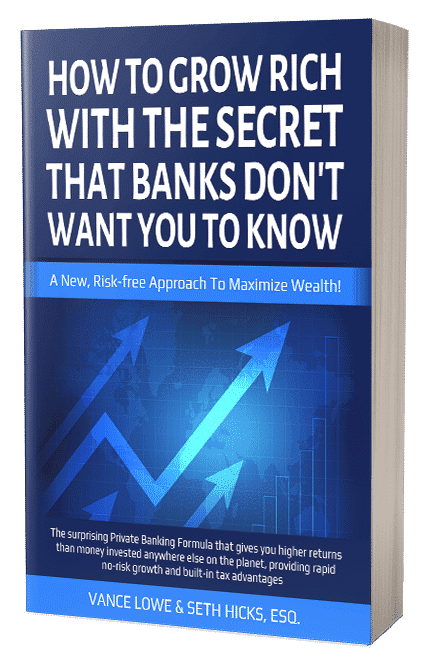
[00:22:21] Seth Hicks Esq.: Yeah, let’s just, uh, well folks, if you wanna learn more about this, you can find us@privatebankingstrategies.com. That’s private banking strategies.com. And there we’ve got a free book offer that should. Pop up for you. And it’s a book that’s called What the Banks Don’t Want You to Know.
[00:22:39] Seth Hicks Esq.: And effectively we shine light on a lot of dark areas like the ones we’re discussing here. And then the book is written with the prospective analysis. And now we’re looking in the rear view mirror saying that some of the things we said in the book have occurred. Now with the bank failures. Mm-hmm. And bail ends.
[00:22:58] Seth Hicks Esq.: And so I would encourage you [00:23:00] to download that book. You can read it or you can listen to it. And from there you can also dive off into hours and hours of podcast content that’s organized on subject matter and seven pillars. And. Various ways. And if those things resonate with you, schedule a call, uh, with my partner Vance, where he walks you through exactly how this can work for you and your family and ultimately lays out an eight year roadmap for you.
[00:23:26] Host: Yeah, that’s fantastic. And for the listener, I know that Seth and I are gonna be covering another podcast after this one, and it ties together. So if you’re interested in how this strategy and the things that he spoke about today are affected by real estate, how you can, uh, get into real estate. And use this strategy to, to help grow your assets.
[00:23:45] Host: That’s gonna be on the next podcast, so I just wanted to tease that out there. Seth, great job today. Thank you so much.
[00:23:50] Seth Hicks Esq.: Thanks, Eric. Appreciate it.
[00:23:52] Host: You bet. And our last thank you, of course, is to you listening audience, thank you so much for tuning in and listening to the Private Banking Strategies Podcast with Seth X.
[00:23:58] Host: If you have not subscribed to the [00:24:00] podcast yet, please click the subscribe now button below this way. When answered, Seth, come out with a new podcast. It’ll show up directly on your listening device. We humbly ask that you share this podcast, write it, and leave a review as this actually helps others find the show.
[00:24:12] Host: Again, thank you so much for listening today. For everyone at Private Banking Strategies, this is Eric Johnson reminding you to live your best day every day. And we’ll see you next time.
[00:24:27] Outro: Did that story feel like it was about you? Do you feel you should be making more progress toward your financial goals? Do you feel stuck? Let us help you get unstuck. Are you ready to take action and get your own private bank? Please call private banking strategies at (817) 200-4777 or visit us at www.privatebankingstrategies.com.
[00:24:58] Outro: Thank you for listening to the [00:25:00] Private Banking Strategies podcast. Click the subscribe button below to be notified when new episodes become available. The information covered in posted represents the views and opinions of the guest and does not necessarily represent the views or opinions of private banking strategies.
[00:25:14] Outro: The content has been made available for informational and educational purposes only. The content is not intended to be a substitute for professional investing advice. Always seek the advice of your financial advisor or other qualified financial service provider with any questions you may have regarding your investment plan.