[00:00:00] Intro: Welcome to Private Banking Strategies Podcast with Vance Lowe and Seth Hicks, your secret weapon to protect your assets and never have to start over financially again. Vance and Seth help high net worth individuals, families, business owners, and investors structure and asset protected fortress for their families.
[00:00:21] Intro: Learn how to keep what you earn and use the velocity of money. To create your own private banking system. Join us on this journey as we explore the secret strategies of the rich and political elite and help you take total control of your financial security now onto the show.
[00:00:38] Seth Hicks Esq.: Hello and welcome to Private Banking Strategies Podcast with Vance Lowe and Seth Hicks.
[00:00:42] Seth Hicks Esq.: Vance. How are you?
[00:00:43] Vance Lowe: I’m doing well. I think we’ve got something for our audience today and I’m really anxious to get into it.
[00:00:50] Seth Hicks Esq.: Yeah, me too. We’ve been talking for a number of episodes about the family bank and how to create a family bank that. Sustains [00:01:00] every other type of economic collapse, every other type of financial failures.
[00:01:05] Seth Hicks Esq.: How do you create a hundred year family bank? We’ve been talking about that and today we’re gonna dig down further into the history and the science of the family bank and why there is no better method to preserve and grow your wealth.
[00:01:19] Vance Lowe: Yeah. So maybe we begin with kind of the structure. Maybe a little bit of foundation here.
[00:01:25] Vance Lowe: Our country became extremely strong. We came from nothing to the most powerful nation on the planet, and we were lucky enough, I guess, in the beginning to know how to survive. And that was taught on a family basis and then in the schools all the way up through as high a education as you could get. And all this was accomplished before banks really entered in, into being, actually.
[00:01:53] Vance Lowe: So let’s talk about maybe the first thing that had to be put together in [00:02:00] order to provide the banking equation, so to speak. I think the first insurance carrier that came in was Lloyd’s of London. They may have a claim to be as old as the world, I don’t know, but that’s the first organized insurance carrier.
[00:02:15] Vance Lowe: They mainly did for shipment and boats and things like that. But anyway, let’s talk about the early participating mutual whole life insurance company. Seth, why? What is that structure and why is that important?
[00:02:29] Seth Hicks Esq.: Well, you kind of touched on it. It’s actually an ancient structure For centuries and centuries before centralized banking was ever conceptualized, and the life insurance products have been the most stable financial institution in the world for centuries.
[00:02:45] Seth Hicks Esq.: So the mutual companies, you actually, you’re an owner, you have an ownership interest, and so there’s dividends paid to owners, and those owners are treated differently than if you were a stockholder. If [00:03:00] you were, you know, a shareholder so to speak, that has little or no. Voice. I think that the mutual life insurance companies have created that niche there that is unsurpassed in every other financial tool.
[00:03:14] Seth Hicks Esq.: And you go, what about the Civil War? That was the banking methodology at that time and error. You had life insurance contract, but they didn’t fail. Life insurance companies didn’t implode during the Civil War. They maintained course, but what about the Great Depression? Same thing, so I’ll let you comment on that.
[00:03:32] Seth Hicks Esq.: But I mean, we’re talking about the stability during any type of economic downturn or recession, how that allows you to have security and safety and long-term planning and distributions. You’ve got a guaranteed contract growth with your mutual life insurance companies that we use. And so those are just a number of the features and the benefits.
[00:03:55] Seth Hicks Esq.: I mean, but I’ll let you comment on what I said.
[00:03:58] Vance Lowe: I can envision at the [00:04:00] beginning is that the startup of these companies, a group of citizens, so to speak, some had a little bit of money, but others, you know, they had the need banded together and form these co-ops. I think they were co-ops in the beginning.
[00:04:15] Vance Lowe: And formed these mutual companies for the benefit of each other. And then once the company and the structure was formed, they would go out and share that with their families and friends and all wanted to be part of it. They wanted the structure to be pure. Very efficient and very profitable. Now, over the years, you know, that profitability we could say kind of gets eroded a little bit, you know, because of just the modern day era.
[00:04:45] Vance Lowe: But like Seth, you said these were put together in such a safe structure that they could withstand anything. At least they thought they could. And so far to date. They have all the economic [00:05:00] downturns that the world has thrown and all the bank failures and the depressions and failures of of large corporations has not affected these mutual companies.
[00:05:10] Vance Lowe: The benefits that you’re touching on, the stability, the long-term planning folks, what we need to understand is that when we enter a contract here, we can know exactly minimum. What we’re gonna have 5, 10, 15, 20 years from now in those accounts. As far as the growth buildup, in addition, what we call the dividends or the profits of the insurance company, if it runs efficient enough, then there are profits to be had, and that is shared among all the policy holders.
[00:05:43] Vance Lowe: And that is something that goes directly into their accounts on a what’s called yield. Basis, that can never be reversed. All credited money into these accounts can never be reversed. And that’s the total opposite of other type [00:06:00] of investing. The stock market, mutual funds, anything like that, they all do things on, and we’ve described this in earlier podcasts, on average rate of return.
[00:06:11] Vance Lowe: Though the math is correct, the amount of money that people receive is nowhere close to that. So that’s the structure. And that structure has proven itself over and over again. And I think that’s why we fast forward today. We’ve got the banks out there, everything else, there’s a lot of reasons. To get this back into people’s lives, to understand how these contracts work.
[00:06:36] Vance Lowe: Because if they’ll take a good look and they understand things, then they’ll use this as one of their choices. Everybody considers banks as the epitome of money management and the understanding of how to grow money. Well, our banks use these. These are the very contracts. So let’s talk about maybe life insurance [00:07:00] as a good asset class.
[00:07:02] Vance Lowe: Let’s kind of get into that a little bit.
[00:07:04] Seth Hicks Esq.: Yeah, I think it’s like we talked about, it’s one of the oldest financial tools in the modern world and it, you know, we’re not solving necessarily for the death benefit. We’ve got something that. Evolved into a much more powerful tool. It acts as a store of capital and you’re actually able to earn.
[00:07:26] Seth Hicks Esq.: Six to 7% currently year over year compounding. So it far outperforms storing your money in centralized banks for that reason alone. But there are numerous other reasons why centralized banks aren’t a safe place to store a large cash value, which we talk about consistently, but their life insurance contracts, in addition to being a savings vehicle, it acts as a capital reservoir.
[00:07:53] Seth Hicks Esq.: That’s protected by most states. Many states, legislative governance of life insurance [00:08:00] contract. It’s a state regulated issue, not federally. And so each state has its own law on life insurance contracts, and many especially southern states have laws on the books where your life insurance contract, cash values, distributions, are completely protected by law.
[00:08:19] Seth Hicks Esq.: Then we talked about how it compounds. And if you don’t know how the value of compounding growth, tell ’em the story about a penny compounded. We talk about that, but it bears quick repetition. Vance what? A penny compounded over 30 days.
[00:08:33] Vance Lowe: Einstein said the eighth wonder of the world was compounding. And you have to keep it in play and you have to keep it working for you.
[00:08:43] Vance Lowe: And this is where people go wrong. When it comes to compounding, if they’re not in control, the compounding doesn’t work in their benefit. It works in someone else’s. Uh, they get the crumbs and those crumbs can compound, but they never do get to see the real results. [00:09:00]
[00:09:00] Midroll: Did that story feel like it was about you?
[00:09:03] Midroll: Do you feel like you are generating a lot of revenue but are not moving forward as fast as you would like? Do you feel you should be making more progress toward your financial goals? Do you feel stuck? Let us help you get unstuck. Are you ready to take action and get your own private bank? Please visit us at www.privatebankingstrategies.com.
[00:09:30] Vance Lowe: So if I go back to the structure, once we set the structure up correctly, and again, we can point back to a podcast. It becomes the perfect investment. It creates so many avenues for a person to be able to accumulate, compound or whatever they need. This becomes literally the in-depth and epitome of investing because of what it provides with absolutely no [00:10:00] risk.
[00:10:00] Vance Lowe: The only possible risk to this contract is you, lemme give you some examples here of what maybe this thing can do. Just on a layman’s term, functionality of a of a family. It’s a great place to save money because it’s liquid. Once you get it going, you have access to that money pretty much anytime you want.
[00:10:21] Vance Lowe: We usually suggest a little bit of structure there ’cause they aren’t quite like the way banks are, but it’s your. That the cash value portion of it. We design banking contracts to develop the most cash possible. We want to get ’em over a hundred percent efficiency, which means producing more than what you put in every year.
[00:10:45] Vance Lowe: As soon as possible. So we got the savings vehicle, we can set up our own lending, uh, structure. Usually cars, education, whatever’s needed. We have these accounts. You can drain the [00:11:00] account or you can borrow it and pay yourself back just like a normal structure. If you do that, everything grows and compounds.
[00:11:08] Vance Lowe: If you save up and spend, you’re no better off than you always have been. Because once you take money out and you spend it, you lose control of that money. These vehicles let you use money and put it back and use it over and over again and collect compounding interest. There’s all kinds of benefits in here.
[00:11:26] Vance Lowe: Once when there’s enough money working for you, there can be a wonderful lifestyle change later on where the dividends, the earnings, are producing the income you need at an older stage in life. Than any other type of government ERISA program. Which are controlled by government. So these are private and independent.
[00:11:49] Vance Lowe: They’re liquid. They’re the one of the biggest advantages of this type of structure. They’re not reported to the IRM. There’s no tax disadvantage. They’re [00:12:00] all tax advantage because if you do things right, not only having the other advantage. I’ve just explained is that there’s totally tax advantage for you and continue to tax on, and here’s something, you know, it’ll, it’ll pass on to errors when you’re done with it if you do it right.
[00:12:17] Vance Lowe: I think
[00:12:17] Seth Hicks Esq.: the tax, the tax carve out is pursuant to internal revenue code 77 0 2, which makes your distributions tax free and mm-hmm. So that, that’s by the, like you said, if it’s structured properly and we don’t make the policy, the modified endowment contract is in some situations. Okay. But we will usually wanna stay within that.
[00:12:39] Seth Hicks Esq.: Tax free economy. So let me ask you this. Why would you put your money in a typical like large bank or even maybe, you know, regular bank that’s in your city that’s governed by FDIC insurance rules and they promise to have your cash there when you want [00:13:00] it, and it’s convenient and it hasn’t failed yet. At least not the Wells Fargo or Bank of America.
[00:13:07] Seth Hicks Esq.: Why shouldn’t I keep my money there instead of a life insurance contract? What’s the reason?
[00:13:13] Vance Lowe: You know, I’ve kind of dedicated my remaining time to help educate the people I care about of what money really is and how it works. You owe it to yourselves to learn. Folks, you can’t rely on what government is saying or the banks are saying, or anyone else is actually saying, and take that as face value.
[00:13:35] Vance Lowe: You have to understand how money works, how it grows, how to preserve it, because if you don’t, you are subject to someone who does. You pass that independence to bondage in essence. Because you don’t understand the workings of money, and I think we could all take this test on what I’m [00:14:00] talking about if we have to go to work to earn a dollar, usually that spread between what your efforts are in producing money for your company.
[00:14:11] Vance Lowe: It can be anywhere from five to 50 to one. You’re getting the one, the corporation and everybody in between can get up to 25. So every dollar you get by the time you get through paying Uncle Sam and everything else. So we have to work hard. We have to spend our time, our close, our talent, the wear and tear a lot of times on our equipment to be able to bring home a paycheck.
[00:14:36] Vance Lowe: So what do we do with that? If we don’t understand how money works, we spend it and it forces us to go back to work and do the whole thing over again, over and over and over again. There’s a few simple things that a lot of you probably know about. But you’ve decided not to do because your friends aren’t doing it.
[00:14:58] Vance Lowe: No one else is doing it. Your [00:15:00] mentors aren’t doing it, and they all think they know something about how money works, but we really don’t and we become actual slaves to the system and we don’t even know that. How would you like to have some more independence if you can learn some of these simple things that we teach?
[00:15:17] Vance Lowe: Every single month, you’re gonna be better off. You’re gonna put more money to work, producing money for you every month. So what we’re trying to put in here, and what we’re trying to do a deep dive on and actually describe for everybody is how important this structure is. Then I believe that this is a, a structure that’s just, I’m gonna call it divine, because it, it works.
[00:15:42] Vance Lowe: So well learn it. Capitalize on it. One of the best structures, if you don’t believe what we’re saying, find out where the banks put their money. Seth, tell us about that.
[00:15:54] Seth Hicks Esq.: Yeah, the, I mean, we’ve talked about this, that the large top tier banks have [00:16:00] a healthy portfolio of life insurance contracts on employees.
[00:16:05] Seth Hicks Esq.: They generally use it as an incentive and they will give the employee a certain benefit, a certain death benefit, but they also have, uh, use of the cash, they have the accumulation, the compounding growth, the tax-free economy, and so they bank a lot of those annual. Dollars 20 billion a year with the top tier banks in life insurance premiums.
[00:16:29] Seth Hicks Esq.: And they disclose those things in their financial disclosures on an annual basis. So you can look those details up. That’s a great, it’s a great tool and a roadmap. But the rest of the banking, and kind of answer my own question, one of the reasons we don’t believe that keeping large stores of cash value of centralized banks is because of derivative lending.
[00:16:50] Seth Hicks Esq.: And every dollar that we take in 90 cents is. Taken out the backdoor and lent and they don’t share those profits with us when we’re their capital partner. We’re giving them [00:17:00] capital to go loan and they don’t make us a capital partner. They actually charge us fees and give us hassles. And you know, it’s just ridiculous where the life insurance companies, your money’s gonna grow and compound year after year.
[00:17:12] Seth Hicks Esq.: And what I wanna talk about in our next episode, Vance, is the predictability of compounding growth. And how those who don’t earn it, pay it. That’s a great tool for us to learn and understand. But I think we’ll wrap this episode up here and lay a teaser for next week’s episode regarding how-tos of compounding growth.
[00:17:33] Vance Lowe: Let’s do that because I’m hoping we’re wetting your appetite just a little bit. We want to get into this a little bit deeper. Each time we do one of these podcasts, we try to take a little bit different angle so people can hear it a little bit different way so that some lights will click for you. What we have is gold.
[00:17:53] Vance Lowe: What we have is a in-depth desire. To help everybody be better off and [00:18:00] just ending with what Seth said, those who understand compounded growth make it and those who don’t pay it, which are you?
[00:18:09] Seth Hicks Esq.: That’s right. Folks. If this content’s resonating with you, hit our website. It’s private banking strategies.com.
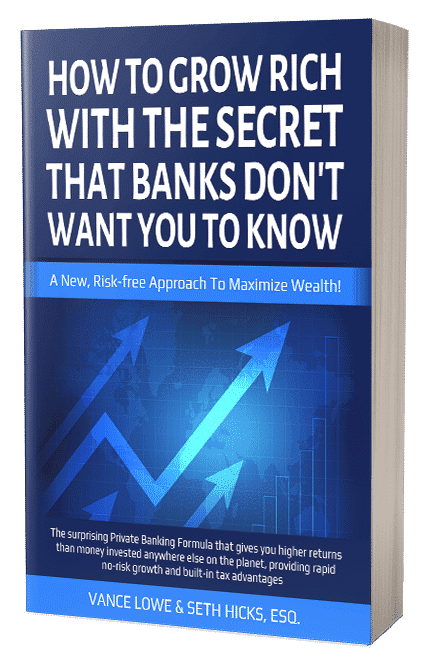
[00:18:16] Seth Hicks Esq.: There you’ll find a free gift invitation. It’s a book that Vance and I authored that tell you. Secrets about bank strategies. We give you roadmaps within that book that will lead you to a conclusion of how to implement financial freedom. So put in your email, your name, and in return for that we’ll give you a PDF version of this book or an audio version you can listen to on the go.
[00:18:41] Seth Hicks Esq.: But more importantly, we’re gonna send you an email once a week that that announces our podcast and gives you a link to Vance’s calendar. And that’s the only place you’re gonna find it. So if you would like to learn more about private banking strategies, how to create a hundred year family bank, how to capture [00:19:00] compounding growth, rather than pay it, then go to our website and follow those steps, folks.
[00:19:05] Seth Hicks Esq.: Until next time, we’ll see you.
[00:19:07] Vance Lowe: We’ll see you. Thank you very much.
[00:19:09] Outro: Did that story feel like it was about you? Do you feel you should be making more progress toward your financial goals? Do you feel stuck? Let us help you get unstuck. Are you ready to take action and get your own private bank? Please visit us at www.privatebankingstrategies.com.
[00:19:33] Outro: Thank you for listening to the Private Banking Strategies Podcast. Click the subscribe button below to be notified when new episodes become available.