[00:00:00] Intro: Welcome to Private Banking Strategies Podcast with Vance Lowe and Seth Hicks, your secret weapon to protect your assets and never have to start over financially again. Vance and Seth help high net worth individuals, families, business owners, and investors structure and asset protected fortress for their families.
[00:00:21] Intro: Learn how to keep what you earn and use the velocity of money. To create your own private banking system. Join us on this journey as we explore the secret strategies of the rich and political elite and help you take total control of your financial security. Now onto the show.
[00:00:37] Seth Hicks Esq.: Hello and welcome to Private Banking Strategy, Vance Lowe and Seth Hicks.
[00:00:41] Seth Hicks Esq.: Vance, how are you?
[00:00:42] Vance Lowe: I’m doing great. I’m looking forward to. Continuing our last discussion, so I hoping that uh, everybody that’s tuned in for us today will be sure and listen to the last one we just did.
[00:00:55] Seth Hicks Esq.: Yeah, we’ve been talking about the private family bank. And [00:01:00] also known as a hundred year family bank.
[00:01:02] Seth Hicks Esq.: And we’ve been describing some of the architecture of this, some of the policy decisions and motivations behind it. And we’ve been talking about it for a few weeks now and it’s well worth the, the discussion and it bears. Emphasis and repetition because this is how we’ve seen the most successful families operate and grow their wealth curve, and we talked about it last time.
[00:01:28] Seth Hicks Esq.: I mean wealth without structure, it dissolves, but wealth with the purpose and with the proper strategies and put into a set of rules with shared purpose in a family and rules of governance. Those are the folks that create. Floors for the next generation to elevate upon, and that’s how you really build a family legacy.
[00:01:51] Seth Hicks Esq.: And Vance, I’ve, I’ve been in times where I’ve had very little money and, uh, not had the resources to even do [00:02:00] minimal things in life. And then I’ve had times where I’ve had an abundance and it’s much easier to operate with an abundance. With wisdom and abundance, and it doesn’t mean that you’re gonna never have challenges or trials in life, but, uh, working from a place of abundance and set financial strategy with our methodology is a hundred times superior to being poor
[00:02:24] Vance Lowe: and
[00:02:24] Seth Hicks Esq.: lacking.
[00:02:25] Vance Lowe: You know that’s so true. And I found human character does just the opposite When they’re in abundance. Yeah. They follow systems and it seems like it just compounds one success after another. But if they get struck down, they stop following basic principles when they should be fine tuning those principles and.
[00:02:48] Vance Lowe: Adhering to them more directly. For instance, no matter what, there are some basic rules and procedures that we all need to follow to be successful. So [00:03:00] all this a hundred year plan, you know, some of us are just starting out, some of us have been doing this for y you know, a couple of decades. But no matter where we are, we all follow the basic principles that we first start with and we just add upon them.
[00:03:15] Vance Lowe: We’re gonna mention an offer, a book that we have, but I’m going to go into that book and say there is a principle to be taught in there, and that’s the rule. We showed an example of compounding a penny over 30 times and the results that happen over those 30 times. There’s no big deal about that until we get to about compounding number 25 and on.
[00:03:39] Vance Lowe: There’s so much that we can learn from just that example. I hope people don’t just, oh, well that’s interesting. That’s huge. And walk on. No, this is your life. How often have you set things up to compound? This is where we’re at, folks. This is what we’re talking about. If we take $1. [00:04:00] And we’re able to put it to work for us and have it produce a volume of return, a repayment structure, or whatever.
[00:04:06] Vance Lowe: We now have money working for us. So there are rules where we pay ourself. We have to go to work, we have to live, but we have to live within our means and we have to put money to work. So all of these are rules and strategies and procedures that we need to follow. How many times, depending on where we are in life, I found out about this strategy late in life in my early fifties.
[00:04:36] Vance Lowe: Where was this When I was young and really getting into money management that in my late twenties, how many doublings could I possibly have? What people don’t understand in this strategy process is that find out how fast you can double something on your own, not having somebody else double it for you, and then see how many doublings you have.
[00:04:59] Vance Lowe: [00:05:00] So Seth, which doubling, is it the first doubling that’s the most important, or is the last doubling that’s the most important?
[00:05:07] Seth Hicks Esq.: It’s the last doubling, of course. Yeah. Like you said, years 25 and on are basically straight up. So
[00:05:15] Vance Lowe: what I’m saying here folks, is if we miss the first doubling, if we procrastinate the full time of a first doubling, we end up losing that last one We could have had, it seems to be the norm.
[00:05:27] Vance Lowe: We’re gonna lose that last doubling, which is 50%. Of everything at that point. So you know, that’s just what we’re, this a hundred year plan are all based on little things that E are easy to accomplish. We just need to put ’em all together.
[00:05:44] Seth Hicks Esq.: Right. Yeah. Some of the principles that we’re talking about folks is that money must flow idle dollars.
[00:05:53] Seth Hicks Esq.: Lose value, and we go into this in great detail with why you don’t store cash value [00:06:00] in centralized banks. Next idea, on top of money’s gotta flow is that that same capital’s gotta be safe, it’s gotta be liquid, it’s gotta be protected. And for, as I mentioned. Centralized banks are not safe and they’re not protected.
[00:06:16] Seth Hicks Esq.: And if you do some research on the Dodd-Frank deck, which is all on our website,
[00:06:21] Vance Lowe: let me, yeah, let me jump in here. Like I said, we think we know something about money when we really don’t. You need to know the difference between average rate of return and yield. Folks, we’ve gotta understand putting money to work versus putting money to sleep.
[00:06:38] Vance Lowe: If I invest in a 401k, am I putting my money to work for me? If I invest in a stock portfolio, am I putting my money to work for me? Find out. Because the answer to both of those is no. You’ve just put it to sleep for you. The people who have your money now, they’re the ones that are putting it to work for them.
[00:06:59] Seth Hicks Esq.: That’s right. And [00:07:00] so keeping control of the asset in a protected and safe liquid way is why we use the whole life insurance contract properly structured because. In that reservoir, it has performed for centuries through every economic downturn, through the Civil War, through the Great Depression, through the 2008 mortgage reset, and will likely overcome every financial crisis because it’s been an existence.
[00:07:32] Seth Hicks Esq.: Far longer than banks, and that’s one of the reasons is because they have a dollar to dollar cash reserve. They don’t get to play funny money games where someone brings in a dollar to a Wells Fargo or Bank of America and they somehow take a dime and put it in the account for that person and they take the other 90 cents and they lend it out times millions.
[00:07:53] Seth Hicks Esq.: So they didn’t earn that money. They just had use of the money. And if everybody goes in for their money at the [00:08:00] same time, that’s called the bank run. It’s not there. And so, so long as everybody keeps playing the charade, it works. Whereas life insurance companies on the other hand, and quite contrary to that poor fiscal management, they have to have a dollar on hand for every dollar that they’re given.
[00:08:16] Seth Hicks Esq.: So great distinction there.
[00:08:17] Vance Lowe: And so learning the basic rules set up your rules of how money flows, that it always needs to move. ’cause money has no value except in the exchange. I remember as a little kid, grandparents, and uh, there were people who would store money in shoe boxes under their bed thinking that was the best thing.
[00:08:39] Vance Lowe: Maybe way back then that would be the case. But today, the way our system, our society, our lifestyle works is money has to move continually. You know, I don’t know if people really understand this or not, but banks won’t even sit. In the bank overnight. It’s called overnight lending. It moves [00:09:00] forward with the sun all around the world, 24 7, 365 days a year, every day.
[00:09:07] Vance Lowe: Money moves because there’s no value if it just sits.
[00:09:11] Seth Hicks Esq.: That’s right. Another thing that we build a foundation upon is the principle that the one who possesses the gold makes the rules. Or another way to say that is the entity who makes the loans. Controls the wealth. He who has the gold makes the rules.
[00:09:29] Seth Hicks Esq.: And so when people go into, and I’m not picking on Wells Fargo or Bank of America, I’m just using them because everybody knows those centralized banks. You go in there and you ask for a home loan mortgage, or perhaps an auto loan or business loan. And they set the terms and usually they’re quite willing to loan you money when you really don’t need it when you’ve got 800 credit and lots of cash flush and don’t really even need that money from a financial standpoint.
[00:09:57] Seth Hicks Esq.: And they set the terms, they set the interest rate, they [00:10:00] set how long it will be, and then they play funny money math with how much interest you have to pay back on top of the principle. Just look at your disclosures, folks on homes that you own truth, and you’ll see that you borrowed. $300,000 to buy a $360,000 house.
[00:10:16] Seth Hicks Esq.: By the time you’re done paying it back, it’s gonna be a million dollars to the bank. That’s funny. Money math at 5% interest, you borrowed 300,000 at 5%, but you gotta pay back a million. Doesn’t make sense. And so in some countries, that type of mortgage loan structure is actually illegal. And regardless, I mean, I’m just trying to shine some light on the fact that centralized banks are not where you want to bank.
[00:10:39] Seth Hicks Esq.: You want to have. A capitalized family bank through your whole life insurance companies that creates liquidity and access without centralized bank regulations.
[00:10:52] Midroll: Did that story feel like it was about you? Do you feel like you are generating a lot of revenue better, not [00:11:00] moving forward as fast as you would like?
[00:11:02] Midroll: Do you feel you should be making more progress toward your financial goals? Do you feel stuck? Let us help you get unstuck. Are you ready to take action and get your own private bank? Please visit us at www.privatebankingstrategies.com
[00:11:23] Vance Lowe: if we can control the banking equation, and that’s what it’s all about.
[00:11:27] Vance Lowe: Magic happens and I guess you could call it magic if you don’t understand money, but putting the banking equation back in the family, back in your life like we used to do it is where everything happens. So all the rules are set up, we follow correct principles. Um, we finance, everybody has to finance, but we have to pay back our money.
[00:11:49] Vance Lowe: That’s the difference. If we save up cash folks and you go purchase a car and you pay cash for that car, you know you’re following your mentors, your parents’ rules, you [00:12:00] know, pay cash for everything, and that car costs $50,000. You just took $50,000 out of production for the rest of your life. How many times could we get that $50,000 to double.
[00:12:13] Vance Lowe: And unless you pay that back with interest, you’re still gonna have to come up with savings. Remember Seth, I, I catch people up all the time and guys are, you know, we’ll have fun doing this. I ask people, do you have a car payment? And they go, no, I got my car paid off. And I kind of smile at ’em and say. I don’t really call ’em liars, but is that car wearing out?
[00:12:35] Vance Lowe: Well, yeah. Is it held its value from when you purchase it? No. So eventually it’s gonna wear out and you’re gonna have to buy a new car, right? So you’re gonna have to save up if you’re gonna pay cash again to purchase the next car, correct? Yeah. You have car payments. So don’t kid yourself, don’t tell anybody that you don’t have car payments or anything that you know is wearing [00:13:00] out that has to be replaced.
[00:13:02] Vance Lowe: The fault comes from not preparing for that, not using the money, getting it back with interest, which will stay paced with inflation so that as prices go up, taxes and everything else goes up. You’re able to stay paced with that inside of a family bank. Your family qualifies. You don’t have to go through all the rigmarole and the disclosure of private financial things.
[00:13:28] Vance Lowe: Your tax returns, which are supposed to be private to institutions who just lose them. I can’t tell you how many times when I’ve shut a loan down and I said, okay, I’ve sent you my tax returns and want ’em back. Can’t get ’em back. That’s private information, so just. These are all things that basic understanding of how money works.
[00:13:49] Vance Lowe: Where’s the risk in a family bank? It’s whether we make the payment back or not. What’s the risk? If we pay Honda Finance and we lose our job, we could lose the car. [00:14:00] We could lose our credit in a family bank if we lose our job. And it’s not our fault. The family bank’s gonna work with us. We can refinance the loan, we can do whatever.
[00:14:11] Vance Lowe: They’re probably not gonna stop it, but they’ll help that family member get back on their feet and get the loans paid for everything you know. Is going to be returned. All the profits, all the compounded interest, all of that comes back into the family bank. So there’s just all these procedures that we can do in a hundred year Legacy that just to me, I, I’m the guy that gets to help teach this to families and they just smile and their eyes open up and it makes sense.
[00:14:41] Vance Lowe: It’s logical. There’s no gap of imagination that we have to come up with to. Set up a plan and follow it.
[00:14:50] Seth Hicks Esq.: The principles that you’re describing, these are principles that banks understand and operate under. Like we’ve described and we’ve talked about many, [00:15:00] many times, corporations understand them with corporate owned insurance policies on employees, which obviously we’ve talked about many times as well.
[00:15:10] Seth Hicks Esq.: The banks are the biggest buyers of life insurance on key employees to the tune of 20 billion. Give or take a few billion a year for Wells Fargo and Bank of America. So that’s quite staggering and the way those work is, we will just go on a quick rabbit trail is like if you’re a corporation and you take out life insurance policies on your employees, you can provide them with performance based incentives, vesting incentives, and provide for catastrophic events for family members in the event that that employee dies.
[00:15:42] Seth Hicks Esq.: So there’s just a lot of win-win application to it. But the point is that I’m trying to make is that the banks understand these principles. Corporations understand these principles. The ultra wealthy and the wealthy understand these principles. We’re making it available to even common men, those people who [00:16:00] are consumed in debt.
[00:16:01] Seth Hicks Esq.: We’re trying to teach folks how to take control of the financial equation, how to get your feet on top of the rock. And build from there. As families learn these systems and build systems around these strategies and concepts, you’re going to succeed. You’re gonna have a capital warehouse for your family.
[00:16:21] Seth Hicks Esq.: You’re gonna have a safe reservoir for long-term compounding. You’re gonna beat inflation and taxes. As your principle grows and compounds inside this bank tax free. There’s just so many applications of it that the reason IBC is called infinite banking concept is because the applications become infinite, which are only dictated by a person’s entrepreneurial setting, their business.
[00:16:48] Seth Hicks Esq.: The applications vary depending on someone’s creativity.
[00:16:51] Vance Lowe: It really is simple little principles that we should just make as part of our lives. We talked about money must [00:17:00] flow, otherwise it’s gonna lose the value. We need capital to be safe, but it also needs to be liquid and protected. Wealth must grow, you know, and be compounding.
[00:17:11] Vance Lowe: On a regular basis, how many uses can we get out of a dollar? How many different things can we get the same dollar to produce? So this a hundred year plan, I would really, really suggest. It’s not complicated. It’s not all about trust work. It’s not all about legalities and sophistication and hard things to do.
[00:17:35] Vance Lowe: I’ll throw in here right now, Seth, that for me to run. The entire plan that I’m on, my a hundred year banking strategy does not take me 30 minutes a month. I go in, I open it up, I move the money wherever it is, I make the payments that I need to make. I move money either in my policies or back out. If I’m getting ready to make another [00:18:00] purchase, if my bank is full, then I’m applying or figuring out how I’m going to increase, you know, my policy count.
[00:18:07] Vance Lowe: I think I am as sophisticated or more sophisticated in all of my dealings with banking than most families are. So it doesn’t, it doesn’t rule your life. This is easy to do. It’s not gonna change the way you live. It’s not gonna make you have to work harder. Maybe a little smarter. Okay? It’s all about who ends up with the money.
[00:18:32] Vance Lowe: Everything we’re doing here is if I put this in play at the end of the day, who’s gonna get that dollar me back or somebody? Am I going to lose it and, and gonna have to go and recreate it again? That should be the question that we always ask whenever we’re getting to put money into play right there. Am I getting it back or am I going to have to recreate it?
[00:18:55] Seth Hicks Esq.: And regardless of how these particular strategies will be [00:19:00] implemented, family to family, all families share the common. Desire to build something that lasts and to create a legacy of purpose and of strength for their children and their grandchildren and their great grandchildren, and to give their. A legacy, a place to start that they created for them and to literally build upon the first generation’s ceiling.
[00:19:24] Seth Hicks Esq.: And then for grandchildren to build on the children’s ceiling and to preserve that wealth, not just consume it, and to pass down this financial wisdom. Rather than what’s been sold in a false bill of goods to, to the common culture. So we’re looking to show people how to build architecture to create your private family bank.
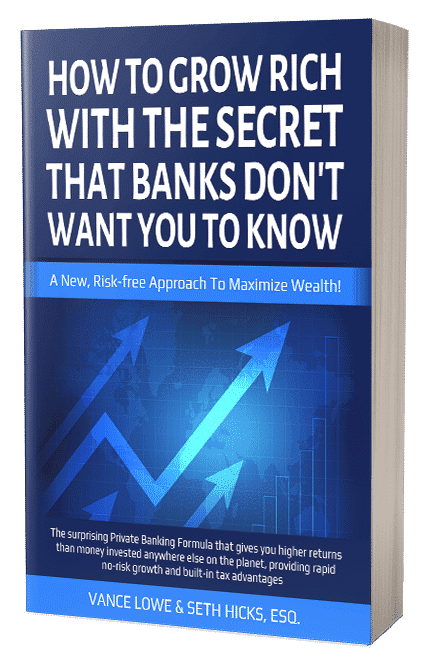
[00:19:45] Seth Hicks Esq.: We’re showing folks the science that powers it and. How to put multi policy structures in place that create Waterfall legacy. So folks, if you want to learn more, you can find [00:20:00] us@privatebankingstrategies.com and therein, you’re gonna get an offer for a book that Vance and I authored called Secrets. The Banks Don’t Want You to know that are gonna keep you from being wealthy.
[00:20:11] Seth Hicks Esq.: And so we’re revealing and, and shining light on things that you may or may not have ever heard before with that book. So put in your name and your email, and in exchange for that, we’ll give you a PDF copy and an audio version. You could listen to it on the go, but more importantly, if this content resonates with you, those emails are gonna have a calendar link to Vance’s calendar.
[00:20:33] Seth Hicks Esq.: And if you wanna learn how to create a hundred year family bank and a legacy that will outlive you, having your children and your grandchildren, your great-grandchildren kissing your picture, then schedule a call with Vince in that email. Vance. Any closing
[00:20:48] Vance Lowe: remarks? This is it. It’s such a wonderful topic.
[00:20:52] Vance Lowe: That’s why I love to do this. It’s just freedom if you want it, if you really want to live [00:21:00] life to the fullest. It, it does take money and I’ll learn what it can do for you. Take the next step.
[00:21:08] Seth Hicks Esq.: Thanks for joining us folks, and hope to see you on the next episode. Bye for now. Bye-bye.
[00:21:14] Outro: Did that story feel like it was about you?
[00:21:17] Outro: Do you feel you should be making more progress toward your financial goals? Do you feel stuck? Let us help you get unstuck. Are you ready to take action and get your own private bank? Please visit us at www.privatebankingstrategies.com.
[00:21:38] Outro: Thank you for listening to the Private Banking Strategies podcast.
[00:21:41] Outro: Click the subscribe button below to be notified when new episodes become available.