[00:00:00] Intro: Welcome to Private Banking Strategies Podcast with Vance Low and Seth Hicks, your secret weapon to protect your assets and never have to start over financially again. Vance and Seth help high net worth individuals, families, business owners, and investors structure and asset protected fortress for their families.
[00:00:21] Intro: Learn how to keep what you earn and use the velocity of money. To create your own private banking system. Join us on this journey as we explore the secret strategies of the rich and political elite and help you take total control of your financial security. Now onto the show.
[00:00:38] Seth Hicks Esq.: Well, hello and welcome to Private Banking Strategies Podcast with Vance Low and Seth Hicks Vance.
[00:00:44] Seth Hicks Esq.: How are. I’m doing wonderful today, folks. We’re gonna be continuing on in a series where we’re focusing on financial freedom. A lot of people that come to us, they want to develop a plan to become financially independent, take back the [00:01:00] baking equation into their life and. Accelerate their wealth curve and their family’s wealth curve.
[00:01:05] Seth Hicks Esq.: And so we’re talking about financial freedom. And last, uh, week in part one, Vance, we talked about different strategies and what financial freedom actually means. And we dug into that. So folks, if you wanna drill down there, go to part one of this series. But today we’re gonna be talking about actually the how to.
[00:01:24] Seth Hicks Esq.: How to achieve financial freedom step by step. That’s something Vance that you take great pleasure in, is teaching people how to take the banking equation back in their life, how to achieve financial freedom, and so we’re gonna dig into that today, folks.
[00:01:39] Vance Lowe: I, I get excited about this and maybe I’m a little bit funny that way, but everybody normally has a reason to get up in the morning.
[00:01:47] Vance Lowe: And, uh, the more motivated you are to get up in the morning, the more productive you can be. And one of the things that I just love is to talk about financial freedom. Spent my whole career [00:02:00] helping people enjoy financial independence, get there, achieve it, and able to go on in life and feel much more comfortable.
[00:02:08] Vance Lowe: And in that process there are things that we all have to do, and I liken that to, uh, baking a cake. You’ve got to follow a recipe in order for it to turn out the same every time. If you decide to leave an ingredient out, it’s not gonna be what you want, and it’s not gonna taste as good as you would like it.
[00:02:29] Vance Lowe: Folks. We do that with our money. We do that with our financial wellbeing. We choose not to do things. And it’s kind of funny. We know we’re supposed to do some things, but we’ve consciously decided we’re not gonna do those. Let me tell you how simple it could be with success, with money. It’s simply following a recipe.
[00:02:53] Vance Lowe: If you follow the recipe, it will turn out every time life happens. There’s all kind of financial [00:03:00] situations out there because our whole world revolves around it. But even if we fall flat on our face, if we’re following those laws and principles, we still can’t help but succeed. So let’s get into that.
[00:03:13] Vance Lowe: That’s kind of some of the reason I get up in the morning. ’cause most people don’t understand these things. It’s definitely not what our government or banks want people to know because it would make them more independent and more able to weather a storm or be able to retire financially secure and keep their families.
[00:03:37] Vance Lowe: And posterity more private. Oh, we know that there are families out there. We all do. We know about the Warren in Buffetts, the Donald Trumps, all these guys that had mastered money all did it exactly the same way, different venues, so to speak, different flavors. So let’s delve into this step by step. The first thing that I [00:04:00] always like to talk to people, I ask them many, many questions.
[00:04:04] Vance Lowe: About their current situation, how much do they bring home, what type of, uh, business they’re in. I ask them about their family situation. All of that is critical to understand and know and, and, and be part of. And then we get into their lifestyle. Okay, you bring home $8,000 a month, $10,000 a month, what do we do?
[00:04:24] Vance Lowe: What are our expenses? So we go through those things. I asked them to tell me about them, and I asked them if they have a car payment. You know what? Almost 50% of the people that I talk to say they don’t have a car payment, and I just start laughing. I said, I’m not laughing at you, but I’ve caught you. Do you drive?
[00:04:43] Vance Lowe: And they all say, yes. Do you have a driver’s license? Yes. Then you have a car payment. Period. And some of ’em wanna try to argue and say, oh, I don’t have a car payment. I said, look, you had to take a chunk of money. Did you pay cash for your car or did you pay it off? [00:05:00] Well, that’s divided. Well, I paid cash for it.
[00:05:02] Vance Lowe: And you don’t have a car payment. Well, what’s happening in that car today? Is it as valuable today as it was yesterday? No, it’s where out, isn’t it? And you’re gonna have to have another car payment. So are you gonna pay car cash with the next vehicle? And, uh, they say, yeah, that’s what I planned. So you’re going to have to save the money up so you’re setting aside money every single month, quote, you have a car payment.
[00:05:24] Vance Lowe: The bad thing people don’t understand in the system that they’re in is that they give away and they break. One of the major rules about money known to man. So, and this, I always quote Warren Buffet on this. He said, if you want to be successful with money, there are some rules you cannot break. Let me give you two rules for this.
[00:05:48] Vance Lowe: Number one rule that number one rule is we cannot ever spend principle, and then he follows that up. Well, let me tell you about rule [00:06:00] two. You can never. Ever break rule number one, and then he smiles. So is that important or is that not important? It is. It’s a proven fact that you don’t have to spend your principle.
[00:06:11] Vance Lowe: You can use it and get it back, or you can burn it, you can use it once. What happens when we use it once? Well, everybody hearing this right now is living it, right? If we, if we spend our earned earned income and don’t get it back, we’re forced to go back to work. There’s one more important one that I tell people that go down this road.
[00:06:33] Vance Lowe: When they find out about, Hey, I might be able to get an advantage doing this private banking strategy, and they start listening to our stuff and they get kind of excited. I go into law or rule number two, which is we call the 10% law. And that goes back anciently. A lot of people say it’s biblical, you know it’s religious and everything else, but they need to understand that the [00:07:00] 10% law is absolutely essential.
[00:07:03] Vance Lowe: And I said as I explained this to you, if you cannot or not willing to live it, then we need to be through, we’re done. Because you cannot do this strategy without that 10% law. So who’s the first person, Seth, that we pay? You know, when we bring money home, you gotta pay
[00:07:19] Seth Hicks Esq.: yourself. You gotta pay yourself first.
[00:07:22] Vance Lowe: Why
[00:07:22] Seth Hicks Esq.: not last? Well, it’s financial discipline that is required, or there won’t be enough at the end of the month, so to speak, sometimes. So what people generally do is they don’t stick to the disciplined plan that you’re describing. And so paying yourself first is a fundamental cornerstone of the infinite banking concept, and Nelson Nash refers to it as, don’t steal the Peas in your own grocery store.
[00:07:49] Seth Hicks Esq.: We’ve talked about that some.
[00:07:51] Vance Lowe: I want to go through this right now because it is a critical point of the step by step. We have this another podcast, but I wanna go through why [00:08:00] people break that law and think that that’s okay. They do, they relegate it to the last, but even those who pay themselves first, they end up and fall prey to life.
[00:08:13] Vance Lowe: And folks, that is a sad, unnecessary mistake. Say we bring home $10,000 a month. And we’re gonna pay ourselves at least 10%. 10% is the minimum. Folks, that would be a thousand. So I’m gonna say we’re gonna pay ourselves $1,200, okay? Because I wanna be above that 10%. And we take that $1,200 and picture this with me folks, we’re gonna stack it up over on the corner of our table.
[00:08:39] Vance Lowe: Now there’s $1,200 standing there, and we have $8,800 left. To live on for the rest of the month. So now we start paying our bills and we start using the money to pay our bills and go through the month. And now we get down to the very end and we’re outta money, but we look over there and there’s one more bill to pay and it’s due [00:09:00] today and it just so happens to be $1,200.
[00:09:04] Vance Lowe: Seth, what do people end up doing in that situation?
[00:09:07] Seth Hicks Esq.: Well, they take the $1,200 that they just paid themselves off the top and they push it onto the bill and they pay themselves nothing and pay the bill.
[00:09:16] Vance Lowe: Yeah, they life happens. Oh, well, you know, I, I gotta pay that bill ’cause I don’t wanna pay a late payment.
[00:09:21] Vance Lowe: And folks. In Nelson Nash’s book and I encourage everybody to get the book Becoming Your Own Banker. ’cause it is incredible if you understand. And that’s our job to make that book come alive. In that book he talks about, it’s all about our imagination. He goes into children. ’cause you can see this in little kids.
[00:09:41] Vance Lowe: There is no limit. There’s no bounds to their imagination when they experience stark terror. Like a lightning and thunder crashing in on them. They are so petrified they fall. They physically are affected. The other thing is when they’re happy and the joy, it just affects [00:10:00] them so immensely. There’s no bounds.
[00:10:03] Vance Lowe: And we’ve learned over the years to, you know, really dial that back to our detriment. The other is, it’s all about how we think in this scenario. I just, uh, painted for you. If we do that, we pass up probably one of the best, most lucrative investment opportunities we could ever imagine.
[00:10:22] Seth Hicks Esq.: What, whoa. Pause, you’re so, you’re telling me that my debt and my inability to pay myself and this shortage is somehow good.
[00:10:31] Vance Lowe: Absolutely it is good. Okay. I have to go back to why did we pay ourself the 10% and the reason for that, when we pay ourself $1,200, do we wanna hide it under a mattress? Do we wanna burn it or do we wanna put it to work? Well, if you wanna put it to work, we wanna put it to work. So in this scenario, when we’re outta money and we have another bill.
[00:10:54] Vance Lowe: I want you to think about this and, and try to envision this. There is you [00:11:00] in the world that has the total view, but then there’s someone else beside you and you’ve met him or her this morning, and he or she is looking back at you in the mirror. That person is supposed to be a reflection of ourselves, but I want you to think of it as those are separate people.
[00:11:18] Vance Lowe: They live in a cont war. And that’s the person who has to pay the expense and who earns the income for this family unit, and he’s the one that’s out of money. He needs $1,200 desperately right now. And you just so happen on the other side to have $1,200 you wanna put to work. Don’t you think the two of you could get together and figure out a finance plan for that guy in the mirror that you could easily afford on a monthly basis?
[00:11:47] Vance Lowe: To pay it back.
[00:11:48] Seth Hicks Esq.: You would think so. Yeah.
[00:11:49] Vance Lowe: See, that’s the difference. If we don’t do that, that $1,200 is gone. Right. But if we lend it in that single case, we’re going to eventually get the money back. Okay. And since we’re [00:12:00] acting as the bank at that time, we can set up any of the terms we want. Right. Right.
[00:12:05] Vance Lowe: So the question is, do we want our earnings high or low?
[00:12:09] Seth Hicks Esq.: Yeah. Do you want your earnings high?
[00:12:11] Vance Lowe: Uh, high. We could charge 25% interest. We could charge 50% interest and double that money at work every two years and still keep the payment reasonable that we can easily afford.
[00:12:26] Seth Hicks Esq.: Meaning that you can still fit that within your $10,000 a month cash flow?
[00:12:30] Vance Lowe: Absolutely. Because we, you know, we may feel like, okay, we’re a little bit under hot water, but now we don’t spend principle anymore. We value the money. We want to use it and get it back. That’s the key. That’s the whole secret here about money folks, to step by step, walk into this and be assured that your money’s working for you.
[00:12:52] Vance Lowe: You’re not taking any risk. You don’t gotta pay taxes and just enjoy
[00:12:56] Midroll: life. Did that story feel like it was about you? [00:13:00] Do you feel like you are generating a lot of revenue but are not moving forward as fast as you would like? Do you feel you should be making more progress toward your financial goals? Do you feel stuck?
[00:13:13] Midroll: Let us help you get unstuck. Are you ready to take action and get your own private bank? Please visit us at www.privatebankingstrategies.com.
[00:13:27] Vance Lowe: It’s not about getting the 1200 back, it’s about putting 1200 to work and receiving. What’s called volume of return in payments. ’cause you see folks, when the guy in the mirror makes that payment back to our account, that’s money returned to us.
[00:13:47] Vance Lowe: That’s a second touch. That money can accumulate and now go by more debt and increase that volume of return. This is what the lending companies do. This is what the [00:14:00] banks do, this volume, they don’t get rid of it, they don’t burn it. They take control of it and purchase more debt. You have, you know, when you’re first starting, most of us have quite a bit of debt.
[00:14:11] Vance Lowe: You know, we’ve got quite a bit of payments out there and we wanna own the debt, not just pay it off and say, Hey, that’s paid off ’cause we don’t have the money back. So I went into length with this, but I want you to understand it’s all about how we think and our imagination. And so we’ve now done two steps or two laws about being successful with money.
[00:14:36] Vance Lowe: So Seth, one of the other things that we refuse to do, and I want to introduce in, in this topic is, you know, we offer, uh, eight year analysis, but in actuality, what is that for people that they. Need in their life to be successful with money?
[00:14:54] Seth Hicks Esq.: Well, we need the discipline that we’re describing, and you need a, a pattern and a plan, a clear [00:15:00] roadmap that you can simply follow.
[00:15:02] Seth Hicks Esq.: And you don’t have to be sucked into the emotion of financial balancing every month. You just follow the plan. And so that’s. Something that I think we distinguish ourselves among others in the infinite banking world is that you actually teach people how to implement the eight year roadmap and the step-by-step strategy for them to be financially free and successful.
[00:15:27] Seth Hicks Esq.: And it’s up to them to follow it. You’ve gotta actually do the work, you know, and get that muscle memory going. But once it’s there, it just becomes second nature. And once you’ve got your processes in place, people skyrocket.
[00:15:40] Vance Lowe: Can you imagine a successful corporation not having a one year, five year, 10 year, totally articulate financial plan for their company?
[00:15:50] Vance Lowe: Every single quarter, every single year, uh, planning meetings are held, budgets are set, you know, each department are declaring what are you [00:16:00] doing? And every, there’s a complete roadmap out. Well, we all know that because we’re probably all involved in that process at work. For some reason we’ve been taught, or actually we have not been educated, that when we get the money in our control, like a business gets the money in their control, they have to manage it for profit, and we have to manage the money we’re bringing home into our family.
[00:16:25] Vance Lowe: We have to run it for profit. If you’re too busy to do that, if you don’t think you wanna do that, then of course this isn’t gonna be successful for you. And whether you believe it or not, you’re probably gonna stay a slave to the system depending on having to go to work to replace the income you spend.
[00:16:41] Vance Lowe: But a roadmap is absolutely critical. It doesn’t take a lot of time. It gets you organized. It lets you know where you’re at. Honestly, I’ve lived this type of roadmap for about 20 years now. Sometimes I haven’t followed it. You know, there’s been months that I’ve gotten off, but I [00:17:00] know where I’m at. I know what’s wrong.
[00:17:02] Vance Lowe: I know where to go and how to get back on track really fast. So we show people, we actually have an eight year analysis that we show people. If they stay the way they are, what’s gonna happen over the next eight years, month by month, versus switching to a strategy that allows you to use money and get it back, and how that’s gonna affect your financial level month by month, right along the same way.
[00:17:29] Vance Lowe: And you’ll be able to see with your own numbers how much better off you’re gonna be. We’re even gonna hinder it. A little bit. ’cause we’re not gonna add any growth on either side. We’re just gonna do math. But if we can get the money back and get another dollar’s worth, it’s amazing what happens over eight years.
[00:17:50] Vance Lowe: So those are three steps right there that we want you to consider setting up in your life and doing the biggest [00:18:00] problem. And we’re here to show you that how to get the money back. We promise people that we’re going to show you how to get back. 100% of your monthly expenses every single month. And sometimes when I’m actually doing that interview with the uh, client, I ask ’em, now, do you think I can really do that?
[00:18:18] Vance Lowe: And they go, well, you have a pretty good reputation, so we’re gonna take your word for it until we can prove you otherwise. And the promise is, we’re so set up to be able to teach that we don’t have even have to be present. It won’t even take 20 minutes of you seeing. The structure of how to get the money back.
[00:18:37] Vance Lowe: When you see that structure, you can look at your spouse or significant other and ask the question, can we actually get the money back? And you’ll both be nodding your head and you’ll go, if I do that, I’ll always get the money back. So folks, I think these are the first three steps you’ve got to get.
[00:18:57] Vance Lowe: Organized because if you try to do the [00:19:00] other little things, if you’re spending principle, you’re losing the money, you may make a lot more money, but it’s all gonna be for Naugh because money at work compound what’s called exponential compounding, where compound compounds and all sides of the circle gets bigger all the time.
[00:19:15] Vance Lowe: Okay. Instead of just. One, one road one way. So Seth, I think that’s probably a, um, a good spot right there for people to think about how they can find out how to actually implement this.
[00:19:29] Seth Hicks Esq.: Yeah. Well folks come visit our website www dot. Private banking strategies.com, private banking strategies.com, and when you hit our website, you’re gonna be able to access just a ton of resources that we’ve developed.
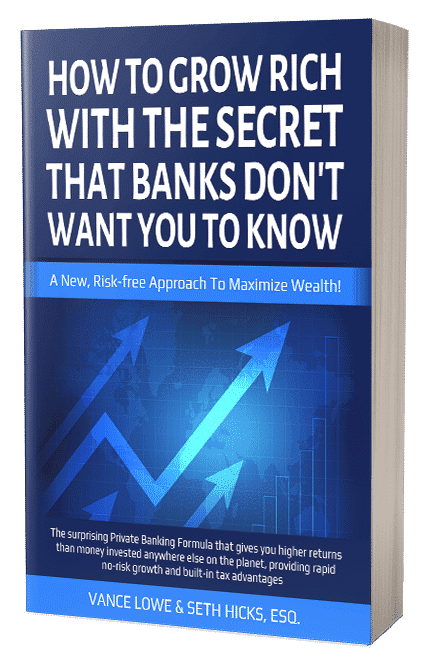
[00:19:45] Seth Hicks Esq.: And the first resource that we have developed is a book that called What The Banks Don’t Want You to Know, and It’s Secrets of How to Grow Rich. Mindset shifts that you need to consider and actually implement in your life to change your wealth curve. [00:20:00] And that book there is available to you when you put in your best email and your name.
[00:20:04] Seth Hicks Esq.: And we will thereby give you the audio book and a version you can listen to or you can. Read it if you’re a reader. And from that place, folks, if that book resonates, this podcast has resonated with you. The content that we’re educating you about resonates. We want you to schedule a call to get this eight year roadmap with fans.
[00:20:25] Seth Hicks Esq.: And the only way that you can schedule that call is to receive the emails because the link to his calendar is in that email. So if these things resonate with you, be on alert for that email to come to you folks, and you can schedule that eight year planning. And a roadmap with Vance, where he lays the roadmap out for you.
[00:20:43] Seth Hicks Esq.: So we’re excited about this and bringing people into financial freedom. We wanna influence and touch as many people as we can. And, uh, just really happy that you’re on this journey with us folks. Vance. Any closing comments folks? Anyone
[00:20:58] Vance Lowe: under any [00:21:00] circumstance in life can do this? If they can live another law, and we’re gonna talk about another law in the, uh, next podcast here, we’ve got, uh, five more principles that we really want to talk about.
[00:21:13] Vance Lowe: So anybody could do this. Anybody can be better off than they were the day before. It’s not. Complicated. It’s just knowledge that you have to have and be able to do it. The surprising thing with everything we’re talking about, Seth, is that it doesn’t have to change the way you live. All we wanna do is change who ends up with the money at the end of the day,
[00:21:38] Seth Hicks Esq.: right?
[00:21:39] Seth Hicks Esq.: You don’t have to work harder, get a second job. You simply change the cash flow. Who ends up with the money? Right. That’s awesome. Well, thanks folks for hanging out with us and taking this journey with us, and we look forward to seeing you on the next podcast.
[00:21:54] Outro: Did that story feel like it was about you? Do you feel you should be making more [00:22:00] progress toward your financial goals?
[00:22:02] Outro: Do you feel stuck? Let us help you get unstuck. Are you ready to take action and get your own private bank? Please visit us at www.privatebankingstrategies.com. Thank you for listening to the Private Banking Strategies podcast. Click the subscribe button below to be notified when new episodes become available.