[00:00:00] Intro: Welcome to Private Banking Strategies Podcast with Vance Low and Seth Hicks, your secret weapon to protect your assets and never have to start over financially again. Vance and Seth help high net worth individuals, families, business owners, and investors structure and asset protected fortress for their families.
[00:00:21] Intro: Learn how to keep what you earn and use the velocity of money. To create your own private banking system. Join us on this journey as we explore the secret strategies of the rich and political elites. And help you take total control of your financial security. Now onto the show.
[00:00:37] Seth Hicks Esq.: Hello and welcome to Private Banking Strategies with Vance Low and Seth Dix
[00:00:42] Vance Lowe: Vance.
[00:00:42] Vance Lowe: How are you? Oh, I’m doing great. I’ve got a chance to put a few notes together to do this last of this three podcast theory, and we’re gonna tie it all in today, folks. We’re gonna make it sing.
[00:00:56] Seth Hicks Esq.: Yeah. We’ve been talking about the example that [00:01:00] Nelson Nash has. In his book with being a grocery store owner and relating that to being a private banker and implementing your own private banking strategies, and we’ve had two parts to this.
[00:01:11] Seth Hicks Esq.: This is the third part we’re gonna drill down even further and dig into more of the concepts that help you to understand how to implement these, these tools and these disciplines to be a successful wealth manager. So Vance, take it away.
[00:01:25] Vance Lowe: Okay, I’m gonna tie in the last one. Folks. If you haven’t seen the first two, I’d probably recommend you stop and go watch those first two.
[00:01:33] Vance Lowe: The second one, we kind of left off with a mindset being able to achieve better results. We used steam versus hot water. There’s only two degrees difference. What? What do we say? 210 degrees you end up with Nice. Hot water, but it doesn’t do anything at that point. Two more degrees, we get steam. And steam is now water’s converted into energy and [00:02:00] power.
[00:02:00] Vance Lowe: It will run a steam locomotive. You know, that can pull a mountain load worth of weight. So in connecting these dots with the mindset and a winning mindset, we discovered that it only took 5% more effort. If you can envision yourself into this story into Nelson Nash’s book, becoming Your Own Banker, the Grocery Store Story, you are that owner.
[00:02:26] Vance Lowe: You need to take that store and be completely successful with it. We talked about turning inventory. The more we turn, the more successful we can be, but we have to break even first, then we have to make a profit, and then 5% more effort. Could produce more than double results. From then on, Seth talked about the exponential growth of our banking.
[00:02:48] Vance Lowe: It starts off pretty slow, but pretty soon we have a increase in the efficiency of the contracts. If we had a guaranteed contract that every dollar we’d. Put in, in year five would turn into a [00:03:00] dollar five or a dollar 20 instantly. The question is, how many of those do we want? We build the contracts for our clients, not for ourselves.
[00:03:09] Vance Lowe: These contracts are built for the long term, the duration, not the quick fix. A lot of people kind of fall prey out there to the internet and they sell product and they put a twist on things that may or may not be good and leave their clients hanging. Why do we know this is because we have to pick up those people.
[00:03:30] Vance Lowe: Those people find their way to us and say, we heard you actually take the banking equation. And we do. And that’s what we’re all about, folks. So what I’m gonna introduce today is in this story, it talks about our family. Which door we’re taking the food out of. There is another partner in all business.
[00:03:51] Vance Lowe: It’s called the Silent Partner, and it was put upon us back in 1913 when the Federal Reserve mandated [00:04:00] our government installed. The IRS, and there was pretty hideous reason for that. The reason the IRS is there is for control of assets, and they do that in the form of the taxes so that the government can receive revenue from our hard work.
[00:04:18] Vance Lowe: What they’ve never told us is that when they tax us, I think Cass, you said it was 1% at the beginning, and now I heard it said a couple of years ago that it takes until between May and June before we start making money for ourselves. The whole year, the whole five months, up to six months now is paying all taxes for government and then we get into start paying ourselves.
[00:04:43] Vance Lowe: No wonder we can’t make ends meet. No wonder the average American is not happy. They have to do everything for everybody else, and that becomes a bad thing. Government hasn’t told us that increasing taxes. Actually lowers the productivity of our nation. [00:05:00] They actually make less money. If they kept the taxes very low, they would, their revenue would be much higher.
[00:05:08] Vance Lowe: Anyway, so we’re getting into the tax issue here, this third silent partner and how we might be able to take advantage of this. Before 1900, this strategy that we’re teaching, this private banking strategy was the banking system of our nation. We didn’t have banks back then. How did people use their money?
[00:05:27] Vance Lowe: They used these special insurance contracts to hold their money, and they did. Were taught in school. Self-financing. They were actually taught how to run their families as an independent unit for success, called an economy, running their own private mini economy for profit. We explained that in the earlier sections here about an economy is a town well in our private economy.
[00:05:53] Vance Lowe: If we set up our private banking, all the money that comes into our economy is after tax. [00:06:00] From then on inside of our economy, we can double asset. All the growth inside those contracts can create no. Taxable events. We’re not breaking any laws. We’re not even in any gray areas. This is just fact we’re using after tax dollars just within ourself.
[00:06:18] Vance Lowe: It’s not a system that is trackable or traceable, it’s private. The assets held in our private banking, in these special contracts or with life insurance carriers, that wealth there is not reported. Nobody knows, including government. How much is there? What it’s worth or anything else until we create a taxable event.
[00:06:41] Vance Lowe: Can they get a report on some of these contracts? Only if you break the rules, they don’t get into it. As a matter of fact, our banks, the banks today, store their safe money in these same contracts, and we’ve talked about that in earlier podcasts. It’s amazing. This strategy folks is [00:07:00] not new. This private banking and what we’re trying to bring back is a proven strategy that’s always been in existence and is in existence today for those who understand how money works.
[00:07:12] Vance Lowe: So, Seth, give us some examples. What would be a tax advantage in this system that people could enjoy with their private banking?
[00:07:22] Seth Hicks Esq.: You touched on it. If you have a car dealership or a grocery store like we’ve outlined or any other type of business endeavor, typical business endeavor, small business owner, large business owner, you have a silent partner that is the IRS and the IRS is going to demand their federal taxes and.
[00:07:44] Seth Hicks Esq.: By their own Internal Revenue Code 77 0 2, and we did a prior podcast that talks about something some people refer to as seven 70 accounts referring to Internal Revenue Code 77 0 2. And what they did is they carved out the [00:08:00] taxation. Of life insurance contracts and certain other accounts, but life insurance contracts are what we’re focused on.
[00:08:07] Seth Hicks Esq.: And the ultra wealthy and the wealthy and prior presidents like John F. Kennedy, Richard Nixon, JC Penny Ray Crock, who started the McDonald’s franchise, Walt Disney, and the list goes on and on and on and on. Ultrawealthy successful people who utilize Internal Revenue Code 77 0 2 to create untaxed wealth creation and wealth growth.
[00:08:34] Seth Hicks Esq.: And that’s through the implementation of these life insurance contracts that we’re discovering. That’s utilizing private banking strategies with the properly structured whole life insurance contract that is not taxed. Once your after tax money has been contributed and capitalized into your life insurance.
[00:08:52] Seth Hicks Esq.: Contract policy. It is forever outside of the taxing system. So long as you do not create a modified endowment [00:09:00] contract, which we will explain to folks who want to understand that line and that difference, the growth becomes parabolic in a compounding nature. Albert Einstein said the eighth wonder of the world is compounding interest and the growth, like we talked about in the second episode, becomes.
[00:09:18] Seth Hicks Esq.: A parabolic curve after year 7, 8, 9, and 10, and in the last years of 20 years that these policies are in effect, it’s almost a doubling every year of cash values and death benefits, and that’s born out in the illustrations, and that’s the power of compounding tax-free growth, which is one of the seven pillars of private banking strategies.
[00:09:40] Seth Hicks Esq.: That’s what makes this strategy so valuable. So important for people keeping what they make and growing it in that parabolic fashion. If you are not having to pay taxes and your money is completely liquid, you can access it now you can access it without penalty. That’s unlike 4 0 1 Ks or [00:10:00] IRAs or any other government sponsored a retirement program where there’s penalties for accessing it too early or accessing it too late, and there’s always tax.
[00:10:10] Seth Hicks Esq.: On it, and they’ve tricked people into believing that you’ll pay tax in the end, but ultimately you’re gonna pay less tax than that. Would you rather pay tax on the seed or the harvest? Well, you’d rather pay tax on the seed because that’s gonna be growing and growing and growing, and you’re making the government much, much larger slice of what you’re creating and you don’t know what the tax rates will be.
[00:10:34] Seth Hicks Esq.: In the future, and they’ve only gone up since the IRS was created. And so you let your retirement account season for 30 years, 40 years, and then the government takes at least a third of it, and what you thought was yours is not yours, and it’s been locked up. Dormant asleep not being put to work, not in a velocity situation like we described in the first two parts of this series.
[00:10:59] Seth Hicks Esq.: It’s [00:11:00] asleep. It’s not making you anything. In fact, with inflation and taxes, it’s almost ridiculous. If you account for what the purchasing power and the value of what that will be, you’re losing value every year, not gaining value when you account for inflation and taxes, when your money is asleep in a government sponsored retirement program.
[00:11:20] Seth Hicks Esq.: Compare and contrast that with the private banking strategies system and structure and it, it’s not asleep. You have access to your money a hundred percent of the time. Full liquidity to put it to use. How do I put my banking assets to use? How do I get that velocity of money? We described it in a consumptive context, gas dentist.
[00:11:41] Seth Hicks Esq.: Grocery store, that’s all consumptive. But how do I actually put that money to work where I can create a return on my investment, my loan at work?
[00:11:50] Midroll: Did that story feel like it was about you? Do you feel like you are generating a lot of revenue but are not moving forward as fast as you would like? [00:12:00] Do you feel you should be making more progress toward your financial goals?
[00:12:05] Midroll: Do you feel stuck? Let us help you get unstuck. Are you ready to take action and get your own private bank? Please visit us at www.privatebankingstrategies.com.
[00:12:21] Vance Lowe: I am gonna give you a little snapshot of how we put money to work, how fast we double assets. Okay? So I’m gonna use an example that I actually did.
[00:12:32] Vance Lowe: Let’s see if I can make this happen verbally. We have this in other podcasts and I have a graph that is called How Fast Can I Double Money? That’s how I evaluate the loans I set up through my private banking. Well, I’ve always paid $500 a month on my cars. It just seems like forever. I’m a car nut. I buy lots of cars.
[00:12:54] Vance Lowe: I’ve always bought ’em the wrong way. I’ve bought new I’ve leased. Leasing is the absolute [00:13:00] worst thing you could possibly do when it comes to cars, but I’ve experienced it all. And then I came across private banking strategies, the momentum of money and how money can be used. So I had two loans with Bank of America, and I decided to set up this strategy.
[00:13:18] Vance Lowe: My payments were $500 a month and I had Tacoma truck when that loan got down to $10,000, which I’d only had to wait a short period of time. When I decided to do this, I decided I was gonna buy that loan from cash value in my policy. One of the things that people don’t understand, that when you borrow money from a policy, you’re not actually taking your cash value.
[00:13:41] Vance Lowe: It stays there and continues to grow. You borrow against that in the cash reserves of the life insurance company because you’re an owner. So I took $10,000 and I bought the debt. Rather than paid it off, I set up my own loan company. My loan company, which costs nothing to set it up and run it. [00:14:00] We show you how to do that and it bought my car loan.
[00:14:03] Vance Lowe: So me, the client, he got an address change on where he made the $500 payment to folks. This was huge, but here’s how money works. This is what we’re talking about. Do you have any idea how valuable that loan is? I would find I hunt for these all day long. I would buy any one of these debts. I would have to come up with $10,000.
[00:14:24] Vance Lowe: The payment is $500. Okay. And the interest rate is 8.5%. Why? Guys listening out there, why would I be so enthralled with buying that debt? You’re gonna make the interest on that loan. What if I were to change that to zero interest rate and tell you that it wouldn’t even dampen my enthusiasm to buy that debt?
[00:14:46] Vance Lowe: Now, there’s only two numbers left, so everybody says, well, I guess it’s the payment then. Yeah, I have to take $10,000. I have to put $10,000 to work. Right? Yes, I’m gonna receive [00:15:00] $500 per month. Money is made off of volume of return, so let’s calculate what that volume of return is. 500 a month times 12 is 6,000 bucks.
[00:15:11] Vance Lowe: Right? That’ll conclude the interest in everything else. So whatever it is, whether it’s nothing or all. To find the volume rate of return, you take the annual payments and divide it by the money at work, 6,000 divided by 10,000. How does a 60% volume rate of return sound to you? Okay, well that sounds pretty darn good and everybody’s gonna think, well, part of that’s principle, part of that’s it.
[00:15:34] Vance Lowe: It doesn’t matter. My goal when I set up this loan was to get all my money back on all the cars I bought in a lifetime. It was over $500,000 that I calculated that I’d spent on cars in my lifetime. I wanted it all back, and this is how I did it. So if I keep that up for five years, 6,000 times five, that’s 30,000 bucks.
[00:15:59] Vance Lowe: That’s not too [00:16:00] bad on an investment of a hundred thousand dollars. How am I doing so far? Pretty good. How much risk am I taking? There’s no economy risk, there’s no market risk, there’s no real risk of theft other than myself if I decide not to make the payments. So I guess that would be the risk factor.
[00:16:16] Vance Lowe: And everybody turns around and says, says, yeah, that’s a pretty good number, folks. This is not what we’re talking about. This is not banking. Banking is all about the volume of return. I now have $6,000 in my hand at the end of year one. What am I gonna do with that? Am I gonna spend it? Am I gonna burn it?
[00:16:34] Vance Lowe: Or am I gonna put it to work and buy more debt? Well, since 60% turned out to be the average volume, when we buy loans, I’ll assume that I get 60% on year ones, $6,000, and add that to year two. I think 3,600 bucks. So in year two, I’m gonna get the 6,000 off the first loan and I’m gonna get another 3,600 because I bought [00:17:00] $6,000 more of debt at a 60% volume return.
[00:17:03] Vance Lowe: And then I’m gonna keep that over that five years in year three. I’m gonna pick up a third one because now that $3,600, which now equals $9,600, I’m gonna go buy debt with that whole thing, and that’s gonna increase my return every year. So here’s the difference. In the first five years, would you rather have $82,000 plus or 30,000 financial planners, stock brokers, people who figure out.
[00:17:29] Vance Lowe: Your money bankers, they will tell you about the 30,000. They understand that they don’t understand the power of banking. This is what we teach. We set it up for you. We show you how powerful this is. So how many times Seth to $82,000 did we double our $10,000? ’cause we didn’t have to come up with more money.
[00:17:50] Vance Lowe: We just used. The same dollars back to us called volume of return. That’s where the money is, and we keep putting that to work. At some point. [00:18:00] We’ve got more money coming in than we’re bringing home at work folks. It doesn’t take that long. It’s amazing. But how many times did we double it? We double it once it goes to 20.
[00:18:09] Vance Lowe: Twice it goes to 40,
[00:18:11] Seth Hicks Esq.: then 80.
[00:18:11] Vance Lowe: Yeah, over three times to 80. And we’re at 82.
[00:18:14] Seth Hicks Esq.: Between three and four. Yep.
[00:18:16] Vance Lowe: Yeah, just over three times.
[00:18:17] Seth Hicks Esq.: And that’s what we like to explain in a nutshell phrase, is that what we do with private banking strategies is we simply change who’s getting the payments, who’s getting the payments in your life?
[00:18:30] Seth Hicks Esq.: We change who’s getting the payments. And within your income. Within your income economy and system, and you don’t have to work any harder. You don’t have to start a new business, you don’t have to take a second job. You simply change who’s getting some of the outflow and you change money that’s leaving your position that you never have control over again.
[00:18:52] Seth Hicks Esq.: And we start taking portions of that and bringing that back into your control, just like you just described. And the next year, there’s gonna be a [00:19:00] larger portion that is taken. Out of other people’s control and coming back into your control, and the next year it’s gonna be more in the same example that you just utilized, and that’s without working any harder and without changing anything except who’s getting those payments.
[00:19:15] Seth Hicks Esq.: You’re able to conquer debt and preserve your wealth, keep what you make, and grow what you make. That’s a simple paraphrase of how this works, folks. How much taxes do we have to pay on that 82,000 bucks. Zero. Are we cheating Uncle Sam? No, that’s Internal Revenue code 77 0 2.
[00:19:34] Vance Lowe: This is the amazing thing.
[00:19:36] Vance Lowe: This is independence. This is privacy. Nobody knows and can track what you’re doing legally.
[00:19:44] Seth Hicks Esq.: That’s right, folks. That’s exactly right. We thank you for joining us on this three part series, folks, and we’ve dropped the nuggets in the other series. Go to our website, private banking strategies.com. There you’ll receive a free book offer.
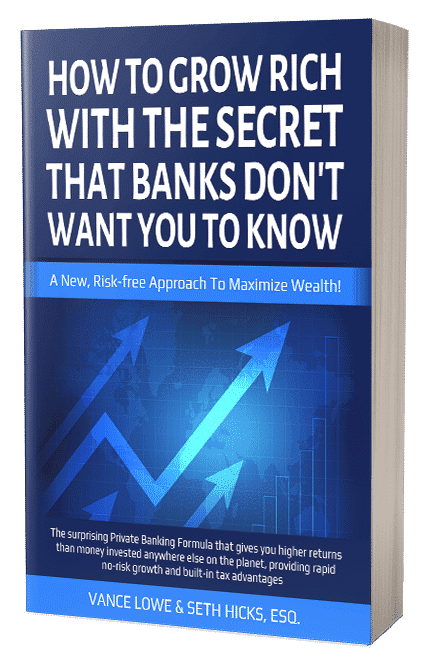
[00:19:58] Seth Hicks Esq.: It’ll pop up and in exchange [00:20:00] for your name and email, we’ll provide a book that Vance and I offered that we like to call a red pull book. What the banks don’t Want You to Know that Keep You From Growing Wealthy, and that’ll be offered to you in A PDF format. You can download immediately or you can also listen to it in an audio version on the go.
[00:20:16] Seth Hicks Esq.: That book will highlight these type of issues that we’ve described and highlight some of the ways that you can change your financial strategies to take back the banking equation in your life. And those emails that we send to you in exchange for your email are super important because they’ll have a link to Vance’s calendar that if you, you like the, the book, you like these podcasts.
[00:20:40] Seth Hicks Esq.: This is resonating and you want to take the banking equation back in your life and you wanna. Keep what you make and grow what you make. You’ll want to schedule a free exploratory call with Vance, and ultimately that process will lead you to a, a very valuable tool and resource called the eight year Roadmap that Vance designs for you [00:21:00] personally and your finances.
[00:21:01] Seth Hicks Esq.: That shows you how private banking strategies will work for you and your family, how you will implement it step by step, month over month, detailed roadmap and plan what creditors to pay, who to pay first, what amounts to pay, and how to take what Vance described and the volume rate of return, and begin to change who you pay and make it your own internal bank until you’ve conquered all your debt.
[00:21:27] Seth Hicks Esq.: You’ve captured all of your outflow and turned it into inflow. And one of the best examples that we have of this is a three-part series called the the Chiropractor Series in our podcast, and that chiropractor series was about a family that came in heavily, heavily in debt, over half a million dollars in debt, some of it high interest credit card, and they were on the brink of.
[00:21:50] Seth Hicks Esq.: Total disaster. We were sobbing in tears, and they ultimately went through the eight year roadmap. They started to implement it, and within a short period of time, six, [00:22:00] seven years, they were totally outta debt. They’d increased their chiropractic offices, they’d acquired more offices, and they had turned all of their.
[00:22:07] Seth Hicks Esq.: Flow into inflow, into their private banking system. If you want to see that in more granular detail, go into those podcasts, listen to those, and ultimately schedule your exploratory call with Vance and go through the eight year analysis and roadmap and you’ll never look back, folks. So Vance, any closing remarks?
[00:22:25] Seth Hicks Esq.: There’s just so much we wanna
[00:22:26] Vance Lowe: say, so very little time to say it in folks. We care. We care about those people who care about improving their lives. I’ve been in money management all my life, and our clients always win. The only thing that can happen is if they steal from themselves. We hang out. We’re there.
[00:22:47] Vance Lowe: So this is just one. Angle one idea. This little series here that’s in Nelson Nash’s book, we promise that we bring this book to life so that people can relate [00:23:00] to it. So hope we’ll see you through a exploratory or on the other podcast. Thank you very much for listening. Thanks folks. See you on the next one.
[00:23:11] Outro: Did that story feel like it was about you? Do you feel you should be making more progress toward your financial goals? Do you feel stuck? Let us help you get unstuck. Are you ready to take action and get your own private bank? Please visit us at www.privatebankingstrategies.com. Thank you for listening to the Private Banking Strategies Podcast.
[00:23:38] Outro: Click the subscribe button below to be notified when new episodes become available.