[00:00:00] Intro: Welcome to Private Banking Strategies Podcast with Vance Lowe and Seth Hicks, your secret weapon to protect your assets and never have to start over financially again. Vance and Seth help high net worth individuals, families, business owners, and investors structure and asset protected fortress for their families.
[00:00:21] Intro: Learn how to keep what you earn and use the velocity of money. To create your own private banking system. Join us on this journey as we explore the secret strategies of the rich and political elite and help you take total control of your financial security. Now onto the show.
[00:00:37] Seth Hicks Esq.: Hello and welcome to Private Banking Strategies Podcast, Vance Lowe and Seth Hicks. Vance. How are you?
[00:00:43] Vance Lowe: I’m ready to do another one. I’m doing great.
[00:00:46] Seth Hicks Esq.: Yeah, we’ve been talking about the hundred year private family bank, and most recently we discussed some of the important groundwork that can be laid in early adulthood with implementing your private [00:01:00] banking strategies. And we talked about parents putting policies and contracts on children right when they’re born, and the compounding value of that by the time they’re 20 or 30.
[00:01:09] Seth Hicks Esq.: And we also talked about. Folks that get a little bit later start and let’s say their early adult life in their early twenties, and they wanna start implementing private banking strategies and what some of those mechanics look like. And we’re talking now. About the second stage of life, let’s call it a family building years, and where you’re 30 to 50 years old and a family may have rising expenses there, looking to buy a home, adding children, they’ve got increased tax obligations and generally less liquidity and cash flow.
[00:01:44] Seth Hicks Esq.: Let’s talk about that family and how they start to implement private banking strategies. What some of the benefits will be for that family that I just described, because that family I just described, most of those folks think, well, I can’t do that. I don’t have any extra money. I can’t work a [00:02:00] second job.
[00:02:00] Seth Hicks Esq.: I’ve got two kids. I’m already maxed out. We like to say all the time, you don’t have to work harder. You just have to change who gets the money.
[00:02:09] Vance Lowe: Let’s set the stage even a little bit better. It seems, Seth, that we get into our professions. Start having a family own a home. You’re living the dream life, the life that’s supposed to get you started and get you towards financial independency, and then all of a sudden.
[00:02:26] Vance Lowe: In their forties to sixties, a bell rings and it’s a warning bell. Things are not going the way we thought they would. I thought I would be at this level. Well, my income might be at that level, but I’m not able to have anything outside really working for me. I might have a 401k, I might have this, but it’s, I can see the writing on the wall that if something doesn’t change, I am not gonna be able to walk into retirement financially free.
[00:02:55] Vance Lowe: As you mentioned, taxes, every time you turn around, they’re having to pay more taxes. They look [00:03:00] about investments of my spare money being able to work for me, and they’re under the impression that the 4 0 1 ks, the tax or the stock portfolios, the other assets they’ve got, or actually at work for them, when in fact they’re asleep for them.
[00:03:18] Vance Lowe: It’s the people who have the money that is making the lion’s share of the growth, doubling assets really quickly, where the, our clients or these people at this age are saying that, all I’m getting is some interest. I’m taking some pretty good risk and all I’m getting is a little bit of interest and it seems to go up.
[00:03:35] Vance Lowe: And then the market and economy crashes and everything goes back down. Is there anything better out there? So that’s a good wake up call We get. A lot of people really start listening now.
[00:03:47] Seth Hicks Esq.: When we talk about that family group, the 30 to 50-year-old, building families and rising expenses and increasing taxes.
[00:03:56] Seth Hicks Esq.: Why are the private banking strategies and life insurance contracts, [00:04:00] particularly when they’re structured properly, provide a way for them to get ahead? How does that happen?
[00:04:05] Vance Lowe: It’s a long-term strategy, and it depends on when we wake up. For me to start banking contracts, I was in my early fifties, you know, wishing that I would’ve known about it when I was 20.
[00:04:16] Vance Lowe: It doesn’t matter. It’s just. When it’s there, we have to act upon it, and we have to have a structured strategy in place, which is we call the banking strategy in place, actively working for us so that we can compound the effect. We can get all the money back, we can put the money at work to work, we can get an ever increasing volume rate of return.
[00:04:39] Vance Lowe: Which are payments coming back to us on money that’s out working. That’s what we have to employ and put in very quickly. Where we store our money is in these contracts. We’re able to take the volume of return while we’re building it up for the next item, store it back into the contract and get. Market returns not of any taxes [00:05:00] or penalties or costs.
[00:05:01] Vance Lowe: So it’s an economy introducing velocity. How many times could I do that in a year? How many times can I accumulate payments coming into me? Will that allow me to go buy more debt and increase the volume of return? And as that volume comes in and is exponentially compounding, we can. Buy more and more debt and that becomes an an issue for us who have been into this for a little while.
[00:05:26] Vance Lowe: We pretty soon have bought all our debt. We wonder where their money came from to buy that debt. We’ve scratching our head. We’ve spent a whole lifetime, haven’t even scratched the surface. And yet, within a five year period of time, we pretty much own all of our debt. And those payments now are coming to us.
[00:05:42] Vance Lowe: Our money’s at work. It bought our own debt. We’re getting the payments off of those from our income, and the world of possibility opens up
[00:05:51] Seth Hicks Esq.: when you say we buy our debt for people that are just tuning in for the first time, we’re talking about high interest credit card debt [00:06:00] or high interest auto loans, or even low interest because those payments are flowing out to other banks, other lenders.
[00:06:08] Seth Hicks Esq.: Those lenders are making a delta an interest and maybe origination fees and all sorts of other junk fees in the loan transactions that in near to the lender’s benefit and takes money out of the family’s pocket.
[00:06:22] Vance Lowe: Let’s say somebody had an emergency and they had to put money on a credit card and. They had to put $10,000 on this high interest credit card.
[00:06:30] Vance Lowe: The interest was 28%. It could be 38%. They took off those USY laws. But anyway, so they start making payments on those credit cards as fast as they can. They don’t have their savings, but they do have other investments, but they don’t wanna disturb the other investment, and they don’t wanna pay that interest on the credit card.
[00:06:50] Vance Lowe: So they sacrifice their income. As our income comes in, they try to load up those payments as high as they can. So let’s say a, a [00:07:00] person can handle $500 a month, it’s $10,000. Uh, debt in the credit card, I could pay $500 a month. It’s 28% interest. Those are the debts that I look for. I just drool at the mouth trying to get one of those.
[00:07:14] Vance Lowe: And when I ask people, why am I so interested? What is the. Incentive to buy that debt. Everybody said that’s 28% interest. And I said, okay, let’s change the interest to zero. My enthusiasm for buying that debt doesn’t waiver one percentage point. So now there’s only two numbers left. Why am I so interested in buying that debt?
[00:07:36] Vance Lowe: And it’s called volume of return. If you’ve got an asset, if you’ve got money like in crypto or can have access to a your IRA or your Roth, or. A stock portfolio, you take the $10,000 and you buy the debt. What’s the payment? The payment is $500 a month. Where can you invest $10,000 and get a volume rate of return of 60%?
[00:07:59] Vance Lowe: How did I come [00:08:00] up with 60%, 500 times 12 if $6,000 back in my hands at the end of the first year, and I divide that by the money at work, the $10,000, that’s 60%. It’s huge. Folks.
[00:08:13] Midroll: Did that story feel like it was about you? Do you feel like you are generating a lot of revenue but are not moving forward as fast as you would like?
[00:08:23] Midroll: Do you feel you should be making more progress toward your financial goals? Do you feel stuck? Let us help you get unstuck. Are you ready to take action and get your own private bank? Please visit us at www.privatebankingstrategies.com.
[00:08:44] Vance Lowe: Now people start realizing, wow, if I put my money to work, if I take control, I can have these returns.
[00:08:51] Vance Lowe: See, now it’s the credit card that’s led you $10,000. Now you’re paying them $500 a month. That’s a 60% volume of return [00:09:00] for them. That’s why people lend money. That’s why it’s the most lucrative business on the planet, is being your old bank, being able to lend money to yourself. And in this group of people where everything’s starting to be normal, they turn to financing and retirement a little bit.
[00:09:17] Vance Lowe: So what is out there, folks? What we have here is a strategy and a system where we can purchase our debt. Since we finance everything anyway, put our money to work, producing volumes of return.
[00:09:30] Seth Hicks Esq.: It’s quite remarkable over time as you begin to look at the wealth curve. One, I think important caveat for folks that are often high interest credit card debt, they’re obviously not managing.
[00:09:42] Seth Hicks Esq.: Finance is very well to begin with and their stewardship may be lacking. How do you teach those type of folks, or maybe one of the golden rules, so to speak, of living within your means? How do you get people to actually operate with that?
[00:09:58] Vance Lowe: That’s a perfect [00:10:00] question, and a lot of people, when we go through the discovery page, let’s talk about your debt, and they actually come in and feel embarrassed.
[00:10:06] Vance Lowe: The average American has almost 45,000 plus. In credit card debt, you know, and I’ve dealt with some with way over $150,000 in credit card debt. And the first thing we do when we come to that, they already know something about the banking strategy and they feel like, Hey, maybe this can work. And so they’re pleading, they wanna learn.
[00:10:29] Vance Lowe: When I take a look at the credit card debt and I see there’s four or five credit cards here, and then we go through assets. Yeah, they still have contributing to a 401k. They’ve got a Roth over here. They’ve got some savings and everything else. Credit card debt. I’d go, congratulations. They look at me like I’m weird.
[00:10:47] Vance Lowe: I said, no. What you have here is an economy. You have several different stopping points, and there’s some strategy in here that’s so simple and so easy to own this debt. It’s ridiculous. So let’s say it’s $45,000 [00:11:00] in credit card debt, and we go over and look at the assets and they’ve got in their 401k, a couple hundred thousand dollars just sitting there.
[00:11:07] Vance Lowe: They can’t touch it. They can borrow out up to $50,000. Normally, almost any of their employers allow that for certain reasons. We can literally borrow that out and we could buy that debt. And now instead of that being outflow, that can be inflow, and that’s tax free inflow. The interest off of that is tax free.
[00:11:29] Vance Lowe: Right off the bat. It triggers no taxable event whatsoever. If they wanted to put it back in the 401k, which we commend don’t, but they could use that and pay that back off and still have the payments coming in. Let’s go back to my first example, Seth. This is why this is so powerful if I’ve got a 60% volume rate of return.
[00:11:50] Vance Lowe: My question to you, is that high enough? Everybody shakes their well. Yeah. I said, how long would you like it to last? And most people, as long as I can. And then there’s [00:12:00] the analytical person that will go in, let’s see if I paid this well. Well, it would only last this long. They said, no it won’t because you’ve always used a credit card.
[00:12:09] Vance Lowe: Right? Yeah. Once we get this 10,000 paid off. If we can still afford the $500, let’s get the prior charges back so we can keep the money employed as long as we want until we have to reassign that after we’ve got the original amount back, plus the interest. So that’s a mouthful, folks, and if you get it good, but we go into detail into this stuff, we actually show exactly what the impact is for you and what you do each and every month.
[00:12:41] Seth Hicks Esq.: That’s what they should uh, tune into, is you can actually get access directly to Vance and try these strategies on for yourself with your numbers, how they fit your family, and we do that in an eight year analysis. If you like this content, folks subscribe and, and more importantly, go to our [00:13:00] website@privatebankingstrategies.com, private banking strategies.com, and you’ll get a, an opportunity to get a book that Vance and I authored.
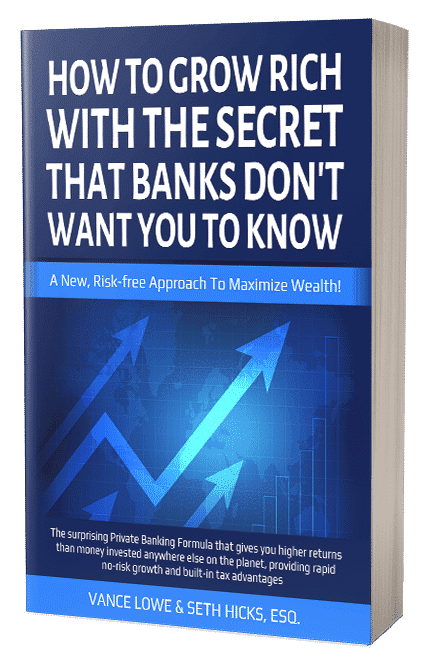
[00:13:07] Seth Hicks Esq.: It’s called How to Grow Rich With the Secrets Banks Don’t Want You to know. And in that book, we highlight a number of banking equation issues and how to take the banking equation back in your life. And you’ll also get an access only through those emails to Vance’s calendar. And if our podcast resonates with you, if our book is making sense to you, schedule a podcast, schedule an exploratory call with Van and get on a call with him and work through your numbers and see how.
[00:13:35] Seth Hicks Esq.: Private banking strategies will change your life. Vance. Any other remarks?
[00:13:40] Vance Lowe: We’ll set it up so that you can literally take this strategy for a test drive in your own current situation. Is there a more simple way to not take risk and get all kinds of gains? And that’s what this group really hones in on.
[00:13:56] Vance Lowe: And the answer’s absolutely yes. You can do this. [00:14:00] It’s easy. Lights come on. You don’t have to guess. You don’t have to assume that something’s going to happen. You just have to do your part. As you said. You’ve gotta do the pushups. Push up every day. Push up every month, whatever it, it calls for in your plan, you can’t help but succeed.
[00:14:17] Seth Hicks Esq.: That’s right. Thanks for joining us, folks. We look forward to seeing you on the next podcast. Bye-bye.
[00:14:23] Outro: Did that story feel like it was about you? Do you feel you should be making more progress toward your financial goals? Do you feel stuck? Let us help you get unstuck. Are you ready to take action and get your own private bank?
[00:14:40] Outro: Please visit us at www.privatebankingstrategies.com.
[00:14:47] Outro: Thank you for listening to the Private Banking Strategies podcast. Click the subscribe button below to be notified when new episodes become available.