[00:00:00] Intro: Welcome to Private Banking Strategies Podcast with Vance Low and Seth Hicks, your secret weapon to protect your assets and never have to start over financially again. Vance and Seth help high net worth individuals, families, business owners, and investors, structure and asset protected tax-free fortress for their families.
[00:00:21] Intro: Learn how to keep what you earn and use the velocity of money. To create your own private banking system. Join us on this journey as we explore the secret strategies of the rich and political elite and help you take total control of your financial security. Now onto the show.
[00:00:39] Host: Hello and welcome to Private Banking Strategies with Advance Low and Seth Hicks, Vance, and Seth, what’s going on?
[00:00:46] Vance Lowe: Hey, it’s great to be alive today. Even in a world of disorganization, but it’s fun to be here.
[00:00:54] Seth Hicks Esq.: Yeah, glad to be here, Darien. We’re excited about this podcast with you and looking forward to jumping into content. [00:01:00]
[00:01:01] Host: That’s excellent. Fantastic. Now I have to say, guys, I am very excited to be here with you. Uh, I am the new guy on the block, but I’m eager to learn from both of you, gentlemen.
[00:01:09] Host: So Vance, I understand that you introduced the show topic with the audience. So what do you have on the agenda today?
[00:01:15] Vance Lowe: Well today, uh, we base the topics on some of the experiences we have kind of on a regular basis, and some of the topics are a little bit seasonal. Some, there’s sometimes of the seasons that we tend to spend more money than other times could be, you know, getting into education.
[00:01:36] Vance Lowe: You know, in the early fall it could be vacation, so to speak, uh, you know, in the springtime wanting to get out. And then in the winter, you know, it could be spending money on Christmas or whatever else. And so we’re kind of in the middle of one of those seasons right now, and I think it’s general that we talk about it, but we end up [00:02:00] spending the money.
[00:02:01] Vance Lowe: You know, we decide we’re gonna spend some money and sometimes we try to do budgets and we do a lot of saving. We do all kinds of things to, uh, meet our expectations that we want, but we’re always under some sort of, uh, guideline. We only have a limited amount of income. We only have so much. And if we’re prudent and live within our means, that’s even harder.
[00:02:25] Vance Lowe: So if we’re gonna spend the money anyway. And then this might be the topic of today. Why not make arrangements to get the money back? If we can get the money back, then we can make the interest or the profits that the people who end up with the money are gonna get. So let’s explore that a little bit.
[00:02:48] Vance Lowe: Seth, what can you add to that, you know, in this season?
[00:02:51] Seth Hicks Esq.: Sure. Yeah. Well, you know, when people first hear that Darien, they think, uh, how do I get my money back? I have to spend, you know, [00:03:00] uh, 200 bucks on my utility internet connection and phone service. I’ve gotta pay for my electricity, my gas bill, my water bill.
[00:03:08] Seth Hicks Esq.: My trash and sewage, I’ve gotta pay for just general expenses on a monthly basis that just flow right out. I’ve gotta pay, generally a car payment may have to pay a house payment. And so those are typical expenses that most Americans have. And we like to use an automobile example to prove that people can get the money back a lot of times.
[00:03:33] Seth Hicks Esq.: And we’ve got, uh, an example. From one of the mentors and, and original OGs, we call him Nelson Nash in the infinite banking concept world, who actually utilized this with his own family members. And he had two twin sisters that were nieces of his, and they one strategy, one employed another. And we’re gonna take a quick look at that, not do a super deep dive.[00:04:00]
[00:04:00] Seth Hicks Esq.: And Vance is gonna walk us through that illustration and we’re gonna prove to you how you can get the money back and how not only you can get the money back that you’re spending on an automobile expense in this particular case, but that at the end of the road you will have. Uh, significantly and parabolically increased your wealth over the alternative methods of financing, even paying cash, just piling up cash, and then buying a, an automobile by cash versus using our methodology and the private banking strategies world and show you exactly what your wealth curve will be at the end of that road.
[00:04:38] Seth Hicks Esq.: So Vance, I’ll, I’ll hand you back the mic and we’ll dig a little deeper into Twin Sisters.
[00:04:44] Vance Lowe: Okay. All of the stems on a couple of of strategies that we live by and don’t even know, and it’s called a get Back to Zero strategy. We’ve been taught by our mentors, our parents, you know, and the [00:05:00] people that we trust that the best way to get through life is to pay cash for everything.
[00:05:06] Vance Lowe: Well, I’m here to tell you that’s just a hundred percent fallacy because we still end up financing everything a hundred percent. Everything we purchase throughout life, we finance, and that’s one of two ways. Either we pull money out of production and buy the item, and once we buy the item, where does that leave us?
[00:05:28] Vance Lowe: It leaves us back to zero if we’ve saved it up and we can’t put it to work. Okay, so normally if we have excess money, we’ve got it working for us. A lot of people think they have their money working for them when they don’t. A lot of people will show me when I ask the question, well, show me your assets that you have working, producing income for you or money for you.
[00:05:54] Vance Lowe: They’ll show. Stock accounts, mutual funds, they’ll show portfolios. [00:06:00] They’ll show 4 0 1 Ks, IRAs or anything else. And they’re absolutely shocked when I tell them and prove to them that you’ve put all that money to sleep. ’cause you have to leave that money in those accounts only to collect interest. You can’t use it.
[00:06:19] Vance Lowe: You can’t pull it out. And the problem is, are the people who are using the money. We believe that they’ll double your money on the average almost every two and a half years. Two and a half to five years, they’re going to double your money. How many of your counts have doubled, you know, at all? So it’s called a get back to zero strategy.
[00:06:43] Vance Lowe: Everything you know in life, when we think we’re doing the right thing, it’s still, we end up losing the money. We spend it, it doesn’t come back. Another catchphrase, what we use is, what arrangements have you made this [00:07:00] month to get last month’s expenses back? So if I were to ask you that, what would you say?
[00:07:07] Vance Lowe: I would say I haven’t made any.
[00:07:11] Vance Lowe: You’d say it’s impossible. Well, it goes along. Everyone’s heard, and sometimes people say, well, I don’t think I’ve ever heard that. I kind of don’t believe it. I’ve been around the block for a while. You can never ever spend principle. Everybody thinks that the Warren Buffets, Donald Trump’s all the successful families out there never spend principle.
[00:07:37] Vance Lowe: So what do you do with it? Also, and here’s the secret guys, do the banks always get the money back? What’s the answer to that? I would say banks always get their
[00:07:50] Host: money
[00:07:50] Vance Lowe: back. They always, some people I’ve heard now, you know, nine out of 10 say, yeah, they always get it back. And then that one will say, well. [00:08:00] Uh, there’s loans that default.
[00:08:03] Vance Lowe: No, no, no, no, no. Banks don’t, they don’t risk their money, and it’s called collateralization. If banks lend out a hundred thousand dollars, they’ll want a million dollars worth of collateralization, and they’ll keep going. If they can get more than that, they want control of everything. So this getting back to zero when it comes to cars, cars are a great thing because cars are a one of the largest purchases that we make and people decide, Hey, I am gonna buy a new car, but to get the value, I’m gonna drive it till it, you know, falls apart.
[00:08:45] Vance Lowe: Other people say, Hey, I’m making a good income, so I’m gonna upgrade my car every two or three years. Even today, in today’s economy, the American automobiles industry and the American cars that we have here [00:09:00] can be of great value if you know how to use them. And they are a tool. I really enjoy playing with people when I ask them if they have a car payment, a lot of people say, no, you know, I’ve paid off my car.
[00:09:16] Vance Lowe: And I go, that’s really, really interesting. So. The only way you convince me you don’t have a car payment is if you’ve torn up your driver’s license and you’re never driving again. ’cause what’s happening to the vehicle? Oh, well, it’s wearing out and eventually you’ll need another one. So my guru who really helped me along the path here, uh, on vehicles, put in a, uh, seminar book, an illustration on how to finance vehicles.
[00:09:48] Vance Lowe: And he had, at the time, most all these experiences in his book were on his family. Uh, he was older, he had some, uh, twin [00:10:00] nieces. They were identical twins. And the story he goes on to tell how identical they were as really something, I guess I’ve, I, I never saw him, but, uh, he, uh, set up a financing situation for the both of them to be able to finance vehicles.
[00:10:18] Vance Lowe: A lot of people will put money in a CD because CD is really a fast start. If you want something very, very short term, then not now anymore. This was, this was back when they were paying 6, 7, 8, 9% interest on CDs and uh, you would put money in there. Over time. I did that personally. I would save up my money in a CD and then I would pull it out and, uh.
[00:10:46] Vance Lowe: Go purchase my car. So they did that, uh, he and he did two illustrations. He says, okay, you guys want to use the cd, but I’ve got another plan for you. If you’ll put the amount of [00:11:00] savings, which is $5,000 a year into a contract that I wanna show you, it’s an old style banking contract. Let’s just compare over a lifetime what the two differences are.
[00:11:15] Vance Lowe: And so he went seven years of them accumulating $5,000 a year. I don’t know. Um, I think Seth, what we’ll do is we’ll provide this paperwork for him. You know, these illustrations should they, they ask for it because this was all, you know, spelled out. So he did that. He also showed if they did it in a cd.
[00:11:44] Vance Lowe: Okay. And at the end of seven years there was, um, and I’m gonna look off to the side here, so I’ve got the exact numbers that are in the book. The CD person had $41,000 plus some change, [00:12:00] and the person in the policy had 35,000. So there was quite a big difference. He goes in and tells a story about the, uh, the twin sisters communicating with each other, and we would do that on a separate basis.
[00:12:15] Vance Lowe: I’m just trying to touch the highlights here, but there was enough in both of these accounts for these two, uh, girls to start financing, and what they did is they took out $10,500. To, uh, finance part of their first car. They may have had a trade in or something else, but that’s the amount they financed and they pay, uh, set up a repayment schedule.
[00:12:43] Vance Lowe: This is where people go wrong. This is, they don’t pay themselves back. They take the cash by the item. But now you have to realize you have to pay yourself back so you’ve got the money back again to do it over again. And, and therefore you break out of the, get back to zero [00:13:00] strategy. So they paid themselves back annually.
[00:13:05] Vance Lowe: Now this is, it is like $166 and, and some change per month, $3,030 per month. Both of them did. Okay. In the cd, I think, uh, per year.
[00:13:17] Seth Hicks Esq.: It’s per year. Yeah, per year. Excuse me. Lemme just interject one moment. So we’ve got two different sisters. One’s gonna use the, uh, private banking strategy. The contract advance is describing, one is gonna use savings through a CD methodology at the end of seven years.
[00:13:34] Seth Hicks Esq.: The CD sister has 41,000. The person who used the private banking strategy, the other niece, the sister, she had just under 36. So CD sister saying, see I’m right. I make more out of a cd.
[00:13:48] Vance Lowe: Yeah, she was just hammering the other one. Yeah, hammering the
[00:13:50] Seth Hicks Esq.: other. Hammering the other sister, you know? Yeah. You made a mistake.
[00:13:54] Seth Hicks Esq.: Nelson doesn’t know what he’s talking about. Her uncle’s crazy. So they financed their first car [00:14:00] that apparently they buy the exact same cars and they, and they utilize the, you know, $10,550 of the CD for the one sister and they use $10,550. From the private banking, uh, contract that we’re describing, the other sister, so that’s just to summarize and and recap the, the foundation that we’re laying and they’re, they’re paying back themselves, both of them, $3,030 a year.
[00:14:27] Seth Hicks Esq.: So that’s just under $3,000 a month that they’re making car payments. CD sister’s paying it back into her bank cd and the other sister’s paying it back into her own private banking strategy.
[00:14:40] Vance Lowe: So this goes on, you know, until retirement, and they’re paid back every, every four years. So every four years they upgrade their car, they trade it in, and they keep financing a new 10,500.
[00:14:56] Vance Lowe: So at age 65, they now compare, [00:15:00] and the CD sister has $258,000 in her CD account. And the private banking strategy has just under $1 million in her policy. If they did everything exactly the same, why did the banking system, the private banking sister, have over $700,000 more than that one in the cd? You have any guesses?
[00:15:36] Vance Lowe: I’m really interested in your comments here as you hear about this. Why would there be such a big spread? Well, I’m
[00:15:43] Host: excited to hear what you guys are gonna say about this because the anticipation is building up over $700,000 in difference. That’s pretty, that is pretty impressive difference. What do you have to say on that piece?
[00:15:55] Vance Lowe: Let me explain that. Who owns the [00:16:00] CD bank? Other people, right? That’s correct. And they make all the profits. Well, these special contracts make you an owner of the life insurance company and they pay profits in addition to the guaranteed account every single year, and those profits were added back in. In addition to that, she got a ton of life insurance, over $800,000 of death benefit paid for during that time as well.
[00:16:33] Vance Lowe: But the beauty part, Seth starts, right? Uh, now, Seth kind of walk ’em through. They’re gonna start taking cash out. They’re now retired and they want to take income out just for this one illustration.
[00:16:47] Seth Hicks Esq.: Sure. So at retirement age, Darien, they’ve got very disparate amounts to draw from. The CD sister has 200 and let’s call it $260,000.
[00:16:59] Seth Hicks Esq.: [00:17:00] The private banking strategy sister has just under a million. So they both start to draw down for retirement needs. And this illustration is a few decades old because these sisters, you know, were younger at when Nelson. Implemented this. So these numbers change with current day values, but this, the illustration still remains.
[00:17:22] Seth Hicks Esq.: So the CD sister pulls out $50,000 a year, and the private banking strategy sister pulls out $50,000 a year. Well, at the end of, as you can tell, five and a half years, a little more than five and a half years, 50,000, 50,000, 50,000, 50,000, 50,000, then 34,000. The CD Sister’s outta money. Her retirement fund is totally depleted, whereas the private banking strategies sister, she draws $50,000 down into death and then she, she doesn’t even use it all by the time she passes on and the death benefit you made [00:18:00] One error Vance and the, and discussing the death benefit.
[00:18:04] Seth Hicks Esq.: She didn’t have $800,000 in death benefit she had. Over a million dollars in death benefits she had, but by
[00:18:10] Vance Lowe: the time she dies through life expectancy,
[00:18:13] Seth Hicks Esq.: right?
[00:18:13] Vance Lowe: Because you see the life insurance in these contracts grow every year. The death benefit amount, it increases every single year. So she could take $50,000 out for the rest of her life, however long that was, and still pass $1.3 million to errors.
[00:18:32] Vance Lowe: Everybody buys cars right? Why not do it a smart way? You don’t have to pay a dime more. That’s what we’re trying to get at. There’s a better way for you to finance and buy things, okay? But you’ve gotta set it up in advance. You’ve gotta know how money works, so we’ve gotta stop treating money like it’s worthless.
[00:18:58] Vance Lowe: If I were a [00:19:00] Martian for instance, and I studied a couple and watched what they would do, they would go to work every single day, fight through traffic, uh, maybe have problems at work. ’cause the bosses irate one day and you know, they cut budgets on the next day. Have to deal with all that. Then turn around and pay Uncle Sam and everybody else before they get to bring home their paycheck.
[00:19:23] Vance Lowe: Okay. And then I watch them spend that as fast as they can so that they don’t have anything left over. At the end of the month,
[00:19:32] Outro: did that story feel like it was about you? Do you feel you should be making more progress toward your financial goals? Do you feel stuck? Let us help you get unstuck. Are you ready to take action and get your own private bank?
[00:19:49] Outro: Please call private banking strategies at (817) 200-4777. Or visit us at [00:20:00] www.privatebankingstrategies.com.
[00:20:03] Vance Lowe: I would come back to my mart and superiors and say, Hey, these guys hate money. They burn it as fast as they possibly can. People don’t realize that if I spend a dollar, all I have to do is go back to work and earn another dollar.
[00:20:18] Vance Lowe: You know, total fallacy, we’re taught that, but it’s wrong. You. Have to make money for your employer, and that’s at least three to one, but probably more between five and 10 to one. Your efforts. And it could be a lot more. We think it’s more like 25 to one. You’ve gotta make and produce $25 under your efforts and have it go through the system for you to get into your paycheck.
[00:20:48] Vance Lowe: A dollar. 25 to one. How fair is that? ’cause you gotta pay everybody else. You gotta make money for everybody else because you spend a dollar for you to just replace that dollar. [00:21:00] Folks, how insane is that doing that? Every single month? Every day we’re going, going back to work. Why not set up a strategy like the banks?
[00:21:16] Vance Lowe: And get the money back. And then when you go to work and you bring home a new paycheck, it adds to the total. So wherever increasing on a monthly basis. Rather than the average American either staying even or going further into debt. Seth, uh, what is it about, uh, where are we on the, uh, deficit these days?
[00:21:39] Seth Hicks Esq.: I think it’s 33 trillion, over 33 trillion in, uh, debt that the, from the printing of money effectively?
[00:21:47] Vance Lowe: Uh, effectively, yes. So. One of the educations that we were denied was how to be independent. Um, [00:22:00] schools used to teach people how to survive, how to be able to go out on their own and survive, and they taught how money worked.
[00:22:08] Vance Lowe: And that education was taken away when, I like to say when our country was conquered back in 1900, you know, uh, it’s, the Federal Reserve was born during that time. And the Federal Reserve, I believe, has taken over pretty much everything. Our government, everything else, and all the mandates that came down.
[00:22:30] Vance Lowe: And the social programming started at that time. And. I think after World War ii, they announced a, uh, communist agenda of 46 or 48 things that had to occur in America. And that was completed, uh, at least 15 years ago. They were, had completed everything on the list. So where are we going folks? We think Seth and I feel that, uh, this is [00:23:00] our salvation if we understand how we can be totally independent.
[00:23:04] Vance Lowe: Living literally off grid. We teach people how to set up their own economies. We used to give a little example, uh, of a gold coin. I’ve changed that to make it more realistic today. Literally, we had enough skills when we graduated high school to go out and start our own town. Had we, you know, retained that type of teaching.
[00:23:33] Vance Lowe: And in your own little town, of course you’re gonna have a, some sort of a bank there. But let me give you a great example of the flow of money that’s not happening in your lives. I’m on a trip and I’m almost out of gas and there’s a little town coming up and I am doing a calculation right now. Can I make it to the town after this one or should I stop here to fill up with gas?
[00:23:59] Vance Lowe: Well, I [00:24:00] decide to stop here, fill up with gas, pay 50 bucks to the gas station, and now I’m gone. But town has a new 50 bucks, right? And the town exists to attract new money, whether it’s from commerce, uh. Tourism employment, whatever that town does, it’s attracting new money coming in. It has to, and a successful town will attract more money coming in than they’ll be losing, you know, out the back door, so to speak.
[00:24:37] Vance Lowe: It’s called Parkinson’s Law. You can read about that, uh, in other books, but, okay, so town now has a new 50 bucks. That gas station owner says, Hey, I just got 50 bucks. I’m gonna take it across the street to the grocery store. I’m gonna buy $50 worth of groceries. So he brings back $50 worth of groceries, but now the grocery [00:25:00] store has my 50 bucks.
[00:25:02] Vance Lowe: The grocery store owner says, Hey, I sold inventory, so I’m gonna go restock my shell. So I, he goes across town. To the warehouse buys $50 worth of inventory, brings back $50 worth of product, and now the warehouse has my 50 bucks. Warehouse owner says, I’m gonna go get my teeth fixed. So he goes to the dentist, you know, gets $50 worth of dentist work done.
[00:25:26] Vance Lowe: Dentist turns around and says, I gotta have a, my car fixed. He goes to the mechanic. Now the mechanic’s got my 50 bucks. The mechanic turns around and gives it, uh, takes it to the restaurant to treat his, uh, little. Daughter and his whole family to a birthday dinner all in one day. So how much money did it take to accomplish that?
[00:25:51] Vance Lowe: It only took $50. But this happens in an economy and it’s called velocity. [00:26:00] How many times can you get a dollar to stop? To produce a dollar’s worth of product or services, and it’s the same dollars going over and over and over and over again. It’s absolutely critical that we have that occur in our lives, and we can do that.
[00:26:18] Vance Lowe: But right now it’s escaping us. Once we spend the money, it’s gone forever. Now, what would’ve happened, Seth in town had I said, oh, I can make it to the next town, and I just blow by.
[00:26:33] Seth Hicks Esq.: Well, that town doesn’t have the, the capitalization in their economy to move from one service to the next and one good to the next.
[00:26:43] Vance Lowe: Okay. We teach families how to get back 100% of their monthly expenses. We have never had a disagreement or somebody who hasn’t agreed with that 100%. And this. [00:27:00] Again, during these times when we feel like we wanna spend money, we want to go places. I’ve always believed I’m, I’m not a budget person at all, but I’ve always believed, uh, when somebody tells me, Hey, we wanna take a $10,000 vacation, you know, maybe every three or four years.
[00:27:20] Vance Lowe: I go for it. The only thing I require is that you have the money in advance. You know, because I as a financial consultant or whatever else, I want you to have the money and want you to get the money back. This way. Before I even knew about this strategy, we would talk about, you know, sound money principles of, of having the money back in their accounts.
[00:27:43] Vance Lowe: Well, if we set up as a bank, the banks always get the money back. So now I’m gonna ask you another question. How do the banks always, why, how and why do you think the banks always get the money back?
[00:27:56] Host: This is a lot to unpack, I have to say, from a, a customer [00:28:00] standpoint. Right. And for everyone listening today, uh, you guys have done an excellent job breaking this down, Seth.
[00:28:05] Host: Before I answer that, I have, uh, two things. That I wanna ask you and then Vance, I wanna ask you a question as well. I wanna start with you, Vance. You just said, and I don’t mean to go completely off topic, but you did just say that you’re not a budget guy. Can you explain what that means for you and the benefits of not being a budget guy?
[00:28:23] Vance Lowe: I don’t live by a budget. I don’t set a budget out every month and then try to live by it. I’m not that particular. Most people are whatever works for somebody, works. It’s just me personally. I put everything on a credit card. Now I have to justify what I spend, you know, to the credit card. ’cause I’m paying the credit card out every month.
[00:28:45] Vance Lowe: That’s all I meant by
[00:28:46] Host: beautiful budget. Okay. Alright. Uh, and then to answer your question, based on the logic that was presented today, I would say that the banks always get their money back by the flow of cash from other places, right? Just like you mentioned, $50 coming into a town, the bank’s eventually gonna get it [00:29:00] back by passing hands down.
[00:29:01] Host: Am I correct?
[00:29:03] Vance Lowe: That is a really good observation.
[00:29:08] Host: Can you please tell us,
[00:29:11] Vance Lowe: banks get the money back by obligation. Obligation. Okay. Now, what days of the week does a bank give away free money?
[00:29:20] Host: Oh, I’m gonna be over to today. What day does the bank
[00:29:25] Vance Lowe: who don’t, so if they don’t give away free money, the, and they get all the money back, they have to lend it, don’t they?
[00:29:35] Vance Lowe: Under contract. So all money, all resources with a bank, bank, presidents, everyone else at the bank, they can’t just go take money out of the bank, they’ll go to jail. Okay? So they have to borrow it just like everybody else. And that’s what we’re talking about. If we set up our own system, our own bank, we put all our money in our own bank, okay?[00:30:00]
[00:30:00] Vance Lowe: And now we have to move money from our bank account to our personal account. That’s the secret we’re not gonna go into, into great. Any more detail. ’cause you know, we spent, uh, kind of enough time talking about ways to get the money back and ways to use money, much more smarter ways to use money more than once inside the town.
[00:30:22] Vance Lowe: The reason the town gets so wealthy or prosper so much is called velocity. How fast can we move the money? Because every time it stops, it creates another dollar’s worth. So Seth expound on that a little more if you want.
[00:30:42] Seth Hicks Esq.: Sure, sure. Yeah. Well, the banks, they get the money back because they make, uh, loans and they generally collateralize their loans.
[00:30:50] Seth Hicks Esq.: That mean they secure their loans. They take a mortgage, a lien instrument against your car until it’s paid off. They take, uh, uh, they take a lien against your house [00:31:00] till it’s pay it off. They take a lien against your business till it’s paid off. And all of the people that. You know, or in that town example, let’s say they all bank at the corner Bank on First and Maine and it’s Wells Fargo or Bank of America.
[00:31:12] Seth Hicks Esq.: So Bank of America has got multiple loans, one to the dentist, one to the mechanic for their businesses, one to the grocer for uh, an equity line so he can make sure he is always got something on his shelves. And all that money comes, flows right back into those banking entities we’re saying. That there’s a different way, and you can actually set up your own banking system where the money comes back to you and you set up agreements between your banking entity and however you borrow the money.
[00:31:41] Seth Hicks Esq.: Let’s say you have a business and you borrow that money out of your banking entity and you lean the business for the loan that’s made to your business, or you may loan money to a third party. And you collateralize that loan as well. And so all the money that’s coming into your control, you set up and put it to work in other [00:32:00] lending transactions so that that money is flowing back to your bank.
[00:32:04] Seth Hicks Esq.: And that bank happens to be a whole life insurance contract that’s carefully structured and the appropriate way which you own a part of as the. An owner of the insurance company, you’re getting paid dividends. And one of the things that we haven’t said, the reason that this twin sister had so much more money at the end of retirement is because of the phenomenon of compounding interest.
[00:32:29] Seth Hicks Esq.: So the amounts in her bank compound and grow annually without any tax consequence at all. And so when you look at these summaries that we’ll provide in. The show notes or as a PDF to folks who wanna look into the illustration. Take a look at every 10th year and you’ll see this money parabolically increasing for the sister who’s using private banking strategy.
[00:32:57] Seth Hicks Esq.: And that’s how she comes to a million dollars in cash [00:33:00] value at retirement age.
[00:33:02] Vance Lowe: Yeah. So people always wanna know how, you know, how do, how do banks make money? Well, they do it. This way and they also cheat. We can get into that later. But if you look, this $700,000 difference is what other people made on people buying cars, you know, and using that money that that’s, that’s the money we lose if we don’t take control and, and be the bank.
[00:33:31] Vance Lowe: Now this, if this will create. From, what was it? 25 years old till 65, a million dollars, $10,500 of financing. What would that total be if we financed 21,000 during that time? Would it be twice as much? Yes. And if mom financed a $21,000 car and dad financed a $21,000 car [00:34:00] under their own system, they’d have $4 million in the retirement account.
[00:34:04] Vance Lowe: What did they have to do? Where did they, you know, did they have to tie it up somewhere? Did they have to go here? Did they have No,
[00:34:11] Seth Hicks Esq.: and that’s an important part of this, is that they gotta buy a car anyway.
[00:34:15] Vance Lowe: Yeah,
[00:34:15] Seth Hicks Esq.: so you’ve gotta earmark funds to purchase the car. And so whether you use the auto dealership to finance the car and they extend you credit, whether you use a cd, whether you use cash savings, you’re gonna have to have a car.
[00:34:28] Seth Hicks Esq.: In our example. I mean, you know, unless you live in Manhattan and you take the subway everywhere, you know, that doesn’t apply to most of the Americans in our culture. You have to have a car, you have to buy certain things, and those, that money that you’re already earning, that you have to pay for your car, you can do it in a different way.
[00:34:45] Seth Hicks Esq.: And instead of having, you know, nothing at the end of that, you can have a whole lot. One thing I want to add too, the, the CD. When you look at the automobiles, okay, and let’s just say that you hold it for seven years and each of these sisters, or [00:35:00] let’s just say you and I, we both hold an automobile for seven years, and you finance that automobile through the car dealership and at the end of your.
[00:35:09] Seth Hicks Esq.: Uh, financing arrangement with the auto dealership, you don’t owe them any more money. You own the car free and clear. Let’s say it was $50,000 to start and then after seven years, it’s worth 25. Let’s say it’s half that you have a $25,000 asset and a $25,000 car. Me, I use the private banking strategy contract.
[00:35:29] Seth Hicks Esq.: I pay my own banking entity back. So the $50,000 that the car cost, it comes right back into my bank. At the end of that seven year period, I have a car that’s worth 25,000 just like you do. There you go. And I’ve got the $50,000 back, but not just the $50,000. I’ve got the interest and I’ve got the annual compounding return year after year.
[00:35:52] Seth Hicks Esq.: So I’ve got 65,000 plus 25, let’s call it. 80, 85, 90, you know, and [00:36:00] let’s, we will use approximation. I’ve got a heck of a lot more than you do. You’ve got a depreciated asset worth $25,000 and I’ve got, I’m flush with cash, not just the 50,000, but the interest and compounding growing return. And I’ve got the asset of $25,000 car.
[00:36:17] Seth Hicks Esq.: So there’s a massive difference that, does that make sense to you? Oh my gosh, a hundred percent.
[00:36:22] Host: It makes sense to me. That’s, that’s something that everyone here listening today should definitely take into one appreciation for what these guys are offering. And then two, reflect on what you guys are doing in your day to day life and see how you can switch to the private banking strategy.
[00:36:36] Host: ’cause it could be the difference, just like our gentleman here have said in this example, difference between hundreds of thousands of dollars when it’s all said and done.
[00:36:44] Seth Hicks Esq.: And that’s why we use something that’s simple, like a car example, an auto purchase, an auto financing arrangement, because everybody generally has that type of arrangement.
[00:36:53] Seth Hicks Esq.: But you can also do the same thing with your homes, with your businesses. And another show, we’ll get into [00:37:00] how you can use this in a business. And there was a gentleman that Nelson Nash, uh, had in his family who had a foresting business, and he used. A lot of heavy machinery, like expensive, heavy machinery on a, a routine basis to clear forest, to process lumber.
[00:37:16] Seth Hicks Esq.: Uh, and he began to use this, his own private banking entity and contracts to finance his equipment purchases rather than using a third party bank. And so you talk about an automobile. Scenario on steroids. That’s what the equipment financing is. So you take it from just purchasing automobiles to utilizing it in your business, and instead of having a million, you’ve got multiple millions, maybe even tens of millions in that cash value.
[00:37:46] Seth Hicks Esq.: But we’ll segue into another episode with that example. Yeah, I think it’s a good place to kind of. Yeah,
[00:37:52] Vance Lowe: Seth, let’s tell people how, you know, they can, they can kind of find out more. I always tell people, we want to get [00:38:00] you ready to take this for a test drive at no obligation. Kind of tell ’em how we do that.
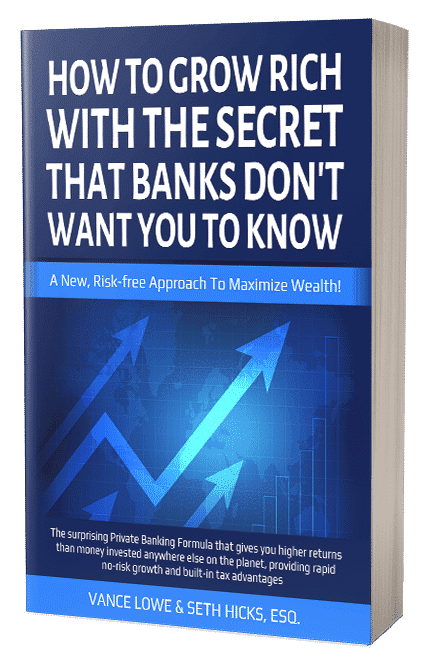
[00:38:05] Seth Hicks Esq.: Sure. Well, the first place that you, you learn about private banking strategies is on our website. It’s private banking strategies.com. That’s private banking strategies. All one word.com and there you’ll have, uh, an offer that we give for a book that we like to call a red pill book that dives into some of these concepts, and we’ve made it available to folks in A PDF or in an audio version so that you can listen to it on the go or you can read it if you’re a reader.
[00:38:36] Seth Hicks Esq.: And that’s our real entry point to. Understanding some of these concepts that we’re talking about, like compounding interests and how, uh, the banking system that most people use is really not a safe place to keep your money. And they’re, and they’re making money off of you and you can actually make the money yourself.
[00:38:52] Seth Hicks Esq.: So once you’ve read that book. We, uh, have all of our podcasts available to our audience on our website, [00:39:00] and you can start in various places. There’s titles that may resonate with you over another. Take a look at a couple of the podcasts. If you want to just start from the very ground zero, start at number one where the intro is, and you can get some foundational block work and what we’re doing there.
[00:39:17] Seth Hicks Esq.: If those things resonate with you, then you can schedule a call with Vance. Through an exploratory call process where he digs in deeper into your particular situation, your family, your finances, your motivations, and starts to begin that process with you in an exploratory call. So that’s kind of our, our general starting point.
[00:39:39] Host: Fantastic. Vance and Seth, thank you for your tremendous insight today. I’m sure the audience has a few questions, but after this, you know exactly who to get in touch with. All thanks to you guys. So guys, any last words before we wrap this up?
[00:39:52] Vance Lowe: I just wish everybody out there to stay safe and, uh, think smart about money.
[00:39:58] Host: Very well said. Yeah. Thank [00:40:00] you. Excellent. All right, guys. Thanks so much for the insightful day, and thank you to the audience for tuning in and supporting the Private Banking Strategy podcast with Vance Low and Seth Hicks. If you’re not subscribed to the podcast, please hit that button below so that they’re up to date when Vance and Seth come out with new episodes.
[00:40:15] Host: And then lastly, if you have any questions. Please email us or visit, like Seth said earlier, the private banking strategies.com website. As soon as you can, this podcast is about educating you, so we want to hear from you all. We also remind you to review and share this episode as it helps others find this show.
[00:40:31] Host: Again, thank you for tuning in. From everyone here at Private Banking Strategies, this is Darion reminding you the secret of getting ahead is simply getting started and we’ll see you next time.
[00:40:40] Outro: Did that story feel like it was about you? Do you feel you should be making more progress toward your financial goals?
[00:40:48] Outro: Do you feel stuck? Let us help you get unstuck. Are you ready to take action and get your own private bank? Please call private banking strategies at [00:41:00] (817) 200-4777 or visit us at www.privatebankingstrategies.com.