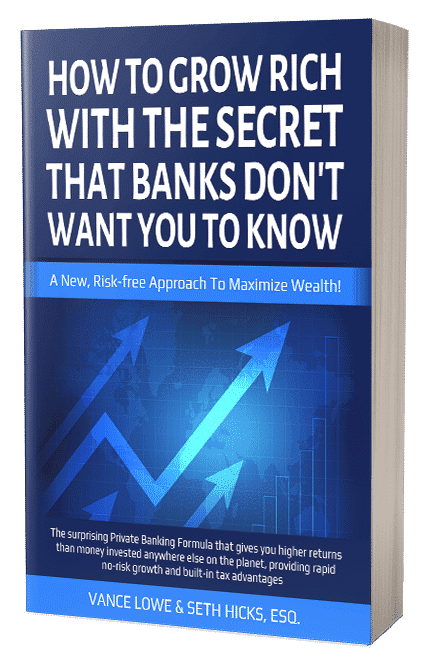
[00:00:00] Intro: Welcome to Private Banking Strategies Podcast with Vance Low and Seth Hicks, your secret weapon to protect your assets and never have to start over financially again. Vance and Seth help high net worth individuals, families, business owners, and investors, structure and asset protect. Tax free fortress for their families.
[00:00:21] Intro: Learn how to keep what you earn and use the velocity of money to create your own private banking system. Join us on this journey as we explore the secret strategies of the rich and political elite and help you take total control of your financial security now onto the show.
[00:00:42] Eric (Host): Hello and welcome to Private Banking Strategies with Vance Low and Seth Hicks. Gentlemen, how are you today? Doing
[00:00:47] Vance Lowe: great, Eric. Thank you. Yeah, we’re just wonderful.
[00:00:51] Eric (Host): Alright, well, I, I’m excited to be back with you again. We’ve had a little bit of a break during the summertime and, uh, a lot of things going on, and today we’re talking about something that I think is [00:01:00] on everybody’s mind, who’s getting close to retirement or who’s, who’s really thought about retirement in any way, shape or form, and what they need.
[00:01:07] Eric (Host): Um, and that’s, there’s usually two questions, right? And correct me if I’m wrong, but. You know, will I have enough money? Is one of the questions. And then how much money do I have? Do I need to retire comfortably? I think that’s kind of what you guys are addressing today.
[00:01:21] Seth Hicks Esq.: Absolutely. That’s exactly the title of this is Do you know how much money you need to Retire Comfortably?
[00:01:27] Seth Hicks Esq.: And we find that most people haven’t really taken a, a deep dive to calculate numbers and understand how much money they need to retire comfortably. But if you’ve gotten serious. Uh, about your retirement planning, then you need to know how much money you need to have. Mm-hmm. Um, one of the things that we run into, people think, well, if we’ve got a million dollars in nest egg, then that, that should be sufficient.
[00:01:51] Seth Hicks Esq.: And others think well probably need 2 million. But when you actually calculate. Uh, that into withdrawal, uh, [00:02:00] yearly withdrawals, a million dollar nest egg will only provide for a $28,000 withdrawal through the rest of your retirement. And would you want $28,000 for the rest of your retirement, Eric?
[00:02:13] Eric (Host): I could use 28 grand right now, but no, I can’t live on $28,000 a, a year for the, for my entire retirement.
[00:02:20] Eric (Host): And I wanna go back because you kind of went really quickly over 3 million bucks. I, I’ve heard 1 million and I’ve heard. People even say you need $2 million of retirement, but you’re saying three. And now that you’ve, that’s kind of given me the numbers for 1 million man. Yeah. 28 grand is not, is not much to live on.
[00:02:36] Eric (Host): There’s not a lot you can do with that in, in one year.
[00:02:39] Seth Hicks Esq.: Well, numerous planning experts, uh, have opined that this, this number is increasing and there’s a number of reasons three that we’re gonna focus on here in this podcast. Okay. For why? Uh, $3 million is something that you should shoot for to create that nest egg.
[00:02:57] Seth Hicks Esq.: But Fortune Magazine cite multiple [00:03:00] planning experts saying that you’re gonna need $3 million to enjoy a decent retirement lifestyle. And there’s three reasons why. Number one is inflation. Um, now Vance, he gave an illustration in a prior podcast about. Lumber cost. Yes. And, uh, just, you know, lumber cost a two by four costing two, three bucks a year, year and a half ago now, costing 10 bucks.
[00:03:26] Seth Hicks Esq.: Mm-hmm. So this is, this is absolutely. Illustrative of many, many things going on. There’s a Mercedes, SUV, that’s military grade used to be a hundred thousand dollars five years ago. Now it’s $300,000. True. Uh, cost of housing, for example, especially in. Coastal places. Mm-hmm. I mean it, it’s three x four x, five x, uh, housing costs.
[00:03:53] Seth Hicks Esq.: Even in Texas, which was pretty well flatlined has began to rapidly increase. So inflation [00:04:00] is rapidly eating, America’s spending power and you know, there’s multiple reasons, but Vance, you could probably comment on this, the Fed reserves interest rates and the artificially suppressed rate and how that affects our spending power.
[00:04:17] Vance Lowe: Yeah. One of the things I wanna do is just jump in in here a minute and, uh, go over some of the reasoning and some of the motivation. We think this podcast is so important to everyone. We have noticed a considerable increase in people’s, people being worried about. Their money. Mm-hmm. They see what’s going on with government.
[00:04:40] Vance Lowe: They see the unprecedented spending that’s totally out of control. And they realize that the end result of that is the, uh, inflation. They’re not even announcing. I, I don’t know Eric, if you’ve heard, but I haven’t, I haven’t heard what the actual inflation rate is this year. [00:05:00] ’cause I don’t think they want to announce it.
[00:05:02] Vance Lowe: They haven’t said a word. Not that, not that I’ve seen. But I do know, and, and we do know that they are trying to increase that inflation in order to erode the purchasing power and people’s nest eggs, let alone the new tax rates that are coming out. This is one time I’ve never, uh, I, I’m just lost for words as to why our government hasn’t announced what they’ve already passed.
[00:05:32] Vance Lowe: There’s a whole new tax law out there that they’re sitting on in the past. And I think what the Constitution requires is that new laws, new procedures gets announced so that the public can voice their opinion to the representatives and then the representatives vote. But everything’s dark now. So the reason I wanted to touch on this with the federal reserve rate.
[00:05:58] Vance Lowe: Uh, being held down [00:06:00] so artificially low, it’s devastating on the economy and every way you look, every which way you go. Then you add a COVID or a pandemic, and. What on all the harbors all around our country is just stacked with, you know, freight liners, uh, just, you know, ships out there waiting to dock, waiting to put in, waiting to bring in supplies.
[00:06:28] Vance Lowe: And because of the shortness of supplies, everything has gone skyrocketed. Mm-hmm.
[00:06:33] Eric (Host): Mm-hmm.
[00:06:34] Vance Lowe: So folks, what we have to do is pay attention to what’s going on. And we have to look at alternative ways that money is used, money is earned, and the ability to hopefully maybe use a dollar more than one time. I think maybe we, we’ve talked about this before in other podcasts, but it’s, it’s shocking news to me [00:07:00] when we started reading these articles and it’s now recommended at.
[00:07:03] Vance Lowe: $3 million. That really honestly only does produce 28 grand a year. And if you’re satisfied with that, that’s fine, and that might work today. But if inflation gets any higher. You think that’s not gonna have to increase? Yeah. Yeah.
[00:07:21] Seth Hicks Esq.: Yeah. Well, correction, it’s $1 million. Uh, nest egg would leave you with 28,000.
[00:07:26] Seth Hicks Esq.: Oh, excuse me. Yeah. Per year to retire on. But if we get to the $3 million point, you got an $84,000 withdrawal over the rest of your retirement. And that may sound a lot better to some and think, well, I could, you know, I could probably make it on 84,000. Well, not if that 84,000 is really 42. And 42 really becomes 21.
[00:07:45] Seth Hicks Esq.: And in the next 15 to 20 years, you’re totally, uh, hamstrung with
[00:07:51] Vance Lowe: the, and not even mention cut in half. Mm-hmm. Yeah. Not even mention the, uh, horrendous, uh, cost of, uh, medical at this point. [00:08:00]
[00:08:00] Seth Hicks Esq.: So, and that’s, we’re gonna get into that, we’re gonna get into the, the reasons two and three. Um, second reason that we want to highlight for why you need $3 million or, or more on a nest egg is the inflationary printing of money.
[00:08:15] Seth Hicks Esq.: We have a nearly, uh, $30 trillion. And the historic average on inflation’s been 3% a year. Well, you can look around at goods and services and say, yeah, this, this is not, uh, an inflation rate of 3% a year. We have to earn more and we have to be smarter, like fans said, getting multiple touches on the same dollar and maximizing the value of every dollar that comes under our control.
[00:08:43] Seth Hicks Esq.: And we’ve went into this in prior podcast with the twin sisters auto financing and Paul Bunion, how they have a predictable, um, nest egg that has no tax ramification when they begin to take withdrawals. And they know every, uh, month of, of [00:09:00] every year exactly what’s in there. Private bank to be able to pull out.
[00:09:05] Seth Hicks Esq.: And so that, that provides a way to keep up with inflation or combat inflation. But even, even considering that if you just had a 3% inflation rate, the, your cost of living’s gonna double in about 20 years. Think about that.
[00:09:21] Vance Lowe: Yeah. Yeah. I can’t, uh. Uh, I don’t think I’ve got the time to share with everybody the devastating effects that people, when they face retirement, they’re ready for retirement.
[00:09:36] Vance Lowe: Um, many times they’re forced into retirement and they’ve gotta live on what they have and they run outta money. So they’re forced to live on, um. Welfare course, social security. Mm-hmm. And we’ve got a huge problem, Eric, right now with Social Security, is that the graying of America, you know, many more people are, are [00:10:00] applying on social Security now than is entering the workforce and pretty darn quick.
[00:10:06] Vance Lowe: That role is gonna reverse and we’re gonna have a terrible strain on social security as to whether they can make that payment or not.
[00:10:15] Eric (Host): Mm-hmm. Yeah. It’s, it’s just, it, it’s, it’s almost like the perfect storm is coming, right? Because the, the dollars it seems to me, and, and what we’ve been talking about is losing its value and the price of goods are, are just going up.
[00:10:30] Eric (Host): So it’s not just one or the other, it’s both together. I can’t even imagine what the numbers will truly be on what a dollar can buy in 10 years or 20 years. And to your guys’ point. People are retiring at 65, but the new numbers that come out for how long people are living, it’s 20 to 30 years in retirement.
[00:10:51] Eric (Host): I, I just, I, I’m 47 years old and it’s hard for me to think back when I was 17, right? That was 30 years ago. That, that’s not, I don’t remember what I was [00:11:00] doing then. I don’t remember. I can’t imagine having to live off of one lump sum from the age of 17 until now. What that would’ve looked like and, and how crazy that would’ve been with all the market interruptions we’ve had and all those different things, let alone inflation, you know, the prices of things.
[00:11:15] Eric (Host): It’s, yeah, it’s, it, it is, um, these aren’t scare tactics that you guys are using. You’re just bringing facts. It really does concern me, you know, from, from where I’m at now, 20 or so years from retirement. Am I gonna be able to get enough? Secured to have that retirement that I want to have without having to, you know, rely on government assistance or government housing of some kind, or food stamps or whatever.
[00:11:39] Eric (Host): Uh, and that’s, nobody has a crystal ball, but boy, it’s better to be prepared than be concerned.
[00:11:46] Midroll: Do you see yourself in that story? Do you feel like you are generating a lot of revenue but are not moving forward as fast as you would like? Are you ready for help? Please call private banking strategies at [00:12:00] (817) 200-4777 or visit us at www.privatebankingstrategies.com.
[00:12:13] Vance Lowe: We have to try to make, uh, or advise people to do. Is get away from what I call the ostrich syndrome. Mm-hmm. Everyone’s hearing this, everyone’s being alerted, they’re scared, you know, they don’t know what what to do, but reality kind of sits in, you know, a little bit of laziness. You know, we talked about that a little earlier.
[00:12:35] Vance Lowe: Mm-hmm. And procrastination. And then pretty soon, another year goes by. The older I get, the faster time speeds up. And if we don’t address this right now. Then the choices will be made for us. You know, Eric, I’m gonna write a book someday. It takes great effort. To fail in America. Mm-hmm. It is done by, you know, choice.[00:13:00]
[00:13:00] Vance Lowe: Every decision made, whether to be successful or not successful has to be made. You know, it’s just amazing. So Wake, we’re trying to set an alert out there, a wake up call now. Right now is the time. You still have a little time to prepare, uh, and get things going, uh, for your betterment. Rather than to just watch it all slip away.
[00:13:24] Vance Lowe: Mm-hmm.
[00:13:25] Eric (Host): Now you guys brought up healthcare earlier and I know that that’s the third reason. Um, so let’s dive into that a little bit, bit more.
[00:13:32] Seth Hicks Esq.: Well, fidelity Investments did a study and they, uh, their statistics show that a 65-year-old couple, uh, retiring now will need $300,000 in out of pocket. Uh. Medical expense cost, they’ll have to have $300,000 clear.
[00:13:49] Seth Hicks Esq.: And that’s not covered by Medicare, and that doesn’t account for inflation. And on top of that, 70% of Americans, they say over 65, are gonna require long-term healthcare [00:14:00] with 40% needing nursing home care, which cost $250,000 a year. Also not covered by Medicare and not accounting for inflation. So we’re talking about.
[00:14:12] Seth Hicks Esq.: You know, multiple hundred of thousands of dollars to deal with healthcare costs. And, and Vance and I have clients in, in the retirement, uh, genre. And it’s very common for them to have knee surgeries and back surgeries and all sorts of other medical needs and have to come up with plans at, at accessing their private banking funds to be able to provide for that care.
[00:14:37] Seth Hicks Esq.: And if people haven’t. Thought of that and haven’t accounted for that, it’ll totally wipe out your entire nest egg and your $28,000 a year will become a very real reality or less. Mm-hmm.
[00:14:54] Vance Lowe: So it’s a wake up call. It really is. It’s uh, everybody and everybody has their ear [00:15:00] and knows the runaway inflation.
[00:15:04] Vance Lowe: Our government and Medicare costs, we all are alerted to this. So we need to figure out what to do and not. Waste time getting our affairs in order. Mm-hmm. So I think that’s critical.
[00:15:20] Eric (Host): Well, I, I know that you guys have provided a ton of information on the previous podcasts, and I know that a lot of what you’re talking about today and a lot of the concerns that you’re addressing today, you address through private banking strategies.
[00:15:31] Eric (Host): So let’s, let’s turn this ship around a little bit because it was a lot of, not gloom and doom, it’s just factual information you’re sharing. But, um, it’s tough to hear that a lot of times. And so let’s, let’s. For the remainder of this podcast, let’s leave some good news on the table for the listeners. How can private banking strategies help alleviate these concerns?
[00:15:51] Vance Lowe: Well, I’m glad you asked that, Eric, because one of the things that Seth and I are seeing right now, we are just absolutely. [00:16:00] Swamped with inquiries. How can I do this? I’ve heard from my friends, here’s, here’s a way that somebody’s being able to get money back. Or, here’s a way that my friend over here ha, has convinced me that he’s using dollars more than once.
[00:16:13] Vance Lowe: Mm-hmm. Uh, in his system. So this is what it’s all about, is creating your own environment. We call it an economy. Uh, and we, we delve down into this, so we’re not gonna do that in this podcast. But the, the reasoning here is, is when money comes in under our control, we don’t wanna let go of that control.
[00:16:35] Vance Lowe: Mm-hmm. If we do it the way most of us are programmed, it benefits the banks, not us, because the banks always get the money back, right? Mm-hmm. And if the banks can get the money back. You and I can too. All we have to do is almost follow the same strategy. So, um, we have a, a detailed way of being able to learn that strategy [00:17:00] and get themselves into it where they stand today and never look back.
[00:17:05] Vance Lowe: How about being more private? How about having a less tax load, uh, on, on growth? How about getting a much. Fair or higher return that doesn’t have any economy risk or market risk or risk of theft. Uh, this is all entailed. And again, we’re going as fast as we can with the, uh, the people that have found some interest here.
[00:17:33] Vance Lowe: Maybe through the podcast and through word of mouth and they want to know more about what’s going on. So the good news is, is there, there is a solution for everyone. Is that gonna help an individual tire financially independent? Maybe not. But if anybody has a chance of it happening in this environment, this is the strategy that will get them there.[00:18:00]
[00:18:00] Eric (Host): Okay, let’s, so let’s give ’em a little bit of some nuggets on, on these specific things that you spoke about today, the inflation healthcare, uh, and a little bit about taxes. What can private banking strategies do to alleviate these? These three reasons?
[00:18:14] Seth Hicks Esq.: Well, well, with private banking strategies, uh, when you fund your, your private bank, as we call it, and you put it into, uh, an asset protected vault, you’ve got complete liquidity on.
[00:18:28] Seth Hicks Esq.: On your cash value. Mm-hmm. And you can pull it out without any tax implication whatsoever, and you can put it back in. So we, we generally have a plan and a purpose for using the same dollar more than once you get paid the dollar, it comes under your control and you put it in your bank and you. Pull it out and you put it in an investment and you’ve got a cycle in an economy where you’re actually able to use the same dollar more than once, and we’ve talked about that in prior podcast.
[00:18:55] Seth Hicks Esq.: That gives you the control element. Now, unlike a [00:19:00] 401k or a government sponsored retirement program, you, uh, you have the complete liquidity here. You don’t, in those programs, you’ve got early withdrawal penalties. You’ve got late withdrawal penalties. You’ve got, you’re gonna lose about a third. Of what you’ve got accumulating there.
[00:19:15] Seth Hicks Esq.: So of course the government wants to tax you on a higher number, not a lower number. That’s, that’s obvious. But with this, this is a carve out that the rich and politically elite have been using for almost 200 years, and it provides that, that banking capital, that vault that you’ve created to grow and compound with guaranteed returns and dividends.
[00:19:38] Seth Hicks Esq.: Year after year without any tax implication. And you pull it out and you put it back in and there’s no tax on that. So you have control over your cash. You can use it when and how you want to, without penalty, without any government intervention or even reporting when you go, when you use the insurance.
[00:19:58] Seth Hicks Esq.: Uh, companies [00:20:00] and our way of banking, there’s no reporting like there is if at a local branch bank and you go in and have a $10,000 transaction and they read you the riot act and ask you, you know, if you’re, uh, some type of terrorist or drug dealer, nothing like that. With insurance companies. Hmm. And so there, there’s the difference.
[00:20:21] Seth Hicks Esq.: And Vance, go ahead. I’ll,
[00:20:23] Vance Lowe: yeah. The, um, today more than ever, people are scared about the banks. You know, when Wells Fargo announced that they were closing lines of credit, they were an nano length away of closing their doors and enacting the Dodd-Frank Act, and they got bailed out. Hmm. So it’s important for people to know they’re, they’re scared of banks.
[00:20:49] Vance Lowe: They know what’s going on there. We realize that the F-D-D-I-C insurance is no longer there to protect our account balances. They don’t have any money in those [00:21:00] accounts, so where can they put money in a safe haven? That’s the safest place on the planet. That’s these type of contracts that are liquid.
[00:21:09] Vance Lowe: Mm-hmm. Um, you know, the best example and, and we, uh, we will go, we go into this in detail. Another podcast is Picture a Little Town Money. You know, there’s a bank in town. What if you own that bank? Um, there’s an employer in town. What if you were the employer? And, uh, people go to work, they deposit money in the bank, and then they spend their money in town and they’ll buy some groceries, and then the grocery store owner will take.
[00:21:38] Vance Lowe: The money and pay for his bill over at the, uh, laundromat. Mm-hmm. The laundromat owner go over, you know, and, uh, you know, spend some money, another part of town and that dollar keeps circling around in town. And this, this is economy. ’cause every time that dollar stops, a brand new dollar [00:22:00] of services or product is initiated.
[00:22:03] Vance Lowe: Mm-hmm. Mm-hmm. So you can do that in your own private family circle. You can circle that money. There’s no taxable events. That’s the difference here. If a taxable event occurs, you have to pay taxes. But if there is no taxable event. We don’t have to pay taxes on non-taxable events.
[00:22:26] Eric (Host): Yeah, it’s, there’s something I wanted to tell you guys.
[00:22:29] Eric (Host): It’s a little, a little story and I, I see this, the banks, I see the banks going this way or have gone this way. Um, I was actually reading something quite a while ago about the airline industry and the airline industry started charging for bags when there. Uh, they were, they were having issues, you know, making all their revenue right there.
[00:22:50] Eric (Host): There was issues with fuel at the time. There was issues with how many people were flying at the time, so they started bag fees, and when one airline started to do it. Other airlines [00:23:00] jumped on board. Almost all of them did it. Here’s the thing. It was, it was meant as like almost a stop gap measure. During that time that was a little bit rougher, so they’d make a little bit more revenue.
[00:23:10] Eric (Host): But guess what? The, the public got used to it. They got used to having to pay for a bag on an airplane and, and instead of complaining about it, okay, well it’s just part of my travel now. So the airlines never got rid of it. Because they, they got that revenue stream. They, they got that income from the sheep, and we’re all sheep.
[00:23:27] Eric (Host): I mean, I’m, I’m, I’m flying to Mexico here, uh, next week. And although I’m not paying for a bag, I’ve got a friend of mine who is, they’re, they’re packing the full bag. And I’m like, all I need is a swimsuit. So I don’t know what you’re, you’re crazy bringing a whole bag. But, but they’re gonna pay that because that’s quote unquote the standard these days.
[00:23:42] Eric (Host): And what I’ve seen, you know, from when I was a kid and, and Vance, I think you’re a couple years older than I am, but when I was a kid, you actually got some money back when you had money in a savings account. And I see absolutely. For, for years there hasn’t been any money given to us from savings account or checking [00:24:00] accounts.
[00:24:00] Eric (Host): There’s no growth there. Um, you know, if you’re signing up for something, it’s 0.01% or 0.02, whatever it is. Right. And I think that they’re able to pay interest, but they just don’t want to anymore because we got so used to not earning anything from them. And they’re like, the sheep are okay with it. So I it’s called, yeah.
[00:24:19] Vance Lowe: Eric, let me explain what you just told the people is completely covered in some of the strategy and learning. It’s called Parkinson’s law. Hmm. We go in and describe a luxury once lived, becomes a necessity. And in life the greed factor kicks in and, and when it’s, uh, experienced by a business, just like you said, Hey, we can get away with this.
[00:24:44] Vance Lowe: Well, the banks, they get away with a lot. You know, banks are considered, they can literally double the money. Your deposits on the average every two and a half years. How much of that do we get from the banks? Zip. [00:25:00] Yeah. Very, very little. And we also described earlier folks about assets. Uh, Seth talked about, um, your assets being able to keep pace if they’re in assets that are considered asleep for you and you thinking that they’re active.
[00:25:21] Vance Lowe: It’s a, it’s a huge mistake. Mm-hmm. Where the people actually take your money, you know, the, the stock people, uh. Uh, market, the stock, uh, companies that are actually taking your money, are putting that money to work, and they’re doubling those assets, your assets over and over again. Mm-hmm. When, you know, 10, 15, 20 years, that account for us would never double.
[00:25:48] Vance Lowe: Yeah. Because it’s, it’s what they can get away with. Yep. Absolutely. Alright,
[00:25:54] Eric (Host): Seth, do you, do you have any closing thoughts for today’s podcast? We’re running low on time. I know that I’m gonna ask you at the end here how [00:26:00] people can find more of these podcasts. ’cause I know you just barely scratched the surface on, on the, uh, the private banking strategies.
[00:26:05] Eric (Host): But do you have any closing thoughts that they need to hear right now?
[00:26:09] Seth Hicks Esq.: Sure. You, I mean, you can find the, the podcast and, and dive down in a number of different, uh, titles that we’ve gotten. Some of those that I would suggest would be the Twin Sisters Auto Financing, which illustrates, uh, two different methodologies, private banking methodology versus the CD type savings arrangement.
[00:26:29] Seth Hicks Esq.: Mm-hmm. And the overwhelmingly dis ending results between these two sisters and how, how much the private banking. Uh, value, uh, brought to that person. And then also the Paul Bunion equipment financing and how u utilizing business cash flow, uh, under your control and capitalizing your own bank with business cash flow, uh, created an absolute gold mine for this, uh, for this guy so people can actually realize that they can [00:27:00] with, with very little.
[00:27:02] Seth Hicks Esq.: Application and putting this structure in place in, in the right way, um, will. Bring an overwhelming, uh, dis disparate difference than 4 0 1 Ks and having no plan at all. Mm-hmm. Or trying to just put your money in the centralized banks. And so I would recommend that people dovetail this particular podcast with some of those and look at, look at those, uh, those numbers that we outlined there, and if, if it resonates.
[00:27:32] Seth Hicks Esq.: Uh, contact us through our website. Uh, it’s www.privatebankingstrategies.com, and we’ve got, uh, uh, a way that you can download a, a red pill book that we have and a lot of other content that you can, uh, that you can learn more about the strategy and if it, uh, you know, feels right for you, we can put together a very detailed structured roadmap for an individual’s situation and create a retirement plan [00:28:00] that will work.
[00:28:01] Eric (Host): Fantastic. And, and if you’re listening to this, uh, on their website currently, or you’re listening to it, maybe on YouTube, know that these guys are everywhere. They, they, their entire goal is to educate and change people’s lives. So they’re on Spotify, iTunes, iHeartRadio, um, apple. Apple Podcasts. I mean, they’re, they’re, they’re everywhere.
[00:28:19] Eric (Host): So you could subscribe on your favorite device using your favorite service. So don’t miss that. Uh, gentlemen, this has been a great podcast. Thank you so much. It’s a lot to think about. Alright. Again, thank you so much for putting this on. And of course, our last thank you always goes to you, the listening audience.
[00:28:34] Eric (Host): Thank you for tuning in and listening to the Private Banking Strategies Podcast with Vance Low and Seth Hicks. If you have not subscribed to the podcast yet, please click the subscribe now button below this way. When Vance and Seth come out with a new podcast, it’ll show up directly on your listening device.
[00:28:46] Eric (Host): This makes it really easy to share these podcasts with your friends and family. And again, this is something that maybe y’all need to sit down at at dinner sometime and talk about. Have ’em listen to it. Everybody get together For barbecue, it’s great to talk about, say, Hey, you know, what do you think about this?[00:29:00]
[00:29:01] Eric (Host): Again, thanks for listening today. For everyone at Private Banking Strategies, this is Eric Johnson reminding you to live your best day every day, and we’ll see you next time.
[00:29:10] Midroll: Did that story feel like it was about you? Do you feel you should be making more progress toward your financial goals? Do you feel stuck?
[00:29:20] Midroll: Let us help you get unstuck. Are you ready to take action and get your own private bank? Please call private banking strategies at (817) 200-4777 or visit us at www.privatebankingstrategies.com.
[00:29:41] Intro: Thank you for listening to the Private Banking Strategies podcast. Click the subscribe button below to be notified when new episodes become available.
[00:29:48] Intro: The information covered and posted represents the views and opinions of the guest and does not necessarily represent the views or opinions of private banking strategies. The content has been made available for informational and [00:30:00] educational purposes only. The content is not intended to be a substitute for professional invest.
[00:30:05] Intro: Advice, always seek the advice of your financial advisor or other qualified financial service provider with any questions you may have regarding your investment planning.