[00:00:00] Intro: Welcome to Private Banking Strategies Podcast with Vance Lowe and Seth Hicks, your secret weapon to protect your assets and never have to start over financially again. Vance and Seth help high net worth individuals, families, business owners, and investors structure and asset protected fortress for their families.
[00:00:21] Intro: Learn how to keep what you earn and use the velocity of money. To create your own private banking system. Join us on this journey as we explore the secret strategies of the rich and political elite and help you take total control of your financial security. Now onto the show.
[00:00:37] Seth Hicks Esq.: Hello and welcome to Private Banking Strategies Podcast, Vance Lowe and Seth Hicks.
[00:00:42] Seth Hicks Esq.: How are you?
[00:00:43] Vance Lowe: I’m doing great. I’m raring to continue our conversation.
[00:00:47] Seth Hicks Esq.: Yeah. Today we’re gonna drive down on compounding interest, and we’re gonna talk about the mathematics of a predictable compounding interest curve and how the family bank [00:01:00] works into compounding growth. So the simple truth is that predictable compounding growth over time outperforms every other type of.
[00:01:09] Seth Hicks Esq.: Volatility or parabolic growth in a certain industry, whether it’s Apple, Tesla, whatever, stocks or other investment opportunities that there are. The mathematics of compounding growth within a life insurance contract is unbeatable.
[00:01:24] Vance Lowe: It really is. It’s proven time and time again that, you know, it has not been beaten long term.
[00:01:31] Vance Lowe: No matter what index you put together or format you go with predictable compounding is what’s critical. In other words, Seth, what we’re really talking to everybody about is that it cannot go backwards. Now every other form of investing and compounding has a risk attached to it that allows your earnings or the fund value to recede or lose ground.
[00:01:59] Seth Hicks Esq.: Right?
[00:01:59] Vance Lowe: And then [00:02:00] it has to pick up from the maximum amount of loss and start building up again. And if that happens too often, you’re just. Treading water. Right? But this is something every single year advances, and you can project more, but it can never go in reverse,
[00:02:17] Seth Hicks Esq.: right? It’s the fifth pillar of the seven pillars of private banking strategies is that the corporate capital that you’ve placed into your policies never goes backwards.
[00:02:27] Seth Hicks Esq.: As long as you continue to exercise the plan. The compounding growth is. Unbeatable,
[00:02:34] Vance Lowe: you’ve got the tax situation going for us. We can accumulate compound, never having to drain the account to pay taxes, but still keep the liquidity, explain non-correlated performance for us that,
[00:02:50] Seth Hicks Esq.: well, it’s not tied to the market, it’s not tied to.
[00:02:54] Seth Hicks Esq.: The volatility of other investments cycle up and down and up and down. [00:03:00] This is a much more, it’s like we use the story of the tortoise and the hare, which most people are familiar with, and the hare says, I’ve got this and I’m so fast. This turtle moves so slow, but the turtle just put one foot in front of the other, one little foot in front of the other consistently.
[00:03:17] Seth Hicks Esq.: Whereas the hair took, rest, took off, focus, took off. Discipline, didn’t implement those type of disciplines that the turtle did. The turtle winds over the long haul, over the long course, and it’s the same thing with these properly structured life insurance contract. Over 30 years, it’s gonna outperform people that said they could make 30% this year in the market, or I can go, you know, invest in BlackRock and I can do this and I can do that.
[00:03:47] Seth Hicks Esq.: Well over time you, they lose. It’s, and it’s a risk filled gauntlet, whereas the life insurance contracts almost set it and forget it. And as long as you follow [00:04:00] our family legacy planning and proper stewardship and the roadmap that’s provided, it will end in success.
[00:04:11] Vance Lowe: It really will. Let me give you a, maybe a, a typical example and see if you don’t fit into this scenario.
[00:04:18] Vance Lowe: We’ve all started savings programs. We’ve all started investment programs and we’ve had certain goals of, of this and that or the other. It’s the constant on and off. I can’t contribute this month because I had an unexpected expense, or I had to withdraw some money for an unexpected event, whatever the case is, and so that capital or that investment that we wanted to compound can’t get its full effect because we are interrupting it all the time.
[00:04:52] Vance Lowe: Seth, one of the beauties of these contracts is you get uninterrupted compounding and [00:05:00] still get access to the money. How on earth can that happen?
[00:05:05] Seth Hicks Esq.: Well, I mean if, if you want to get off into the, the technical. Aspects of it is a non-direct recognition policy, whereas the insurance companies treat that, that you access, that you’ve capitalized in your private bank as if it never leaves your bank, and so they continue to compound and grow that number every year.
[00:05:28] Seth Hicks Esq.: Even if you’ve drawn out cash value to invest in another opportunity or to buy a house or whatever that circumstance may be.
[00:05:37] Vance Lowe: So I need $10,000 because I’m purchasing or remodeling something. So I go to my life insurance company and I have one of these specially designed contracts, and I said, I want to borrow $10,000 of my cash value because I plan on paying myself back.
[00:05:56] Vance Lowe: Well, here’s what happens, folks. They don’t lend [00:06:00] you your cash value. They lend you $10,000. Against the money you have in the policy and lends you money that is in the cash reserves of the insurance company. That’s where the money’s coming from. So your money continues to compound, but you get leverage on that.
[00:06:19] Vance Lowe: You get credit on that, and you can borrow as much money as in there because the insurance company is not at risk because it’s fully collateralized. Now, in addition, there are profits on top of that that come in and whenever credited into your account, will never leave because of a bad year or something like that.
[00:06:40] Vance Lowe: So there’s all these things that are going for us. These dividend participation is the right of every single policy. You become an owner of that life insurance company, just like the rest of all the policy holders, and you have the right to vote and you can, if you’re [00:07:00] active, you can decide on who’s running the company and a lot of the affairs that are going on inside a life insurance company, if you’re active.
[00:07:08] Vance Lowe: So we’re owners and that’s how we get access to the money and still get the advantage. Where on earth can you pull money out and keep it in production? You can take it out and try to get another investment going for you, but it doesn’t give you the advantage of these contracts. And so, uh, folks, you really need to understand this and take some time to understand what this type of compounding could do for you.
[00:07:34] Seth Hicks Esq.: Right, and you mentioned like one of the human frailties or weaknesses is the inability to maintain continuous, uninterrupted contribution and growth, whereas once you’ve got the capital in your banking system, the insurance company is. Handling that for you, it’s set it and forget it. And within that system, you also are not having [00:08:00] your wealth eroded by taxes on the money that you pull out or put back in.
[00:08:05] Seth Hicks Esq.: There’s no taxable event there so you don’t have taxes eroding your wealth. And you’ve got constant, complete liquidity. So it, you know, it’s interesting, we, we kind of joke about this every once in a while. Banks, tho those are institutions that loan you money when you really don’t need it when you’re already rich.
[00:08:23] Vance Lowe: Yeah. When you don’t need it, they’ll give you all you want. Let me give credit to, for one thing that people discipline, people do, but they do it wrongly. They will contribute into a retirement program at work, a 401k for instance, and they’ll do systematic. Deposits and sometimes the company will match that or not.
[00:08:45] Vance Lowe: It doesn’t matter. But that systematic deposit going into that over a full career of time, AMAs a lot of money in that account because of that discipline and that structured to where they [00:09:00] really can’t get at it, except in some sort of hardship. They can borrow it and then the company’s gonna put that back in there and they’re gonna charge interest so that it will still grow.
[00:09:10] Vance Lowe: The only problem is. Is that somebody else is controlling the money, they’re doing the compounding and they’re making at least five times as much that then they’re willing to credit us. They’re very expensive, they’re very controlled, restrictive, and full of tax problems. You’ve gotta do it their way.
[00:09:31] Vance Lowe: You’re gonna get penalized. You gotta do it their way or you get penalized. You can’t have access to it like you can this way. If we pay taxes on the small amount and can grow money and have it taxed, advantaged from then on, there’s no looking back. So the discipline, for some of you that that’s good, but it’s like climbing up this ladder on a wall.
[00:09:56] Vance Lowe: You get to the top of the ladder, you look around and discover you’re on the wrong wall. [00:10:00]
[00:10:00] Seth Hicks Esq.: Well, that’s what 4 0 1 Ks and, and government sponsored programs are. They’re climbing up the wrong ladder, and I don’t know how many wealthy people that have come to us that have just contributed to 4 0 1 Ks and employer so-called matching programs over the years, and they, they may not understand a number of things that are problematic with that one.
[00:10:22] Seth Hicks Esq.: It’s not really your money. It’s locked up within government controls. You’re gonna be taxed, you’re gonna be taxed on distributions, you’re gonna have forced distributions, and you’re gonna have penalties if you need liquidity or access to your capital.
[00:10:37] Midroll: Did that story feel like it was about you? Do you feel like you are generating a lot of revenue but are not moving forward as fast as you would like?
[00:10:47] Midroll: Do you feel you should be making more progress toward your financial goals? Do you feel stuck? Let us help you get unstuck. Are you ready to take action and get your own private? [00:11:00] Please visit us at www.privatebankingstrategies.com.
[00:11:08] Seth Hicks Esq.: The father of the 401k Tad Dena, D-E-N-N-A, we talk about him. We got him in our blogs, we got him in our podcast.
[00:11:16] Seth Hicks Esq.: He is the one who created that and he calls it a monster, and he effectively feels like it doesn’t benefit the contributors the way he intended it to employers have. Help get the fees shifted over to contributors and to the employees becomes very expensive. The money, actually, you’re gonna lose at least a third of what you think is in there, and more likely more than that.
[00:11:43] Seth Hicks Esq.: And the government can change the rules on you. So that’s what makes the compounding growth inside a life insurance contract. Far superior. You’re not. Experiencing market volatility or risk like than a lot of government sponsored programs are. [00:12:00] You’re not getting churned on fees. You’re not getting taxed on ends and outs.
[00:12:04] Seth Hicks Esq.: You’re not getting penalized, your liquidity’s maintained. You have access to it. And when you pay yourself back, you’re actually capturing the loan interest yourself and able to create the compounding interest cycle and the velocity of money that we teach people to do so. Those are primary reasons that make it so far superior that it’s not even funny.
[00:12:26] Vance Lowe: See, this is why we call it the perfect investment. This combination that it provides rarely exists in anything else out there. We can’t find that people of today think they have to see the growth immediately. Right now it’s a I want it today type attitude. That hurts us because are we really just living for today?
[00:12:53] Vance Lowe: Are we not wanting to live for tomorrow? Are we not wanting to live a year from now? So we’ve gotta [00:13:00] change our motivation and our attitude to get into things that will work for us, a startup company. It has to invest a lot of money before they start making a profit, right? Once they start making a profit, they can make a lot of money if they run the business correctly.
[00:13:18] Vance Lowe: Now, these life insurance contracts are like setting up and running your own business, quote your bank, the banking equation. That’s why we always say we need to put the banking equation back in your life so that you make the profits, you make the interest, and you get the money back. The banks. Always get the money back, even on failed loans because of collateral, they get the money back.
[00:13:43] Vance Lowe: They do such a beautiful job. They never risk their own money. They only use your deposits and they make thousands of times more than they pay us for using our money. So I think that’s important to understand.
[00:13:57] Seth Hicks Esq.: Right. And you know, unlike traditional [00:14:00] loans and. The typical centralized banking mechanics with when you’re accessing your own family banking capital, you don’t have credit checks, you don’t have approval issues, you don’t have financial disclosures where you’re effectively waiving your constitutional rights and, and protections.
[00:14:19] Seth Hicks Esq.: You don’t have any market risk or volatility that it’s tied to, don’t have penalties. As we said for early withdrawal, there is no early withdrawal. In fact, the way we structure it in intends upon using the cash value in your policies immediately, consistently, but not mandatorily. You can let your money sit compound and grow, set it and forget it.
[00:14:42] Seth Hicks Esq.: And some of our wealthy clients, our ultra wealthy net worth families, they use it as a a place to apportion wealth within different sectors and set it and forget it. And that’s a very conservative way to do it, but it still generally outperforms people who try to [00:15:00] swing for the fences, but. That’s a whole nother strategy depending on your leveraged risk.
[00:15:06] Vance Lowe: It’s just such a a no risk type avenue for us to go with these things being structured correctly. You know, you get, like we said, and we just can’t say it enough, liquidity. You invest in 4 0 1 Ks or any erisa government owned trust. ’cause that’s what they are. People need to be aware of that. They are government owned.
[00:15:30] Vance Lowe: Trusts. So when you invest in an ERISA program, it’s the government that owns ’em, not you. So you get credit for ’em, you know, and hopefully, you know, everything will work out fine, but I don’t wanna take that risk with what’s happening in the history, recent history of where things are.
[00:15:49] Seth Hicks Esq.: I want to ask you a question here.
[00:15:51] Seth Hicks Esq.: Let’s take some key features and benefits of financial instruments that people seek after people want liquidity. [00:16:00] They want tax advantages, they want growth, and many people would prefer predictable growth over swinging for the fences. They want the ability to leverage their capital into appropriate risk investments.
[00:16:15] Seth Hicks Esq.: They wanna protect the capital and keep their assets protected, and they want the ability to have a multiverse type of product. So when we look at stocks, bonds. Real estate investments and assets, commodities, all of those different various asset classes and many others. How do they check the box or not check the box with liquidity, tax advantages, predictable growth, asset protection versus a life insurance contract?
[00:16:44] Vance Lowe: There’s an effect that we all have, and you can really see that in horses and cattle. They’ll come up to the fence and they’ll see this tall grass on the other side, and they’re just long. They have [00:17:00] plenty of grass where they’re at, but that grass on the other side of that fence is so tempting and they want that here.
[00:17:07] Vance Lowe: It’s new bells and whistles. Oh, the other’s old. It’s plain Jane. It’s not keeping up with the times. And we fall prey to that. We fall prey to individual. Things that we think really might get a home run, but we haven’t got a stable foundation yet since money is not being taught in any of our education.
[00:17:29] Vance Lowe: System at any level, people are left to their own imagination and advertisement to learn what they think money should do and how it should be. And one of the sad things is, is that we have to have a foundation. A minimum amount that will always grow and protect us because once you’ve got into something like this, could I borrow some money out if I think, and if I’ve done my homework on a investment, Seth, you and I have done this [00:18:00] ourselves several times as we’ve borrowed money from our accounts and done an investment that we felt very comfortable with money that we could lose if we had to, but it’s always returned a good.
[00:18:12] Vance Lowe: Profit to us, we pay ourselves back off and, you know, can take advantage of that. But it’s because of the foundation that we have that we can venture out. Everyone wants this, you know, the walls and the roof first, and as soon as the wind blows, everything comes crashing down because there’s no foundation.
[00:18:35] Vance Lowe: This is what we’re talking about here, folks, is that this type of properly constructed foundation, you know, insurance contract can form the basis of your stability and you’ll never look back. You’ll always have this rocks. Solid stability and then we can show you how to leverage it.
[00:18:53] Seth Hicks Esq.: Absolutely. Well, folks, we’ve got an offer for you if you like the content that you’re [00:19:00] hearing.
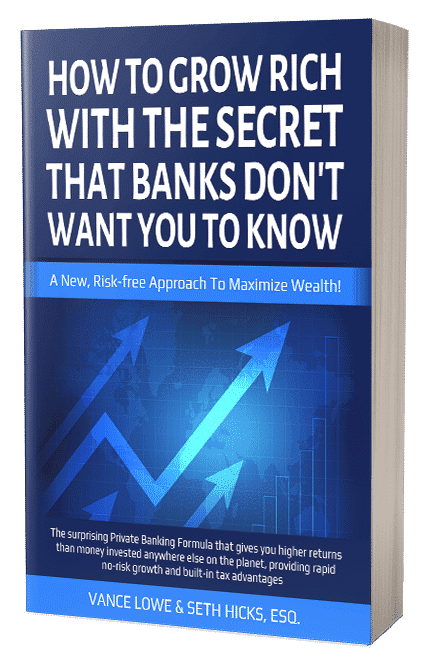
[00:19:00] Seth Hicks Esq.: If you wanna learn more about this or you want to be taught on how to achieve financial freedom, create a financial legacy that outlives, economic downturns, economic catastrophes, and sets up your family for a hundred years and more, and hit our website, private banking strategies.com. It’s private banking strategies.com and Vance and I have a book called How to Grow Rich with the secrets that Banks Don’t want you to know.
[00:19:27] Seth Hicks Esq.: Put in your name and your email. And that book will be made available to you in a ebook, PDF, or an audiobook you can listen to on the go. But more importantly, you’re gonna get emails with a calendar link to Vance’s calendar. And if this content resonates with you and you wanna learn more, schedule an exploratory call with Vance.
[00:19:46] Seth Hicks Esq.: And that’s your first steps to taking a journey with us on how to create a hundred year Family Legacy Bank, Vance. Any other closing remarks?
[00:19:57] Vance Lowe: We just invite you to learn, [00:20:00] educate yourself a little bit more. If anything we can share with you, if it helps you, you know we all win. We really appreciate that.
[00:20:09] Seth Hicks Esq.: Awesome. We’ll see you on the next one, folks. Thanks.
[00:20:11] Vance Lowe: Bye-Bye.
[00:20:13] Outro: Did that story feel like it was about you? Do you feel you should be making more progress toward your financial goals? Do you feel stuck? Let us help you get unstuck. Are you ready to take action and get your own private bank? Please visit us at www.privatebankingstrategies.com.
[00:20:37] Outro: Thank you for listening to the Private Banking Strategies podcast. Click the subscribe button below to be notified when new episodes become [00:21:00] available.