[00:00:00] Intro: Welcome to Private Banking Strategies Podcast with Vance Low and Seth Hicks, your secret weapon to protect your assets and never have to start over financially again. Vance and Seth help high net worth individuals, families, business owners, and investors structure and asset protected fortress for their families.
[00:00:21] Intro: Learn how to keep what you earn and use the velocity of money. To create your own private banking system. Join us on this journey as we explore the secret strategies of the rich and political elite and help you take total control of your financial security. Now onto the show.
[00:00:38] Seth Hicks Esq.: Hello and welcome to Private Banking Strategies with Seth Hicks and Vlo Vance.
[00:00:42] Seth Hicks Esq.: How
[00:00:43] Vance Lowe: are you? I’m doing great. I’m ready to get into the next part of this series here on the grocery store story.
[00:00:50] Seth Hicks Esq.: Absolutely. Like we said in the last section, you guys, this is a fundamental principle and an absolute necessary discipline to [00:01:00] succeed in your wealth management and your wealth growth. We’re using Nelson Nash’s book where he describes our banking strategies as like a grocery store, like the ownership of a grocery store and managing your inventory and whether you and your family purchase your inventory and your groceries through the retail register, paying full price or go out the back door.
[00:01:24] Seth Hicks Esq.: And we answered that question in the last part, Vance. But let’s summarize that there and then dig down even a little deeper.
[00:01:31] Vance Lowe: Okay, so we summarized that is that all business operate on a procedure and everybody chooses what that procedure is. The problem is a lot of people choose wrong and their businesses fail.
[00:01:44] Vance Lowe: And so the philosophy here with whether we take food out the front or the back, we’re gonna dissect that a little bit more, means the difference between making great profit versus little or no profit or even failure of the business. [00:02:00] So we want to encourage, always finding the most profitable way of doing things.
[00:02:07] Vance Lowe: Nelson Nash, he would always ask the audience a question about a grocery store. When your wife comes in, buys her groceries, says you’re the owner, what’s she gonna do? Is she gonna go out the front door or the back door? He makes the people answer the question. So guys, if you didn’t answer it in the first podcast, answer it now.
[00:02:27] Vance Lowe: Most people are gonna say they take it out the back door because it’s an advantage and it’s a perceived false advantage. It’s a false assumption. If they would go through the cash register, they would take. Quote, the most profit possible and they would succeed. So let’s get into this, Seth. The other thing that we mentioned last time was the theory that he put in here, one stolen can of pea, and he really analyzes that in this story.
[00:02:57] Vance Lowe: How are we gonna relate that, Seth? What does that [00:03:00] mean to somebody who’s thinking about setting up and putting their own banking equation in their life?
[00:03:05] Seth Hicks Esq.: Well in the grocery store ownership example, at the time Nelson wrote this book, you could sell a can of pea for 60 cents at a competitive rate, and it actually cost the grocery store owner 57 cents, 3 cent profit margin on that sale of pea.
[00:03:21] Seth Hicks Esq.: So if your wife steals the can of pea out the back door, you have to sell 20 cans of peas with that three. Sent profit to actually pay for the one she just stole. And in, in our private banking strategies, it’s the same thing. We have a warehouse of money that is our capital and that is our inventory. And what do banks do with money?
[00:03:43] Seth Hicks Esq.: They lend it and they keep lending and every dollar that comes in, they fractionalize and create a derivative lending situation where they create money outta thin air. That’s a whole nother topic. And, and they lend that money out. We’re talking about centralized bank. And that’s why we [00:04:00] teach you how to take your money outta centralized banks and put it in a private banking strategy.
[00:04:04] Seth Hicks Esq.: But we want to capture that same mindset and that tool, that key that we see from centralized banks, and that’s keeping the money moving in the lending environment. So it’s like the peas, the more peas that you sell, the more can of peas that you sell, the more profitable you’ll be. You need. Nelson writes in his book, 15 Cells of a Can of Peas to break even 17 cells of a can, of pea to be profitable, and 20 cans of peas will be.
[00:04:31] Seth Hicks Esq.: Super profitable and you can retire early. It’s the same thing in the banking system that we utilize the private banking system, the more that you can put your money into motion with good loan purposes and repayments, it’s like selling your PS over and over again. We call that the velocity of money and also the volume rate of return.
[00:04:53] Vance Lowe: Seth, let me give a good hard example that I use many times as people go through the process of learning this. There’s [00:05:00] certain laws about running a grocery store. We have to follow laws on any discipline that we pursue. It could be in sports, it could be banking, it could be raising families, whatever it is gonna be, there’s a proper process and there’s a way to excel at it.
[00:05:18] Vance Lowe: The difference between profit and retiring early is three cans a piece per year. Okay. Or three turnovers of inventory. Let me relate that now to banking. There’s one of the laws out there that’s called the 10% law, and it goes back biblical. It is designed to make sure and guarantee that we’re better off than we were the month before.
[00:05:41] Vance Lowe: So it says that we should pay. Ourselves off the top, a minimum, absolute bottom minimum of 10%. And I warn the people and I tell them, I’m going to stop you right here, and we’re not gonna go forward if you’re not gonna do this because your plan will fail. It’s that [00:06:00] critical. But what is left unsaid is that.
[00:06:03] Vance Lowe: If you can do 20%, you need to do 20. If you can do 30%, you need to do 30, because that much more volume of money coming in creates that much more opportunity and exponential growth is almost unimaginable. So that law relates to this stolen can of peace and the turnover. And the productivity, putting a dollar to work the velocity, how many times can we get that dollar to touch down folks?
[00:06:30] Vance Lowe: How important is it to do that? Well, if the banks won’t let a dollar even sit overnight, it must be pretty darn important because they’re the best masters of money on the planet next to the insurance actuaries. I think they have the actual better minds because they don’t get to Fractionalize, they don’t get to create excess money and cause problems.
[00:06:52] Vance Lowe: They have to do it correctly. So velocity here is critical. So I’m gonna change that volume and turnover [00:07:00] in the grocery store to our banking, which is economy. A town is run by an economy, so we need to do some thinking. We need to understand how a town operates because it’s all about money. It’s all about attracting new money coming in, and then the town needs to be set up with enough services so that it doesn’t lose more money out the back.
[00:07:22] Vance Lowe: Then it brings in, if that’s the case, it will prosper and really grow and the town will be booming and it’ll be a fun place to be at. But if it starts losing more than it brings in. The reverse happens and it soon becomes a ghost town. So let me give a great definition of the velocity of money you need to sample this and understand how money actually works.
[00:07:44] Vance Lowe: I’m on a business trip. I take that business trip and I look at my gas gauge and I’m calculating because it’s getting pretty close to empty, and I see a town up here in the next few miles, and I’m just trying to decide should I stop at this town or can I make it 10 more miles to the next [00:08:00] town? I take the safe route.
[00:08:01] Vance Lowe: I decide to stop, fill up with gas, and then I’m gone. I’m out of town, but I paid $50 for gas and I took $50 worth of gas with me. That gas station owner, he can take that $50 across the street and he can buy groceries with that $50 and he can bring back $50 worth of food. Well, now my money’s sitting over at the grocery store.
[00:08:21] Vance Lowe: Grocery store has it. He sold inventory, so he takes that $50 across town to the warehouse. He buys $50 worth of inventory and brings back $50 worth of inventory. And now my $50 is at the warehouse. Well, he has some dentist work he needs to be done. So he takes that $50, gets $50 worth of work done at the dentist.
[00:08:42] Vance Lowe: So what just happened here, folks? It’s only one $50, but what happened?
[00:08:47] Seth Hicks Esq.: The exchange in value traded hands numerous times based on various people’s needs, and that money turned and brought value to every person that you described. The [00:09:00] mechanic, the dentist, the warehouse, the gas station, the shop owners. It circulated in a way that brought value to each of them, and that prospered their economy.
[00:09:11] Seth Hicks Esq.: So what’s
[00:09:11] Vance Lowe: critical here that you take away folks, is that we have to be able to be in a situation to use a dollar more than one time and not lose control of it. Would you be surprised if I told you this goes on even much more in one day in a town, you know that single $50 produces in product and services, thousands and thousands of dollars, things can move.
[00:09:37] Midroll: Did that story feel like it was about you? Do you feel like you are generating a lot of revenue but are not moving forward as fast as you would like? Do you feel you should be making more progress toward your financial goals? Do you feel stuck? Let us help you get unstuck. Are you ready to take action and get your own private bank?
[00:09:59] Midroll: Please [00:10:00] visit us at www.privatebankingstrategies.com.
[00:10:07] Vance Lowe: We are running a private economy. We’re gonna talk about the tax effects. Remember, there’s a thief out there in Nelson Nash’s book. He has five laws, and one of them is called the Willy Sutton Law. Seth, what is that? Willy Sutton Law.
[00:10:21] Seth Hicks Esq.: Willie Sutton was a famous bank robber, and he ultimately got caught and was asked Willie, why did you steal the gold from the banks?
[00:10:28] Seth Hicks Esq.: And he said, well, that’s where the gold is. That’s where the money is. That’s where I’m gonna steal it from. And the point was, is that there’s always gonna be someone trying to take valuable things from you. And in our culture and context, it’s generally government confiscation, government control, whether it’s taxes or you’ve got federal taxes, state taxes, you’ve got.
[00:10:50] Seth Hicks Esq.: Fica, you’ve got all these involuntary takings, and when it was initially proposed in 1913, income tax was supposed to be [00:11:00] 1% of people’s income. Well, now it’s grown. You know, the tax brackets are becoming insane, and you pay sales tax on everything you buy. The government can make more income on transfer of automobiles than the value of the automobiles if it’s sold five times.
[00:11:15] Seth Hicks Esq.: So it’s become ridiculous with the type of. Taxation. So the Willie Sutton law is one that says you need to be aware that if you have something valuable like your private banking, that there’s gonna be other outside forces that try to invade and take those resources and assets.
[00:11:32] Vance Lowe: There is another partner in all business, it’s called the Silent Partner, and it was put upon us back in.
[00:11:41] Vance Lowe: 1913 when the Federal Reserve mandated our government install the IRS, and there was pretty hideous reason for that. The reason the IRS is there is for control of assets and they do that in the form of taxes so that the government [00:12:00] can receive revenue from our hard work. What they’ve never told us is that when they tax us, I think cassette, you said it was 1% at the beginning, and now I heard it said a couple of years ago that it takes until between May and June before we start making money for ourselves.
[00:12:19] Vance Lowe: The whole year, the whole five months, up to six months now is paying all taxes for government and then we get into start paying ourselves. No wonder we can’t make ends meet. No wonder the average American is not happy. They have to do everything for everybody else, and that becomes a bad thing.
[00:12:38] Vance Lowe: Government hasn’t told us that increasing taxes actually lowers the productivity of our nation. They actually make less money. If they kept the taxes very low, they would, their revenue would be much higher. Anyway, so we’re getting into the tax issue here, this third silent partner and how we might [00:13:00] be able to take advantage of this before 1900.
[00:13:04] Vance Lowe: This strategy that we’re teaching, this private banking strategy was the banking system of our nation. We didn’t have banks back then. How do people use their money? They use these special insurance contracts to hold their money, and they did. Were taught in school self-financing. They were actually taught how to run their families as an independent unit for success, called an economy, running their own private mini economy for profit.
[00:13:31] Vance Lowe: We explained that in the earlier sections here about an economy is a town well in our private economy. If we set up our private banking, all the money that comes into our economy is after tax. From then on inside of our economy, we can double asset. All the growth inside those contracts can create no.
[00:13:54] Vance Lowe: Taxable events. We’re not breaking any laws. We’re not even in any gray areas. This is [00:14:00] just fact we’re using after tax dollars just within ourself. It’s not a system that is trackable or traceable, it’s private. The assets held in our private banking, in these special contracts or with life insurance carriers, that wealth there is not reported.
[00:14:18] Vance Lowe: Nobody knows, including government. How much is there? What it’s worth or anything else until we create a taxable event. Can they get a report on some of these contracts? Only if you break the rules, they don’t get into it. As a matter of fact, our banks, the banks today, store their safe money in these same contracts, and we’ve talked about that in earlier podcasts.
[00:14:42] Vance Lowe: It’s amazing. This strategy folks is not new. This private banking and what we’re trying to bring back is a proven strategy that’s always been in existence and is in existence today for those who understand how money works. So, Seth, give us [00:15:00] some examples. What would be a tax advantage in this system that people could enjoy with their private banking?
[00:15:07] Seth Hicks Esq.: You touched on it. If you have a car dealership or a grocery store like we’ve outlined or any other type of business endeavor, typical business endeavor, small business owner, large business owner, you have a silent partner that is the IRS and the IRS is going to demand their federal taxes and. By their own Internal Revenue Code 77 0 2, and we did a prior podcast that talks about something some people refer to as seven 70 accounts referring to Internal Revenue Code 77 0 2.
[00:15:42] Seth Hicks Esq.: And what they did is they carved out the taxation. Of life insurance contracts and certain other accounts, but life insurance contracts are what we’re focused on. And the ultra wealthy and the wealthy and prior presidents like John F. Kennedy, [00:16:00] Richard Nixon, JC Penny Ray Crock, who started the McDonald’s franchise, Walt Disney, and the list goes on and on and on and on.
[00:16:09] Seth Hicks Esq.: Ultrawealthy successful people who utilize Internal Revenue Code 77 0 2 to create untaxed wealth creation and wealth growth. And that’s through the implementation of these life insurance contracts that we’re discovering. That’s utilizing private banking strategies with the properly structured whole life insurance contract that is not taxed.
[00:16:31] Seth Hicks Esq.: Once your after tax money has been contributed and capitalized into your life insurance. Contract policy. It is forever outside of the taxing system. So long as you do not create a modified endowment contract, which we will explain to folks who want to understand that line and that difference, the growth becomes parabolic.
[00:16:53] Seth Hicks Esq.: In a compounding nature, Albert Einstein said The eighth wonder of the world is compounding interest. [00:17:00] And the growth, like we talked about in the second episode, becomes a parabolic curve after year 7, 8, 9, and 10. And in the last years of 20 years that these policies are in effect, it’s almost a doubling every year of cash values and death benefits.
[00:17:17] Seth Hicks Esq.: And that’s born out in the illustrations and that’s the power of compounding tax free growth. Which is one of the seven pillars of private banking strategies. That’s what makes this strategy so valuable, so important for people keeping what they make and growing it in that parabolic fashion. If you’re not having to pay taxes and your money is completely liquid, you can access it now, you can access it without penalty.
[00:17:43] Seth Hicks Esq.: That’s unlike 4 0 1 Ks or IRAs or any other government sponsored a retirement program where there’s penalties for accessing it. Too early or accessing it too late, and there’s always tax on it, and they’ve tricked people into believing that you’ll [00:18:00] pay tax in the end, but ultimately you’re gonna pay less tax than that.
[00:18:04] Seth Hicks Esq.: Would you rather pay tax on the seed or the harvest? Well, you’d rather pay tax on the seed because that’s gonna be growing and growing and growing and you’re making. The government much, much larger slice of what you’re creating, and you don’t know what the tax rates will be in the future, and they’ve only gone up since the IRS was created.
[00:18:24] Seth Hicks Esq.: And so you let your retirement account season for 30 years, 40 years, and then the government takes at least a third of it. And what you thought was yours is not yours, and it’s been locked up. Dormant asleep not being put to work, not in a velocity situation like we described in the first two parts of this series.
[00:18:45] Seth Hicks Esq.: It’s asleep. It’s not making you anything. In fact, with inflation and taxes, it’s almost ridiculous. If you account for what the purchasing power and the value of what that will be, you’re losing. Value every year not gaining value when you [00:19:00] account for inflation and taxes, when your money is asleep in a government sponsored retirement program.
[00:19:05] Seth Hicks Esq.: Now, compare and contrast that with the private banking strategies system and structure and it, it’s not asleep. You have access to your money. A hundred percent of the time, full liquidity to put it to use. How do I put my banking assets to use? How do I get that velocity of money? And that’s what we like to explain in a nutshell phrase, is that what we do with private banking strategies is we simply change who’s getting the payments, who’s getting the payments in your life.
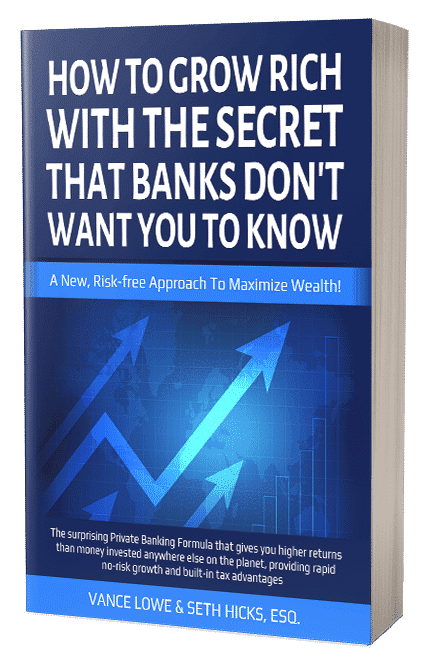
[00:19:35] Seth Hicks Esq.: We thank you for joining us folks, and go to our website, private banking strategies.com. There you’ll receive a free book offer. It’ll pop up and in exchange for your name and email, we’ll provide a book that Vance and I offered that we like to call a red pull book. What the banks don’t want you to know that keep you from Growing Wealthy.
[00:19:54] Seth Hicks Esq.: That’ll be offered to you in A PDF format. You can download immediately, or you can also listen to it in an [00:20:00] audio version on the go. And that book will highlight these type of issues that we’ve described and highlight some of the ways that you can change your financial strategies to take back the banking equation in your life.
[00:20:15] Seth Hicks Esq.: And those emails that we send to you in exchange for your email are super important because they’ll have a link to Vance’s calendar that if you, you like the, the book, you like these podcasts, this is resonating and you want to take the banking equation back in your life and you wanna keep what you make and grow what you make.
[00:20:32] Seth Hicks Esq.: You’ll wanna schedule a free exploratory call with Vance, and ultimately that process will lead you to a very valuable tool and resource called the eight year Roadmap. That Vance designs for you personally and your finances, that shows you how private banking strategies will work for you and your family, how you will implement it step by step, month over month, detailed roadmap and plan.
[00:20:57] Seth Hicks Esq.: What creditors to pay, who to pay [00:21:00] first, what amounts to pay, and how to take what Vance described and the volume rate of return, and begin to change who you pay and make it your own internal bank until you’ve conquered all your debt. You’ve captured all of your outflow and turned it into inflow. They’d acquired more offices and they had turned all of their outflow into inflow, into their private banking system.
[00:21:22] Seth Hicks Esq.: If you want to see that in more granular detail, go into those podcasts, listen to those, and ultimately schedule your exploratory call with fans and go through the eight year analysis and roadmap, and you’ll never look back, folks. So Vance, any closing remarks? There’s just so much we wanna say,
[00:21:40] Vance Lowe: so very little time to say it in folks we care.
[00:21:43] Vance Lowe: We care about those people who care about improving their lives. I’ve been in money management all my life, and our clients always win. The only thing that can happen is if they steal from themselves. We hang out. We’re there. So [00:22:00] this is just one angle, one idea. This little series here that’s in Nelson Nash’s book, we promise that we bring this book to life so that people can relate to it.
[00:22:13] Vance Lowe: So hope we’ll see you through a exploratory or on the other podcast. Thank you very much for listening. Thanks folks. See you on the next one.
[00:22:23] Outro: Did that story feel like it was about you? Do you feel you should be making more progress toward your financial goals? Do you feel stuck? Let us help you get unstuck.
[00:22:35] Outro: Are you ready to take action and get your own private bank? Please visit us at www.privatebankingstrategies.com.
[00:22:46] Outro: Thank you for listening to the Private Banking Strategies Podcast. Click the subscribe button below to be notified when new episodes become [00:23:00] available.