[00:00:00] Intro: Welcome to Private Banking Strategies Podcast with Vance Low and Seth Hicks, your secret weapon to protect your assets and never have to start over financially again. Vance and Seth help high net worth individuals, families, business owners, and investors, structure and asset protected tax-free fortress for their families.
[00:00:21] Intro: Learn how to keep what you earn and use the velocity of money. To create your own private banking system. Join us on this journey as we explore the secret strategies of the rich and political elite. And help you take total control of your financial security. Now onto the show.
[00:00:38] Seth Hicks Esq.: Hello and welcome to Private Banking Strategies Podcast with Vance Low and Seth Hicks Vance.
[00:00:43] Vance Lowe: How are you? I’m doing great. I’m looking forward. I think we’ve got a very important topic.
[00:00:49] Seth Hicks Esq.: Absolutely. It’s a little bit more technical, but one that people out there in the investment world need to be cognizant of, and I guess one way the meat of the coconut is analyzing. [00:01:00] Rate of returns versus yields and how money managers package your investment returns to you, and sometimes manipulate statistics to make you think that you’re doing better than you are.
[00:01:14] Seth Hicks Esq.: So you need to get your head outta the sand and actually think through these type of issues. Average rate of return versus yield. So talk to us about what people need to do.
[00:01:24] Vance Lowe: I’ve got quite a bit of experience in managing assets and working in the stock market, and I have had my mentors and I follow Warren Buffet very closely.
[00:01:34] Vance Lowe: I think he’s probably the all time best investor there’s ever been, and he shares his information with everybody and he is also a little bewildered with the average people because they choose not to follow sound advice. We call it herd mentality. Everybody’s doing it this way, so it must be right.
[00:01:55] Vance Lowe: Absolutely not. If everybody’s doing it that way, you can guarantee it’s the [00:02:00] wrong way to do it. It’s almost guaranteed if everybody buys this investment, it’s almost guaranteed. The one you should be buying is 180 degrees opposite that. It’s too late, right? So it’s all about winning or losing in investing, and people want to invest money.
[00:02:19] Vance Lowe: They get enticed with really high returns and think, oh great, I can do that too. It’s too late. It really is too late. If somebody reports, I got 24% last year, first of all, don’t believe it because they may not have really, and second of all, if they did, it’s too late for you. What goes up comes back down.
[00:02:40] Vance Lowe: It may walk its way up and if you know what you’re doing, you can do it that way. But today I’d like us maybe to focus on, uh, fundamental error that everybody seems to make and it’s on purpose. The stock market is in existence so the stock market can make money. The broker dealers are there [00:03:00] to make money no matter what.
[00:03:01] Vance Lowe: The market is going to make the money, the investors supply the money. They’re not using their money, they’re actually putting it to sleep in these accounts. And those companies who get that investment money, they’re gonna put it to work and they’re gonna double it as quick as every two and a half years.
[00:03:19] Vance Lowe: But yet what you get out of it may be losses, right. Okay. And if they make a loss, oh, well, tough. You ran the risk, not us. We got our expenses and we made our salaries and everything, and you get nothing. That’s what the stock market means. We have a chance of making money if somebody really understands the basics.
[00:03:39] Vance Lowe: And the procedures have proper investing. They can do pretty well. Not a hundred percent of the time. We never could, but we were very good at it when we did it. We were one of the top money managers. We just didn’t wanna be the biggest. So this fundamental error that people make is they make decisions based on what’s known as average rate of [00:04:00] return.
[00:04:00] Vance Lowe: That seems to be the acceptable way. For all the masses to make decisions and folks, that’s the wrong information. I’m telling you right now, it’s critical that you understand that most people, if they go to work, they buy into a, a problem to begin with, and that’s called a 401k. And Seth, you can make note of why that’s, I’m calling that a problem, but they go into it, they’re shown the different accounts and they’re shown.
[00:04:29] Vance Lowe: What those accounts have done over the certain amount of time, and it’s called the average rate of return. That number has nothing to do with what people actually make with those investments. And the sad thing is, is that that is tracked. When you buy in, they know where you bought in at and when you sell, they know where you got out at.
[00:04:55] Vance Lowe: And that profit divided over that period of time is the correct [00:05:00] number. So Seth read for us if you would, I think you’ve got it there. The definition of how they calculate rate of.
[00:05:07] Seth Hicks Esq.: So the average rate of return is a financial metric used to measure the profit or loss of an investment over a specified period of time, and that’s expressed as a percentage of the initial investment cost.
[00:05:23] Seth Hicks Esq.: It’s calculated by taking the sum of all yearly returns and dividing that by the number of years that you’ve got of investment.
[00:05:33] Vance Lowe: Okay, so all investors get in at a different time, don’t they? You know, except for government, they get to get in ahead of time. That’s a source of contention because they get to invest on insider information, and that’s against the law.
[00:05:49] Vance Lowe: Which everybody would talk to the congressman about that and make that illegal for them as well. Maybe Trump will, I don’t know. Anyway, so based on that definition, guys, here’s what I [00:06:00] saw and happened in in investing pretty much my career. An individual brings me. A hundred thousand dollars. So we’re actually going to lay this out for you and come up with the exact numbers.
[00:06:11] Vance Lowe: He gives me a hundred thousand dollars to manage at the end of year one. I report that that account grew by 100%. So if we add a hundred percent to $100,000, that’s gonna come up to $200,000. Okay? So people write that number down in year two. I report a loss of 50%, and here’s where a lot of people get lost.
[00:06:36] Vance Lowe: They’ll take that original amount. And they’ll say, okay, it’s 50% loss, so it’s down to $50,000. That’s not the case. We take the ending year one balance of 200,000, and we subtract a 50% loss to that. The end of two years back to even balance is right exactly what we put in it.
[00:06:57] Seth Hicks Esq.: At that point, you’ve made nothing.
[00:06:59] Seth Hicks Esq.: You’re not [00:07:00] ahead a single penny at the end of year two, but they had a hundred percent gain the first year.
[00:07:04] Vance Lowe: Right. So had we not made any gain, right? Yeah. Had we not made any gain and lost 50%, now we could see that our value’s down to 50,000 and actually see a loss.
[00:07:17] Seth Hicks Esq.: Yeah, but listen to this for a second, Vince.
[00:07:19] Seth Hicks Esq.: So if you’re a consumer out there and you’re going, Hey, I know a money manager. Who can get alternating years. He does a hundred percent in this year. If you could have your crystal ball, but the second year you’re gonna have a 50% loss. I mean, people just looking at that from an outside perspective of not understanding this statistical analysis, they’d go, well, if I can do a hundred percent one year and only 50% the next year, I should be getting ahead by 50% over two years.
[00:07:46] Seth Hicks Esq.: But you’re not.
[00:07:47] Vance Lowe: Yeah, they think sometimes that, oh, well then we take that 50% loss off of the a hundred percent from the year before. Right. And that should give us 150,000 incorrect. Right? It’s based [00:08:00] on the total of the account value. When you report that year’s end, it’s on the account value from the start of that year.
[00:08:08] Vance Lowe: So we’re now back down to that a hundred thousand. So let’s go to year three. I report a gain of 25%. So now we take that ending balance of year two at a hundred thousand, and we grow it by 25%. So at the end of year three we’re standing at 125,000. So I hope everybody’s following along with us ’cause this is important.
[00:08:31] Vance Lowe: So now we’ve been three years of investing. We got 125,000. That by itself would be pretty darn good. Okay, but we hit year four and we lose 12.5%, and I usually rattle this off to people that I’m teaching that’s coming in as clients. In year one, I gain a hundred percent. In year two we lose 50%. In year three, we gain 25%, and in year four.
[00:08:58] Vance Lowe: We lose 12.5%, [00:09:00] how much is in your account? And they look at me and I smile and say, that’s an unfair question. You’d have to be a genius mathematic to do that, but some can. I’ve actually had a couple, say just over a hundred thousand, and they’ll be right because when we subtract 12.5%, it’s based on 125,000.
[00:09:19] Vance Lowe: Right. US 12.5%,
[00:09:22] Seth Hicks Esq.: right?
[00:09:23] Vance Lowe: And so our account balance at the end of four years is 109,375 bucks. Okay? So it did get us a little bit of a gain, but here’s the surprising thing that everybody doesn’t understand. The math on the average rate of return is different. So let’s do the math here. We take 100. We minus 50, these are the percentage reported minus 50, plus 25, and minus 12.5.
[00:09:58] Vance Lowe: That total comes up to [00:10:00] 28.125%. Once we get that total, we divide it by four. The number of years held. Okay. When we make that division, that number comes up to 28.125% average rate of return, and that’s what goes in the prospectus. So if I were to go into a money manager and I ask him what the average rate of return is on, that’s, he’s gonna tell me.
[00:10:26] Vance Lowe: And when I turn around and I ask him what the yield is on this account, he’s not gonna tell me. But the correct question is what’s the yield on this account? So Seth, we need to go through the definition of yield. Do you have your version of it?
[00:10:43] Seth Hicks Esq.: Yeah. I think that yield is what you’re able to keep from what you’ve made.
[00:10:48] Seth Hicks Esq.: So keeping what you make and not having it disappear. That 9,375 in the example that you gave over a four year period, your [00:11:00] 9,000 is what you’ve made. That’s it. So if
[00:11:02] Vance Lowe: they actually cashed out, that would be the yield. Understanding what yield really is is going to be a turning point in your life. It’s very valuable to you.
[00:11:12] Vance Lowe: Yield means money put in the account. That cannot be reversed. It’s your money. You can book it. When I was a young child and the branch banking just took off. The banks would come into the schools and set everybody up with a savings account and actually put money in their savings account, and they taught us about yield.
[00:11:37] Vance Lowe: Yield was when we pay the interest on this account that is going into your account and nobody can reverse it. It’s your money. So in this case. The yield would be the 9,325 if you took it, because it’s still volatile until you actually take it. It’s just a number, and [00:12:00] so people don’t understand what was the value when a person got in, and what was the value when they got out?
[00:12:07] Vance Lowe: After fees. Okay. After your commissions on both ends, and it’s even worse, this is, you know, showing what the count. If they sold it, then they’re gonna take a broker fee for it. We take that $4,375 and we divide it by four. So, had the person come to me and ask me the average rate of return, I would report 25 and a quarter percent.
[00:12:33] Vance Lowe: However, if you asked the correct question, what’s the yield on this account? I would say 2.343%. Mm-hmm. Now, how likely are you gonna buy that investment?
[00:12:42] Seth Hicks Esq.: You’re not.
[00:12:43] Vance Lowe: You’d much rather chase a 28%. Here’s where I think all these guys who will monitor the brokers, you know, give us so much due diligence that we have to do, they still go wrong and they know they’re going wrong because they condone this [00:13:00] average rate of return to entice people to invest on thinking that this is what people got out of the account and then they go to the brokers and they go, no, those numbers are correct.
[00:13:10] Vance Lowe: Well, those numbers are correct. They don’t have anything to do with what people make. Well, sure they do because this is the reported rate of return. So no, it’s not. It doesn’t correlate with what people make, and I guess the smart ones. Who’ve been in and stayed in and not gotten in trouble or something.
[00:13:31] Vance Lowe: We’ll kind of agree with that. Well, yeah, but you know, they don’t give us that information. They have it, but it’s the truth and they don’t wanna share it. So folks, do yourself a favor. Switch to yield on everything you do. Find out what the yield is if you’re hooked into these 4 0 1 Ks, and you have to make choices every time.
[00:13:51] Vance Lowe: Call up these money managers. Try to get correct information. You’re reporting stuff that doesn’t correlate. Just take a look. [00:14:00] Anybody can do this. If you’ve been with that company four or five years and you’ve got a 5% average rate of return or whatever the five year average rate of return is, see if your account did that.
[00:14:12] Vance Lowe: A lot of people don’t really know that if it did or not. A lot of people are gonna say, oh yeah, it did, but you need to subtract what you put in it and what your employer put in it during that time to see what the real yield is for you. It’s not gonna be that number. I guess statistically it could be if they did it exactly one way and we did the same thing all the way through.
[00:14:39] Vance Lowe: But you can see this four year period that they kept track of to come up with a four year average rate of return, had nothing to do with what’s in the account.
[00:14:49] Midroll: Did that story feel like it was about you? Do you feel like you are generating a lot of revenue but are not moving forward as fast as you would like?[00:15:00]
[00:15:00] Midroll: Do you feel you should be making more progress toward your financial goals? Do you feel stuck? Let us help you get unstuck. Are you ready to take action and get your own private bank? Please visit us. At www.privatebankingstrategies.com.
[00:15:20] Seth Hicks Esq.: So let’s contrast that with some of the private banking strategies, contracts that we put people in and how those returns are kept and bank and how that works.
[00:15:32] Seth Hicks Esq.: Can you shed some light on that?
[00:15:34] Vance Lowe: Yeah, we all need to understand that America went from nothing to becoming a world power in the first a hundred years, and we didn’t have banks. But a banking equation was performed and the life insurance industry is the banking equation in America. Even today. The banks hate to hear that.
[00:15:57] Vance Lowe: Okay. Government hates to hear that [00:16:00] because that would create independency and all the, uh, strategies that went with that to help people understand what money is, how it works, pretty much has been eradicated. Banking is based on yield, so we show people the yield of these accounts and the non guarantees.
[00:16:23] Vance Lowe: There’s also profit in these types of things, and it’s not guaranteed, but it’s also yield. So it still goes into your account and cannot be reversed. They could have a disaster year and say, oh, well we’re in a negative, so we gotta lower your account, balances by our losses. Nope, these contracts are one sided.
[00:16:45] Vance Lowe: All you have to do is fulfill your end of the agreement and they have to live up to the contract. This is what’s so devastating with universal life. It takes away yield. That’s the short answer to that stuff. So people don’t make a mistake because [00:17:00] otherwise you may be enticed to what they call higher levels of returns, but it’s never happened in the history of ul.
[00:17:07] Vance Lowe: Never ever has it beat as the standard participating mutual whole life contracts.
[00:17:12] Seth Hicks Esq.: They never do. That’s a whole nother topic as far as you, you see a lot of that in the industry. People pushing index universal life. And these higher, supposedly higher rate of returns and that aren’t guaranteed, but they’re fraught with so many a gauntlet of alligators, so to speak.
[00:17:30] Vance Lowe: The risk changed, Seth, the risk transfers to the client, the insured, instead of the insurance company. So they love it and they push it.
[00:17:39] Seth Hicks Esq.: Some of the horror stories that we’ve had, not from one of our clients because we don’t put them in indexed universal products, but like someone missing a premium payment in their old age and the contract canceling and them having no value, or what are some other scenarios with those types of contracts that backfire and blow up in [00:18:00] people’s faces?
[00:18:01] Vance Lowe: One of our major companies introduced that back in the seventies, and they told us to solve at an 8% average rate of return. Well, I knew that was too high, so I went down to 4%. Well, these contracts again still transfer even though we did that to be very conservative. The cost of insurance are at two different levels, the current, what the insurance company’s costing now, but they have the opportunity to go way up here in expenses and cost of the insurance should they see an, you know, adverse condition.
[00:18:36] Vance Lowe: What happened to this company? It was Aetna Life Insurance Company sold to Franklin Life Insurance Company. That whole book of business, I had 20 clients that I’d put on that and they, we showed ’em what, how much they could put in and what the minimum they had to put in to keep it for life. And you know, most people fall prey.
[00:18:57] Vance Lowe: To put the minimum in. So [00:19:00] that’s what these clients did, and I guess it started about 2019, somewhere, right at 2000 it was sold to Franklin Live, I think it was Franklin Live, so whatever it was sold to another company. And in 2019, they took that whole book of business. They bought and moved it to the max cost.
[00:19:21] Vance Lowe: So I asked them, I said, can you send me the adverse selection or the adverse conditions that exist to justify that? I said, no, we don’t have that. So it was a, a class action lawsuit by anybody would’ve done it. But now all 20 of my clients are in their eighties and 85, and they’re getting notifications that their $30 a month premium is now going to over $500 a month just to stay in force.
[00:19:48] Vance Lowe: They can’t afford it, and they lost the insurance, and I had 20 phone calls over a year’s time, and I had to talk to those clients. It just destroyed me.
[00:19:59] Seth Hicks Esq.: So they have [00:20:00] no cash value that they’ve built up over decades. Zero.
[00:20:05] Vance Lowe: Before they went up in value. But what it was, it was an outright tactic of the life insurance to take those profits.
[00:20:13] Vance Lowe: Now, they didn’t wanna have to pay the death benefits, so they went all the way up to that max because they could by law, except I think they broke the law, but that’s not my choice, is the agent. I told them, I said, Hey, here’s what I found out. They’re not justified. If you wanna pursue legal action, I think you have a good case.
[00:20:32] Vance Lowe: Those clients are dead today. Unfortunately, it was right before I learned about this banking. That’s what made me so angry. It’s really important. Yield means you can count on the future. You know what? That a number’s gonna be as the worst case scenario. It could be a whole lot better. And then when we put banking.
[00:20:53] Vance Lowe: Strategy in their life. When we actually use the money during the time, it’s gonna be five to 10 times that amount long [00:21:00] term. Okay? And once it’s in the accounts, once it’s in there, there’s no market risk, there’s no economy risk, there’s no risk of theft. You’re holding your money in the safest place on the planet, which are life insurance companies.
[00:21:14] Vance Lowe: They have a dispensation from the Dodd-Frank Act so your money can’t disappear. The banks have sold all their own stock in, in their own banks, and they put it with the life insurance companies.
[00:21:26] Seth Hicks Esq.: It’s an epiphany, I think, to a lot of people, and especially folks out there that are in the wrong products.
[00:21:32] Seth Hicks Esq.: Sometimes these problems don’t surface until the variant of their life and when you need it the most. It’s not there. I mean, that’s a tragic situation where those people got the rug pulled out from underneath them, and we’ve got other reliable folks out there. One, one gentleman who we’re loosely affiliated with that talks about UILs and these type of.
[00:21:53] Seth Hicks Esq.: Pitfalls all the time. Todd Langford and does a good job of really explaining some of [00:22:00] those intricacies of why you’re gonna get burned at the end and why private banking strategies and those folks who really know what they’re doing don’t ever place people in indexed universal life for the the reasons we’re discussing.
[00:22:13] Vance Lowe: It’s so devastating that the NNI Institute, which is the Nelson Nash Institute that created and brought back the the banking strategy, we have to become certified to represent that product the right way. And I hold that certification. If I were caught trying to do IBC and sold a UL or an IUL, I would lose that certification in heartbeat.
[00:22:39] Vance Lowe: Understand. One of the problems that we all fall prey to is that the grass is greener on that other side of the fence. It’s just a little greener over there. It’s more exotic. I remember when things started really going funny is Ale Williams invented and he gained ground like crazy. It was a pyramid.
[00:22:59] Vance Lowe: [00:23:00] Commission scheme. Okay. And it was buy term and sell the difference. And that’s what Dave Ramsey picked up.
[00:23:06] Seth Hicks Esq.: Buy term and invest the
[00:23:08] Vance Lowe: rest. Yeah. Vest the rest in mutual funds. Right now I’m halfway through a video. Dan and I has this, and they’re really going through what Dave Ramsey says, and what Dave Ramsey says is wrong, dead wrong, and it’s easy to prove because he puts no value on money and he assumes that you’re gonna get a high percent interest rate all the time.
[00:23:31] Vance Lowe: And what calculations he does, he doesn’t subtract taxes. On a million dollar life insurance policy. You know, if you were paying a thousand dollars a month in permanent insurance, you could buy that million dollar insurance policy for maybe somewhere between a hundred and $200. So you would have $800 you could invest.
[00:23:52] Vance Lowe: And get a 9% return over a 20 year period of time. I don’t believe that math works. It doesn’t create a million dollars, [00:24:00] okay? And you’re outta the life insurance. But during the time, if you invested the difference, you would have the death benefit and the amount in the, uh, mutual fund. That part of it would be true.
[00:24:14] Vance Lowe: But at the end of 20 years, you’re 20 years older and if you’re an out of a million dollars, you gotta go buy more insurance term or whatever else you’re gonna do. And you have to assume 9% every single year. I can testify as a good money manager, four to 5% long term. It’s just that it’s no bells and whistles.
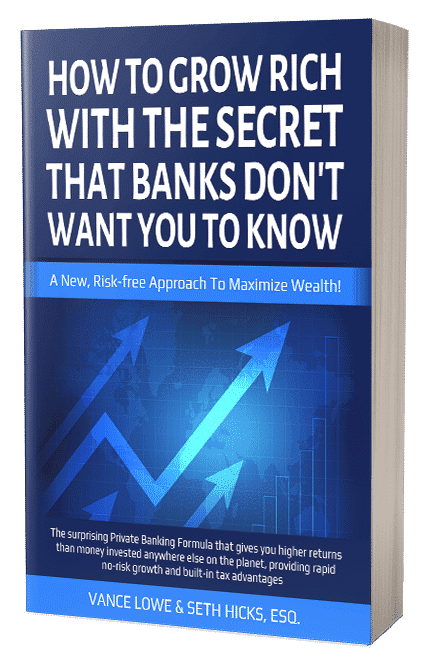
[00:24:37] Seth Hicks Esq.: Makes total sense. Well, Vance, I think this is probably a good place to point people in the right direction. Folks, if you like, the content of this podcast and other podcast is we’ve developed, you’re on the right track and Vance and I have made a book available for all of the people that wanna learn more about private banking strategies.
[00:24:55] Seth Hicks Esq.: And you can actually get access to that book at at our website, it’s private [00:25:00] banking strategies.com. And there you’ll be asked to put in your name and email and we’ll send you the book in an audio. Format and A PDF, so you can listen to it on the go or you can read it if you’re someone who wants to print it out and take notes.
[00:25:12] Seth Hicks Esq.: If the book and this podcast and our other content, which is quite robust on the website are resonating with you, then click the link on one of the emails that we send you to schedule an exploratory call with Vance and he’ll start to apply your particular situation, your goals, your finances, into how this would work for you, and ultimately you’ll take it for a test drive.
[00:25:34] Seth Hicks Esq.: You’ll get an eight year analysis. If you walk down the the road with multiple appointments with Vance, and you’ll get a roadmap that tells you exactly what to do, when to do it, how to do it, to maximize financial freedom and taking back the banking equation in your life. So that’s our process folks. We look forward to seeing you again on our podcast or hearing from you and scheduling a call.
[00:25:56] Seth Hicks Esq.: Van, any closing remarks?
[00:25:58] Vance Lowe: Now I think, uh, we [00:26:00] pretty much said it, but do yourself a favor. Go there and look. Test it out. Find out if this is right for you. You can do that without expense and either mark it in that you, you’re gonna be better off or you’re not. So that’s what we offer.
[00:26:15] Seth Hicks Esq.: Alright, folks, we’ll see on the next one.
[00:26:17] Seth Hicks Esq.: Thank you.
[00:26:18] Vance Lowe: Thank you. Bye-bye.
[00:26:19] Outro: Did that story feel like it was about you? Do you feel you should be making more progress toward your financial goals? Do you feel stuck? Let us help you get unstuck. Are you ready to take action and get your own private bank? Please visit us at www.privatebankingstrategies.com.
[00:26:43] Outro: Thank you for listening to the Private Banking Strategies Podcast. Click the subscribe button below to be notified when new episodes become [00:27:00] available.