[00:00:00] Intro: Welcome to Private Banking Strategies Podcast with Vance Low and Seth Hicks, your secret weapon to protect your assets and never have to start over financially again. Vance and Seth help high net worth individuals, families, business owners, and investors structure and asset protected fortress for their families.
[00:00:21] Intro: Learn how to keep what you earn and use the velocity of money. To create your own private banking system. Join us on this journey as we explore the secret strategies of the rich and political elite and help you take total control of your financial security Now onto the show.
[00:00:38] Seth Hicks Esq.: Well, hello and welcome to Private Banking Strategies Podcast with V Low and Seth Dicks Vance.
[00:00:43] Vance Lowe: How are you? I’m doing great. I’m looking forward to, uh, talking with you today.
[00:00:48] Seth Hicks Esq.: Yeah, likewise, we’ve got a, uh, topic that captures a lot of people’s attention and we begin to lay this out for folks and it’s almost like light bulbs going on [00:01:00] when people start to get it. But we help to build a structure of financial freedom with private banking strategies and the financial.
[00:01:08] Seth Hicks Esq.: Freedom aspect is more than just having wealth, and it’s more than just having stuff stacked up in a portfolio. Vance, I I want you to kind of drill down a little bit for our audience and help people understand what financial freedom is in the context of private banking strategies and how it’s achievable.
[00:01:29] Vance Lowe: Well, Seth, I think our audience out there always has looked for and dreamed about someday being what’s called financially independent. That occurs, I guess we go, you know, right to the basics of understanding what that means. Financial freedom is when you are at a point where your assets are producing enough income that you no longer.
[00:01:53] Vance Lowe: Are required to work. You now have options and choices. Many people [00:02:00] settle on employment that they really don’t like, and throughout all life they’ve dealt with the hassles and the pressures and everything at work, trying to build a a nest egg. One day be financially independent. So the problem we’ve seen, at least, uh, I’ve seen over almost a 40 year education with helping people plan for financial independence is the way it’s set up, the way people are doing things the way.
[00:02:28] Vance Lowe: People think they need to handle money. And so our philosophy with private banking strategies, it’s like a, a fable I’ve heard many years ago feed a starving man a fish and you feed him for a day. Teach a man how to fish. You feed him for a life. Right. And so folks, one of the things we do here that MAL that distinguishes us, and I wish this were actually not the case because I think everybody, you know, has the right to [00:03:00] this knowledge, to this information because it’s life changing.
[00:03:03] Vance Lowe: It’s. At least for all of our clients. The clients always win, and it’s an education on what money is, how money works, how to put what we call the banking equation back in people’s lives, and being able to be the master, the fishermen, so to speak, to be able to fish for, for all they want in the future.
[00:03:24] Vance Lowe: Another thing for financial independence is. We’re chasing something and we’re not getting there, and we don’t know why. And it’s really frustrating. Most Americans are just frustrated to death, you know, because 10 years ago they thought they would be someplace, and that 10 year goes by really quick and nothing’s changed.
[00:03:43] Vance Lowe: They’re mi, the numbers might have changed a little bit, but they’re no better off. And that’s because they keep doing the same thing. We’ve been taught how to handle our money. We’ve used mentors, the people we trust, any education that we have. And folks, we’re here to tell you that education [00:04:00] feeds the banking system, and that’s something that has to change.
[00:04:03] Vance Lowe: So we want to help people become financially independent and enjoy financial freedom with what made America extremely strong. Before there was any type of banks, how did Americans do it? Well, it all stemmed around the family unit, the individual unit, uh, life insurance companies handled. The banking equation.
[00:04:27] Vance Lowe: When the pilgrims first came over to America, Lloyd’s of London was one of the first companies over here. Life insurance has been around for a long time, longer than our country, because that’s what handled the banking equation, right? Then people got greedy and they wanted to set up a actual banks well, I think they can go to some of our other podcasts and find out our actual history and how we feel about the banks out there.
[00:04:53] Vance Lowe: We were brought up the state to believe that banks are the only safe place for our money, when in fact, nowadays [00:05:00] it’s one of the most risky. So with the Dodd-Frank Act, we don’t have FDIC insurance. It’s really not there. It’s more of a fallacy. They can take our accounts, our money, we deposit in banks virtually at any times.
[00:05:14] Vance Lowe: Banks are working almost on an insolvency on a daily basis. Why? Because banks will tell you just the opposite. They lend out more than they get. What? What does that ratio, Seth?
[00:05:26] Seth Hicks Esq.: Well, fractionalized lending is one of the Achilles hill with centralized banking, and we’ll just say conservatively, they have to hold 10% reserve back.
[00:05:35] Seth Hicks Esq.: But if it’s a big bank, it’s actually less than that. So you bring a hundred thousand dollars in, the bank has to keep 10,000 in reserve. They take the 90,000 and they lend it
[00:05:45] Vance Lowe: out. Okay. They take 90,000 and lend it out. It’s actually more about 900,000 that they, because they get to multiply it, that factor, they get to multiply the money they have on deposit.
[00:05:58] Vance Lowe: And what makes them in [00:06:00] insolvent is that they have lent far, far more money than they have on deposit. That’s why when you go to a bank, you don’t get to liquidate your account. You don’t get to walk into your bank and say, pay me cash in dollars and drop my account. They don’t have to do that. They have up to at least six months to pay you any money outta your account anyway, and you signed that and.
[00:06:21] Vance Lowe: Without reading it, so they won’t do it. You know, if you need $10,000 of cash, you have to call and make an appointment. Give them a few days to accumulate that money and sign forms on what you need that cash for. So the education and the freedom we wanna look for, it’s in knowledge, it’s in understanding how money really works, and this is what we teach the people.
[00:06:44] Vance Lowe: So we need to have our money much more secure. We need to have our money working for us if we can do that and then solve the problem. I’d mentioned just a little bit earlier, we, we try to get ahead, but we don’t understand why we’re not, and that’s ’cause we don’t know what the [00:07:00] problem is.
[00:07:01] Seth Hicks Esq.: I mean, what we’re trying to do is empower people to be able to implement strategies that help achieve financial freedom goals, and we think that our strategies are the best possible available to Americans to be able to accomplish that.
[00:07:16] Seth Hicks Esq.: We want to capture their financial security. We wanna establish, you know, a stable income and help them build. Wealth across generations, but let’s look at financial freedom from the lens of debt. How does, uh, private banking strategies work with people who have
[00:07:34] Vance Lowe: debt? You know, this might go contrary to our listeners thinking, we love debt.
[00:07:40] Vance Lowe: We absolutely enjoy it. When I, I’ve talked to so many people over the years who come in and they’re absolutely embarrassed. The average American has so much in credit card debt. It’s unbelievable. They live beyond their means. I, I think the last time I, I looked, it was over $45,000 in credit card debt in a [00:08:00] family situation.
[00:08:00] Vance Lowe: And they come in with multiple credit cards all maxed out, and they’re embarrassed about it. And I just smile and say, well, congratulations. This is economy. This is movement of money, right? You think it’s lemons? We’re gonna turn it into lemonade. It’s all about how we think in our imagination, folks, we need to think differently about money.
[00:08:23] Vance Lowe: We need to educate, uh, people because everyone is programmed to make a decision that will favor banks instead of themselves. For instance, when I talk to people, well, how long is it gonna take you to get out of debt? You know what the, a answer nine times out of 10 is, we’re never gonna get out at 10.
[00:08:40] Vance Lowe: That’s a sad scenario because they’re always owing someone else. What if we give them the choice, Seth? What if we were to give a family the choice of who owns the debt? What if they own their own debt? What if they understood the problem that every single thing we buy, we finance [00:09:00] in life, we either pay cash.
[00:09:02] Vance Lowe: And lose the money we could have earned because we took it out of production for the entire rest of our lives. People don’t understand that’s the most expensive financing, not the 35% on a credit card, but what if we just turn the table and instead of someone else getting the money, at the end of the day, we end up with the money.
[00:09:25] Vance Lowe: So if we’re going to finance everything, who would you rather make the payment to yourself? Or someone else yourself. Okay, so what’s really important is to understand in debt-free living is that we have to control that debt. Sometimes we have to borrow money, and that’s not a bad thing. People think that credit cards leaving balances on credit cards or a terrible thing.
[00:09:49] Vance Lowe: It’s not as long as they’re organized, as long as they know what they’re doing. It’s another opportunity to move money. If we could use money. And get it back and then [00:10:00] reuse money again and get another dollar’s working, get it back. How fast do you think we could purchase that debt? Now we’ve got money out there working for us.
[00:10:08] Vance Lowe: Whatever the interest rate the credit card is. So folks, some of the stuff I’m saying, it’s just. Because I’m doing it every single day. We have isolated incidences and learning techniques to actually delve a whole lot deeper. We can’t do that in these podcasts because we want to try to keep the topic on financial freedom, but live debt free to the outside world.
[00:10:33] Vance Lowe: 90%, probably 95% of all, all of our clients that have been with us for five years. Own 100% of all their debt and they are blown away because they don’t know how they did it. ’cause they didn’t change their lifestyle. They didn’t, you know, dedicate more money. The only thing we changed was we put in the banking strategy.
[00:10:52] Vance Lowe: The banks always get the money back. It’s that simple folks. We put that strategy in your lives, you get the money back and then you [00:11:00] buy more debt with that while new money’s coming in while you’re working. It’s an exponential compound. So being debt free doesn’t mean you don’t have debt. It means if you bought the debt and you’ve put the money to work,
[00:11:14] Midroll: did that story feel like it was about you?
[00:11:18] Midroll: Do you feel like you are generating a lot of revenue but are not moving forward as fast as you would like? Do you feel you should be making more progress toward your financial goals? Do you feel stuck? Let us help you get unstuck. Are you ready to take action and get your own private bank? Please visit us at www.privatebankingstrategies.com.
[00:11:45] Midroll: So the cash flow is
[00:11:47] Seth Hicks Esq.: instead of going out of your hands to credit card companies and banks and lenders and everyone else that you owe, you create a system whereby those payments are coming back into [00:12:00] your own bank.
[00:12:00] Vance Lowe: Right. And what’s the risk with the guy in the mirror, the gal or the guy in the mirror?
[00:12:04] Vance Lowe: That’s the one that’s gonna be your client, uh, to learn this strategy. As long as they make their payments, they’re fine. The question is, is who do you want the payment made to
[00:12:14] Seth Hicks Esq.: you build a reliable payment structure. Does that provide you with some predictability and some financial planning so that you know, based on your income, what debts to attack first and how.
[00:12:27] Vance Lowe: Oh yeah. You know, I hear this time and time again as we do this and we teach the clients, they’re amazed that it doesn’t even take a half hour, 20 minutes a month to do the strategy, and they get to live the life the way they want. They have to be a little bit disciplined, you know, they have to have accountability, but people don’t know.
[00:12:45] Vance Lowe: How they’re supposed to run their private life. ’cause they’ve never been taught when it comes to money. You just said volume of return. The payments coming in instead of away from us. Now they’re coming into us. That’s the secret of compounding [00:13:00] wealth is the volume of return coming in to us on money we have out working for us.
[00:13:05] Vance Lowe: Okay. That’s another thing that helps, solves the problem. People think they have their assets investment working for them. They don’t. It’s a hundred percent, 180% opposite. Whoever has the money and they’re making the lion’s share of money and they’re paying you as little as they can get away with, but letting you take a hundred percent of the risk if they make a mistake.
[00:13:28] Vance Lowe: How fair is that? It’s not. And we think the money’s working for us. Stocks, bonds. We have to leave that money in those accounts. In order to get the interest or any type of growth, like I said, we take all the
[00:13:40] Seth Hicks Esq.: risks. It imprisons your money, it locks it up. Mm-hmm. And we teach people constantly. Money in motion is what creates velocity and momentum and power.
[00:13:52] Seth Hicks Esq.: Money just sitting is dead money and
[00:13:54] Vance Lowe: you’re. The difference between the two is so powerful. It’s hard for people to [00:14:00] understand. The people who are using your money are doubling that money anywhere from two and a half to five years consistently. Wouldn’t you rather get that? Wouldn’t you rather be able to put that to work and not have any risk whatsoever?
[00:14:15] Vance Lowe: So this is what we’re talking about. We’re not talking about getting everything paid off and not flowing money. What we’re doing is trying to teach people how to put the banking equation back in their lives. Banks put money to work and they always get it back. It’s that simple.
[00:14:34] Seth Hicks Esq.: You actually lay out a roadmap for people that guides them and instructs them step by step of what to do.
[00:14:43] Seth Hicks Esq.: Can you explain, uh, that roadmap and what we call an eight year analysis,
[00:14:48] Vance Lowe: we have a way of allowing people, or letting people test, drive the strategy, putting their numbers in and seeing in realistic format? In other words, [00:15:00] no stretch of the imagination, no assumptions. Just pure math compared to what they’re doing versus getting the money back and reusing it.
[00:15:09] Vance Lowe: You know, folks, wouldn’t that make a, a huge difference in your life if you could get back 100% of your monthly expenses every single month and then reuse that money? I. So we’re all about the old style strategy before there were banks is that families have a way to register or track how much better off they are every single month.
[00:15:30] Vance Lowe: Uh, with this strategy, we can show you how much better off you are every single day. And I’ll give you a hint today. Americans are not better off by 5 cents a day. That’s the tragedy in America because of the problem. Okay? Right off the bat, if you just work the strategy and move the money, it’ll move you to somewhere around $4 a month, just depending on your circumstances.
[00:15:57] Vance Lowe: But that’s pretty much the average that we do, and it’s [00:16:00] easy to track. It’s easy to see. The problem is we’re giving our money away. We’re breaking a hard commandment law in money. You can never, ever spend principle. That’s the problem We spend our principle. Our principle, you know? Well, what is that definition?
[00:16:16] Vance Lowe: It’s the money you bring home from your paycheck after taxes. That’s principle. Well, I have to use it to live. Sure you do. You know, there’s components you’re not employing to be able to get the money back. The bank has to use the money just like you do, but they always get it back because it’s the banking equation, and that’s what we teach.
[00:16:39] Seth Hicks Esq.: Right. So that eight year analysis and that roadmap we make available to folks that have listened to our podcast and have consumed some of our content and people that go, man, I want financial freedom. I, I want this eight year roadmap. Folks, we make that available to you through our website. Private banking [00:17:00] strategies.com and@privatebankingstrategies.com.
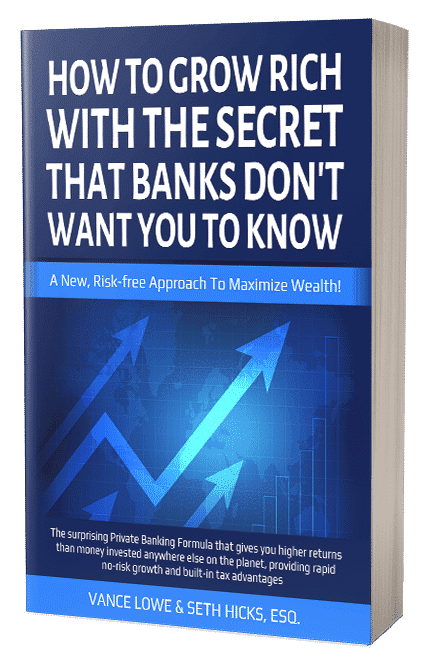
[00:17:03] Seth Hicks Esq.: We’ve got a free book offer that Vance and I authored called What the Banks Don’t Want You to Know. And in that book, we identify a number of nuggets and truths that a lot of times. Shock people, Vince, and they come to a realization like, wow, I’ve been brainwashed into a centralized banking mindset. And so when we pop that bubble and show them alternative banking strategies through our book and through our content, people take off with it.
[00:17:34] Seth Hicks Esq.: So folks, when you hit our website and you put in your email, you’re gonna get that book available to you either on audio or PDF, and we’re gonna send you some valuable emails that will have a link to Vance’s calendar where you can schedule that eight year roadmap. So if our podcast here resonates with you, if our book resonates with you, be on the lookout for that email that you get from us on the front page of our website and set up that eight year [00:18:00] roadmap with Vance Vance.
[00:18:01] Seth Hicks Esq.: What would you add to that?
[00:18:03] Vance Lowe: You know, I think you said that. Good. We’re gonna continue down this road in, in our next podcast, and we’re gonna take it another step further.
[00:18:12] Seth Hicks Esq.: Absolutely. Yeah. We’re gonna drill down here on financial freedom and address what a a lot of people ask us about and what a lot of people come to us for is financial freedom.
[00:18:21] Seth Hicks Esq.: So we look forward to seeing you guys on the next podcast. Thank you, Vance. We’ll talk to you next time.
[00:18:27] Outro: Thank you very much. Did that story feel like it was about you? Do you feel you should be making more progress toward your financial goals? Do you feel stuck? Let us help you get unstuck. Are you ready to take action and get your own private bank?
[00:18:45] Outro: Please visit us at www.privatebankingstrategies.com. Thank you for listening to the Private Banking Strategies Podcast. Click the subscribe button below to be notified when new [00:19:00] episodes become available.