[00:00:00] Intro: Welcome to Private Banking Strategies Podcast with Vance Low and Seth Hicks, your secret weapon to protect your assets and never have to start over financially again. Vance and Seth help high net worth individuals, families, business owners, and investors, structure and asset protected tax-free fortress for their families.
[00:00:21] Intro: Learn how to keep what you earn and use the velocity of money. To create your own private banking system. Join us on this journey as we explore the secret strategies of the rich and political elite and help you take total control of your financial security. Now onto the show.
[00:00:37] Seth Hicks Esq.: Hello, welcome to Private Banking Strategies with Vance Low and Seth Hicks Vance.
[00:00:42] Seth Hicks Esq.: How are
[00:00:43] Vance Lowe: you? Oh, I’m doing great today and like last week. I’m just. Anxious and ready to delve into this deep dive about policy loans.
[00:00:53] Seth Hicks Esq.: Yeah, we’re talking to folks about how policy loans work and we’ve, we’ve done two podcasts which drill [00:01:00] down into various issues, and, and this is the third part of this multi-part series.
[00:01:06] Seth Hicks Esq.: Let’s jump right in Vance, and here’s one of the questions that we’re often asked. Well, why should I? Borrow that $30,000 to purchase this new automobile from my own bank when I can get a low. From the auto finance company, so they’re gonna finance this automobile for me, Vance for 1.99% for seven years.
[00:01:35] Seth Hicks Esq.: Why wouldn’t I take that cheap money instead of using the $30,000 in my bank and paying back my loan at 20%?
[00:01:45] Vance Lowe: Let me preface that answer with a question, Seth. Do automobile dealers ever do gimmicks? Of course, and we all prey to that gimmick. That’s their number one gimmick. [00:02:00] Automobiles, and I know this for a fact, always have a financial financing factor built into their car that they’re going to sell, and they never go below that, so they have to sell the car.
[00:02:14] Vance Lowe: At a zero financing gimmick or a 1% financing gimmick at a higher price that you could get it paying the regular rate. So the advantage is having the cash, having the money, self-financing it, and go making the very, very best deal you can. And I’ve done that time and time again. It was a lesson on my son when he purchased a car.
[00:02:38] Vance Lowe: I announced to the family that the family bank now will buy all the car loans. A little bit rebellious, I guess, but he went to Honda Finance and financed his vehicle. And thought I’d be mad at him and I wasn’t. But it was in November for Thanksgiving that they came by and he had just purchased the car maybe a month or so [00:03:00] before.
[00:03:00] Vance Lowe: And so I thought, here’s a perfect time to teach a lesson. So I said, bring over the paperwork on the cell of the car. So he brought the sticker and everything over and I said, I wanna show you something. So while we was there, I called the dealership and I put it on speaker phone. I said, what would you sell me this car for today if I just bring in cash?
[00:03:23] Vance Lowe: You don’t have to look up anything, but you know, put any contracts together. I want your absolute walkaway price right now. And the guy said, well, lemme go talk to my manager like they always do. And he came back. He gave me the quote and I said, thank you very much, and hung up. And then I looked at my son and said, son, what did you pay for the car?
[00:03:46] Vance Lowe: And he looked at me and said, more than that. I says, I’ll bet you the difference is even higher than what the family bank would’ve charged, that you would’ve gotten credit for. And the money back in our pocket. [00:04:00] He learned a hard lesson there, so that’s where I’m going. I think that maybe there’s some more slants to that.
[00:04:05] Vance Lowe: You want to talk about Seth, to get people to realize that, you know, shopping for the cheapest interest rate is not the best answer. You’re dealing with
[00:04:14] Seth Hicks Esq.: professional car dealership that knows their profits, their margins, and that, you know, 0% financing or 1% or 2% financing has. Their profit built into it, just like you just demonstrated and.
[00:04:34] Seth Hicks Esq.: You can actually test that by going to different dealerships just like you did, and getting low, lowest cash prices available for them and comparing to what they’re gonna finance. So you’re really not getting a lower interest rate. That’s what’s being sold to you and you’re being convinced of that because you’re only focused on.
[00:04:58] Seth Hicks Esq.: Interest rate. Interest rate, [00:05:00] and you’re not really seeing the big picture, but when you are able to actually buy that car through your own banking system and self-finance it, you’re paying less for the asset and you’re also building your own cash flow plus interest. Back into your banking system where you’ve got the use of the dollar again, and it’s growing and compounding in a tax-free system inside your policy, and you don’t have those benefits or values when you finance it through the automobile dealership, or when you finance it through any third party, the money is escaping your control.
[00:05:39] Vance Lowe: Nelson Nash has one of his five laws, it’s called the Golden Rule. A lot of people who are religious, uh, you know, do unto others as you would have them do unto you, but the golden rule when it comes to money is he who has the gold. Makes the rules. So if we have our own self financing, we can pretty much [00:06:00] dictate the terms, and that’s really important.
[00:06:03] Vance Lowe: One of the questions I get is that if I borrow money from my policy, it’s 5%. And if I go get this loan over here, they’re offering 3%. Wouldn’t it be better if I did the loan at 3%? And let’s say there’s no gimmicks. Okay. Cars are one thing ’cause there are a lot of gimmicks and depending on the economy and everything right now, interest rates are are higher.
[00:06:28] Vance Lowe: So I doubt you would get that without a gimmick, but let’s just say you could. And would it be smart to go ahead and finance that way? Well, the answer to that question is absolutely not, because who’s gonna get that interest? They are right. Okay. Who’s gonna make the profit on the loan? They are, right.
[00:06:47] Vance Lowe: Don’t you want that interest rate? Don’t you want the profits coming to you? Don’t you want to get the money back and be able to, you know, use the dollars over and over again Here you’re leaking money, you’re leaking [00:07:00] volume, you know, of control to someone else. You, you’re not gonna get that back. Okay? So at best.
[00:07:07] Vance Lowe: If you finance it with them, you gotta turn around and buy it back to you to get the money back. What’s gonna cost double the time. So folks, it really is, I don’t care if we work too hard because we’re brainwashed about chasing interest rates instead of volume. So credit cards are one wonderful, fabulous financial tool if used correctly.
[00:07:33] Vance Lowe: Regardless of the interest rate, I mean, they all have high interest rates now, and I’ve watched people pass up fantastic opportunities and deals and everything else because they’d have to put it, uh, on a payment for a little while, and they would pay 35% interest. Well, the item that they could pick up was a 50% discount.
[00:07:54] Vance Lowe: Okay. We’re so afraid. Of the [00:08:00] interest rate, we avoid the problem, which is the volume.
[00:08:03] Seth Hicks Esq.: Right. Well, that’s an excellent way to say it. And here’s another thing to think about with third party loans, automobile financing, or just any type of banking, traditional banking, and I think Mark Twain said that a banker is someone who will loan you money when the sun is shining, but wants to take it back the second it starts raining.
[00:08:25] Seth Hicks Esq.: You know, it’s, they’re self-motivated. They’re doing things in their best interest and it’s not in your best interest.
[00:08:32] Vance Lowe: Yeah, exactly. So let’s just take a, a line of credit on, uh, a mortgage. Okay? You’ve got equity in the home. If you need the money, you’re not gonna get that home equity line of credit.
[00:08:44] Vance Lowe: They’re always at, what’s it gonna be for? Oh, well we don’t think it should be used for that. And you don’t get the loan if you don’t need the money. If you just walk in there and say, Hey, you know, how much do I get on a home equity line? You know, I’m thinking someday in the future I’ll probably upgrade [00:09:00] the kitchen or something and, and don’t wanna have to go through the process at that time.
[00:09:04] Vance Lowe: You can have all the money you want. Yo, you can get 80% right now. Just send us this, this, this, and, uh, we’ll set it up. When you don’t need money, there are two financial tools you really need. We recommend everybody have ’em. And that is credit cards, and that is home equity lines of of credit. Okay? Just, just to help with that, for emergencies and for opportunities
[00:09:27] Seth Hicks Esq.: and that gives you, uh, liquidity in the event that you need it.
[00:09:31] Seth Hicks Esq.: And you can also take advantage of opportunities that come along and implement your private banking.
[00:09:38] Vance Lowe: Look at this, Seth. It gives you re-access to your principle. It’s not anywhere close to what we’re setting up with self financing with a life insurance company. ’cause you don’t get the profits and you don’t get the interest, but you do get the principle back or reuse of the principle.
[00:09:55] Vance Lowe: I can show people how to buy real estate. Just by using a [00:10:00] $15,000 credit card, ending up with completely paid for rental units or investment properties over a 10 year period of time by putting all their money into the credit card, they max it out. They borrow all the money out, buy the unit. Now their paycheck goes into the credit card.
[00:10:16] Vance Lowe: So they don’t have a credit card payment. You gotta understand that you won’t have a credit card payment because all your money’s going there and you’re living on less than you’re actually bringing home. And that credit card gets paid off. You do it again and again and again, and each time you’re investing and paying off real estate, it’s so fast and works so well.
[00:10:33] Vance Lowe: Those are tools if used the right way. If we use ’em for consumption, it’s slavery. There’s nothing to show for it. Christmas is probably the worst culprit. Everybody goes out, they wanna buy gifts, and that’s gone and over with. Now they’re left with the bills and they can’t afford to pay the bills. Now they’re in the high interest rates and they’re slave to the system.
[00:10:54] Vance Lowe: Here’s
[00:10:54] Seth Hicks Esq.: something that we’ve talked about before that I think is a really good illustration [00:11:00] of how this is a superior strategy to, let’s say things like CDs. How does financing a purchase through your life insurance contracts and your own private banking compare with putting money aside in a CD or.
[00:11:17] Seth Hicks Esq.: Money market account and then paying cash from that system. And we talk about the twin sisters example with Nelson Nash’s nieces, which one of ’em invested in the CD and one of ’em invested in life insurance contracts and to, for the purposes of purchasing automobiles. Why don’t you take us through that illustration to kind of demonstrate the difference between putting your money in the CD and then paying cash for something versus putting your money in your life insurance.
[00:11:46] Vance Lowe: Yeah, I, I, I could do that. We’ve already done that. It’s in Nelson Nash’s book and people can see the difference. Let me start off with how I learned it. I saved up in a, a savings account at a [00:12:00] bank, $25,000, about 45 years ago, and $25,000 back then I could buy a brand new car. And when I got to the bank, my banker came out and said, Hey, I understand you’re taking $25,000 out and gonna go buy a vehicle.
[00:12:17] Vance Lowe: He said, I’ll tell you what. Why don’t you buy a CD from us and we will pay for that 25,000 and we will pay you 4% return. Back then, that’s what they were paying. And then we will collateralize that and lend you $25,000 for your vehicle, but we’re going to have to charge you 6%. However, by the time you pay off your vehicle, there will be more money in your account than you’ve paid us back.
[00:12:49] Vance Lowe: I called him a liar, and then later I did the math. How in the heck does 4% beat 6%? It was a phenomenon. So same thing here. With a [00:13:00] cd, a CD’s, a quick start in Nelson Nash’s book. The story goes every year that these twin sisters would get together, and the one that had the CD said, how much is in your account?
[00:13:12] Vance Lowe: All about 3,500 compared to 5,000. And the CD said, wow, it must be something wrong with you. You must be stupid or something. You need to get over here. And that goes on for a couple of years. And they almost stopped seeing each other, you know, just over that. No of less reasons. People get mad at each other over money.
[00:13:33] Vance Lowe: But in year 15, the IBC sister or private banking strategy went ahead. She never, ever went behind again. And an age 65, there was more than $700,000 difference between the two accounts. And people ask, well, how can that be? They did exactly the same thing. They financed their cars, they paid the same interest, they did everything.
[00:13:59] Vance Lowe: ’cause they started [00:14:00] financing their cars after five years so that they were putting money in. And the reason is because the CD sister didn’t own the bank. She couldn’t make the profit. She didn’t get any interest where the IIVC sister. Owned the life insurance company and got the profits plus all the interest build up.
[00:14:20] Vance Lowe: That’s a $700,000 difference. Doing the same thing, folks, exactly the same thing.
[00:14:26] Seth Hicks Esq.: The life insurance contracts are typically gonna have a higher return. You’ve got the dividends being paid, guaranteed cash value increases. You can continue to borrow against those cash values. And without losing any of the guaranteed cash in value increases or any of the dividends, you’ve got the flexibility of making the payment on your own terms and you’ve got the death benefit In the illustration that you’re talking about, the two twin sisters at the end of their journey there, there were in so-called [00:15:00] retirement age cd.
[00:15:01] Seth Hicks Esq.: Sister pulled $50,000 a year out for about five years. The private banking strategies or infinite banking concept. Sister pulled $50,000 a year out until she died, which, and she also had like almost a million dollars in cash value and a multimillion dollar death benefit to her heirs.
[00:15:21] Midroll: Did that story feel like it was about you?
[00:15:25] Midroll: Do you feel like you are generating a lot of revenue but are not moving forward as fast as you would like? Do you feel you should be making more progress toward your financial goals? Do you feel stuck? Let us help you get unstuck. Are you ready to take action and get your own private bank? Please visit us at www.privatebankingstrategies.com.
[00:15:52] Vance Lowe: It’s the perfect investment. Life insurance agents tendency will not do this and the reason [00:16:00] they won’t do it. Is because life insurance comes with a commission for them, payable by the companies, and that’s the same way with us, but we’re in it for what’s called the long haul. What we want to do is set up the banking equation.
[00:16:17] Vance Lowe: People outgrow. Their first policy. It’s a series of contracts, as it says in Nelson Nash’s book. I thought I could do it with one, and I just finished getting my 20th policy averaging one per year since I started this thing. I keep expanding. Our book is full of these ways to answer this question, how financing purchases.
[00:16:43] Vance Lowe: Increases through our life if we use it. Again, it’s using the money we, we know what’s gonna be there if we don’t, as far as the guarantees, but if we put it to work through this banking equation, Seth and I have been talking about through all of this series here, it’s untold where it can go. [00:17:00] CD example is short term and it won for the first five years and then it got too close to call for the, for the next 10 years I think.
[00:17:09] Seth Hicks Esq.: Yeah, and, and that’s if you’re measuring just that money value. But we’re not even addressing things like asset protection. Like many, many states guarantee exemption from liability in your insurance contracts. And so your money in a CD is not protected from creditors or any type of liability that you may incur, whereas.
[00:17:35] Seth Hicks Esq.: Cash value in your life insurance contract and the proceeds paid on it and many, many states are. If you want to drill down on that particular issue a little bit further, you can look at our podcast called The Twin Sisters on our website under resources. We go through the illustrations and have the actual numbers showing you the differences in those two ways of skinning that cat, so to speak.
[00:17:59] Seth Hicks Esq.: Now, let’s [00:18:00] shift to another question that we often have, and that’s, how does a loan from a 401k that someone might have been plugging away and investing in compare with your cash value policy loan? So 401k loan on one hand. Then your life insurance contract on the other, how do those two compare?
[00:18:22] Vance Lowe: I guess as I look back, and I know all about the histories of 4 0 1 Ks and what’s occurred, not so distant past where the father of 4 0 1 Ks said was the biggest mistake he ever made, inventing 4 0 1 ks.
[00:18:38] Vance Lowe: We’re talking about two different worlds. One is controlled by government, a hundred percent, and owned by government 100% versus your control. So at the end of the day, who’s gonna treat you better? I often ask, in the history of my life, has our government ever had a law or a benefit, a [00:19:00] program that benefited me?
[00:19:03] Vance Lowe: And the answer’s no government and, and that is what we call a parasite. They just keep feeding and getting bigger and bigger and it’s a corruption, and we kind of know what that’s going through today. But on a 401k loans, what’s amazing, how government creates a problem then offers a solution, and this is their solution, but they totally take control.
[00:19:27] Vance Lowe: Someone else, whoever’s got your money, they’re the ones doubling every two and a half years is your 401k doubling for you every two and a half years? Well, the response we get is, well, my employer is also contributing. I can’t beat that. No, you can’t if you put all your money to sleep. But what we show people is if you can get control of your 401k, which you probably can’t, if you know you’ve put it with your existing employer, it’s completely locked up.
[00:19:57] Vance Lowe: Government has it [00:20:00] earmarked to show up. I think social security for the future, that’s why they, they don’t complain about it or talk about it anymore. How many trillions of dollars or that is that they want to access that will show up Social Security for a short period of time. But sometimes your employer.
[00:20:18] Vance Lowe: Will allow what’s called hardship loans on a 401k, and you can borrow up to 50% of the money that’s in there, or $50,000. Okay? But again, you’re under total control of the employer. He chooses your investments, which ones you can pick. That’s all controlled is the highest cost. All the fees and charges in there are astronomical, the most expensive way to invest, and you don’t get to use the money.
[00:20:46] Seth Hicks Esq.: It’s like putting your money in jail. There’s no liquidity, and if you take a loan out of your own banking system through your life insurance contract, as we’ve discussed, you have complete control over the terms of that [00:21:00] loan. Do you think that the 401k provides that same flexibility with repayment? No, no,
[00:21:07] Vance Lowe: it doesn’t.
[00:21:08] Vance Lowe: There’s some drawbacks with, uh, borrowing money from the 401k. If you switch jobs, it’s mandated that you pay that loan back instantly, or they’ll charge you current income taxes and penalties. There’s no program out there by government that you will win at their expense, okay? All they want is to tie up your money.
[00:21:29] Vance Lowe: And the, the bad thing is, Seth, is the education today, or the lack thereof. And without proper education, we run in herds. It’s called herd mentality, and we’re herded this way and that way and this way according to the banks and government. And we’re just like sheep and cattle out there. You can tell kind of the sides with political events going on, the people who feel like they’re entitled versus the people who wanna be left alone.
[00:21:59] Seth Hicks Esq.: That’s [00:22:00] the biggest misconception that most people have. With 4 0 1 Ks IRAs, 4 0 3 Bs, all these what we call government sponsored retirement programs, and thinking that the money is theirs, it’s not their money. It’s locked up. You cannot access it. With any assured liquidity, if you do access it, you’re gonna be suffering penalties before 59.
[00:22:29] Seth Hicks Esq.: So if you don’t hit it in that space, or you need the money at a different time, you’re gonna be penalized and you’re certainly gonna be taxed no matter what. And they, the, the employer and the government sets all the terms. See, these
[00:22:42] Vance Lowe: government programs are for the totally ignorant. I call it, who cannot get out of bed on their own.
[00:22:52] Vance Lowe: They, they cannot survive on their own. They have to be looked after. And I’m telling you, I’ve been in [00:23:00] Washington, I’ve seen and tasted the atmosphere there of how they treat and feel and think about the citizens of the United States. Cattle sheep have a higher status. The citizens of the United States with our government today, they think that we are just dumb, lame and need to be told what to do, how to do it, and when to do it.
[00:23:23] Vance Lowe: Now, I’m not that type of person. I don’t want that type of control. To me, that’s total slavery. Yet people are just buying into that. So 4 0 1 Ks is part of the herd mentality. We show people how fast if they strip those out, they pay the taxes, they pay the penalties, how fast they make those back. If you could double assets every two and a half years, it wouldn’t take very long, would it, Seth?
[00:23:49] Seth Hicks Esq.: No.
[00:23:50] Vance Lowe: If you are getting the doubling now, instead of providing all this money to other people who are doubling it.
[00:23:56] Seth Hicks Esq.: In the retirement type perspective, if you’re [00:24:00] taking policy loans for retirement income to those sunset years, do you pay them back in that situation? And if not, how does that interest accumulation affect your policy?
[00:24:15] Vance Lowe: That is a great question. I think we’ve probably done a, a, a few podcasts on those and that leads into education and retirement programs. It’s the American dream for parents, or it was to be able to send their kids to college today. College is totally changed and they brainwash our kids into socialism and communism.
[00:24:37] Vance Lowe: At this point, before college was teaching people how to think and solve problems. That’s not the case today. It’s just they want the degree. They don’t have any experience or anything else, but they wanna be a doctor or a lawyer or someone who has high income so that they can retire with a lot of money.
[00:24:56] Vance Lowe: Nelson Shaw, a very simple way. If you were to save [00:25:00] that money. You would put into college and you put into this banking strategy, he would have, or she would have far more tax, retirement income, tax free than they could ever amass in a retirement program, and it would be theirs. They would own it, it would be safe.
[00:25:18] Vance Lowe: There would not be anywhere near the risk of having it confiscated. Like all the ERISA programs, Seth, you easily mentioned all the things that government are doing and the reason we don’t own them is because they’re all owned. Actual ownership of ERISA programs are government trusts owned by the government that you get to participate in.
[00:25:42] Vance Lowe: They own the contract where it used to be they controlled the taxes against that. Not today. Today they can seize the entire account. They gotta give us credit for it somewhere like social security. But we don’t get the money, just credit. And if you’re maxed out [00:26:00] anyway, it’s not gonna do you any benefit.
[00:26:02] Vance Lowe: So they’ve got it earmarked for that. They want it. And unless we can change government what’s going on, I think they’re gonna get it. So, yeah.
[00:26:11] Seth Hicks Esq.: So with the, the retirement distributions that you take from your. Life insurance contracts, like we’ve talked about, you don’t have to pay the the loan backs, and we build that in to a retirement type strategy where you’re effectively structuring that.
[00:26:31] Seth Hicks Esq.: So is that something that you work with folks on?
[00:26:34] Vance Lowe: Let me give a good example. Of how this, you know, is calculated and put together. We’ve been in a contract for a long, long time and we do an illustration with the growth of the policy as it is today. It’s gonna spit off X amount, and that’s the reasonable amount a person can expect to live off of.
[00:26:53] Vance Lowe: Okay. So that amount needs to be pretty high. Well, how do we do that in the policy? Well, over the years, [00:27:00] all of our premium is called base. It’s basis. So instead of borrowing it right up front, we take that out of the policy. We surrender that amount of money down. To basis. Okay, so we’ve now got that that out as completely tax free.
[00:27:21] Vance Lowe: When money would be taxable would be on the gains. If that were possible and we switch to loans, then we borrow money like we would borrow to finance things. Now we’re gonna finance our retirement and there’ll be a huge amount that will pass on to errors. People are very mistaken. When they think they can replace a hundred thousand dollars a year income with a million dollar retirement plan, they can’t do it.
[00:27:49] Vance Lowe: It can’t be done. So you’ve gotta have a large enough engine, you’ve gotta be realistic. And since we live in a world where we con ourself and by conning ourself, [00:28:00] it goes back to I ask people who are driving, do you have a car payment? And they say, no. I said, liar, thoughtfully. I said, your car’s wearing out.
[00:28:13] Vance Lowe: You may have paid it off, but you’re gonna need another car and you’re gonna have to come up with more cash. Or you’re either making a payment, saving money, or you’re gonna make a payment paying to somebody else. But don’t tell me you don’t have car payments. Same way here. We con ourself, we kid ourself.
[00:28:30] Vance Lowe: I’ve got a million and a half in my 401k. No you don’t. It’s gonna be minus taxes and penalties if you needed it today. So just subtract 40%. That’s how much money you have. No, no. Yes, yes, yes. And you’re paying the bill on their half. Guys, you want to do everything we can to try to move from qualified accounts out.
[00:28:55] Vance Lowe: Governments making that harder and harder for professionals to help people [00:29:00] do that because they’ve earmarked that money for them. They don’t want professional people showing the average everyday person how to move that money. No.
[00:29:10] Seth Hicks Esq.: Right. Makes, makes perfect sense. Well, folks, that is gonna conclude our deep dive into how policy loans work in this three part series.
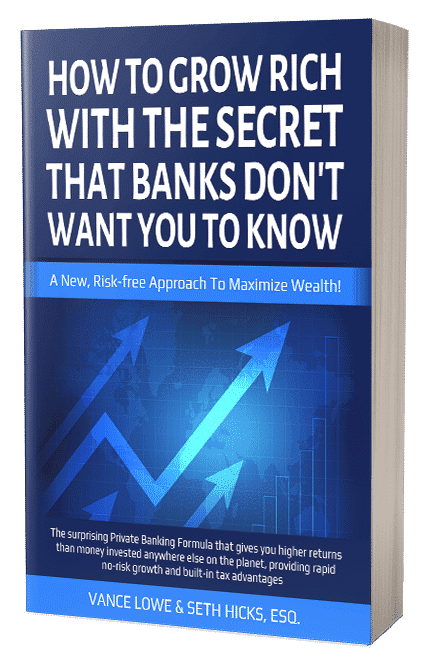
[00:29:20] Seth Hicks Esq.: If this is your first introduction to private banking strategies, you’re gonna get an opportunity to access a book that Vance and I author called How to Grow Rich with the Secret that Banks Don’t Want you to know. And put in your email and your name, uh, on our website, and that book will be made available to you instantly in PDF and audio form.
[00:29:40] Seth Hicks Esq.: And on our website. We’ve also got all of our podcasts available, lots of different articles and things that you can, uh, educate yourself with. And if those things are resonating with you, schedule a call, an exploratory call with Vance. He’s got a calendar link in the emails that we send. That’s effectively how you learn how private banking strategies can [00:30:00] work for you and your family.
[00:30:01] Seth Hicks Esq.: We’re excited to, to help you on your journey to be a part of that and look forward to working with you. Vance. You got any closing comments? Well,
[00:30:10] Vance Lowe: people what we need to know and what, what we have to keep in the back of our mind. It’s all about what we think we know about money that’s incorrect. That’s really hurting us.
[00:30:20] Vance Lowe: And please do yourself a favor, look in the mirror and tell yourself that you really don’t understand the flow of money and that everything that goes through our hands is something that we’re gonna be held accountable for. And we can either get it back or we can say it’s worthless. I hope that this will help enrich
[00:30:39] Seth Hicks Esq.: your life a little bit.
[00:30:40] Seth Hicks Esq.: Alright, thank you folks. Well look forward to seeing you on the next podcast. Bye-bye.
[00:30:45] Outro: Did that story feel like it was about you? Do you feel you should be making more progress toward your financial goals? Do you feel stuck? Let us help you get unstuck. Are you ready to take action and get your [00:31:00] own private bank?
[00:31:01] Outro: Please visit us at www.privatebankingstrategies.com. Thank you for listening to the Private Banking Strategies Podcast. Click the subscribe button below to be notified when new episodes become available.