[00:00:00] Intro: Welcome to Private Banking Strategies Podcast with Vance Low and Seth Hicks, your secret weapon to protect your assets and never have to start over financially again. Vance and Seth help high net worth individuals, families, business owners, and investors structure and asset protected fortress for their families.
[00:00:21] Intro: Learn how to keep what you earn and use the velocity of money. To create your own private banking system. Join us on this journey as we explore the secret strategies of the rich and political elite and help you take total control of your financial security now onto the show.
[00:00:48] Host: Make sure you pay attention today because I’m gonna be learning something myself. You know? I don’t have it all figured out. And this whole concept of infinite banking and private banking strategies, that’s a new concept for me. It’s not something I [00:01:00] learned. It’s something I’m learning. And so, Vance, thanks for coming on the show.
[00:01:04] Host: And Seth,
[00:01:05] Vance Lowe: thank you for having us. Thank you, Tony.
[00:01:08] Host: Yeah, so you guys in the pre-show when we were chatting, you guys got some, some great stories and, and some wisdom behind you. And what I love about having you on the show today is you’re giving us two different perspectives. You know, we don’t talk a lot about taxes on the show.
[00:01:21] Host: Again, that’s another topic I’m learning about. I wish I had learned not to pay the US government, the million plus dollars in taxes that I’ve paid them for my lifetime. I don’t even know, I, I think I stopped counting at a million because I don’t wanna know what it really is and. How to, how to keep some of that money, but also this whole concept of being your own banker.
[00:01:40] Host: That’s, that’s really kind of a, I’m not a big fan of the Federal Reserve Bank, so anything we could do to keep money outta the hands of the Federal Reserve Bank, I think is a good thing. And anything we can do to keep the money outta the hands of the government, that’s a good thing too. So teach us how to do that.
[00:01:53] Host: Guys, what’s your story from your childhood that got you kind of passionate about this and, and kinda led you on this [00:02:00] journey?
[00:02:00] Seth Hicks Esq.: Go ahead, Seth. Yeah, well, I, I grew up in a middle class family, had great parents, both college graduates that really instilled value in me that I could accomplish whatever, but set my mind to, and so they built a foundation that I could stand on and, and reach higher and go further, and really gave me a prosperity mindset and mind.
[00:02:22] Seth Hicks Esq.: You know, expectation that that prosperity is achievable. And so I excelled academically. I went to law school, went into a practice in large firm, and also had a strong work ethic that they’d instilled. And so I think those fundamental building blocks helped to propel me into a place where I was able to.
[00:02:44] Seth Hicks Esq.: Live a, you know, a prosperity mindset and it’s really a mindset. Success is a mindset, not necessarily a destination. It’s a journey. And then when I met and became partners with bands that was only amplified and, and [00:03:00] being able to add so many more fundamental building blocks to the way I was doing things that help people keep what you make and pay less tax in the legal way and be able to accelerate your wealth.
[00:03:13] Seth Hicks Esq.: Curve and, and such a, a stronger fashion.
[00:03:17] Vance Lowe: I guess it’s my turn. That’s right. You’re, you guys, you guys are
[00:03:22] Host: supposed to have more of a rhythm here. I mean, you guys need, right? Yeah, I guess so. Where’s that? How’s that handoff happening? Yeah, bumbled.
[00:03:31] Vance Lowe: Well, hey guys, I grew up in a little town in Utah. My family was, I guess, considered blue collar because my dad worked at the US Steel plant.
[00:03:40] Vance Lowe: He was a a worker there for his entire career, and they instilled in me the work ethics that I think I have today to help me. Stay out of trouble. I was very prone to exploring things I shouldn’t. So my dad decided that if we can [00:04:00] keep him hard at work, then he’ll stay out of trouble. And he taught me a few things along the way that stuck with me.
[00:04:07] Vance Lowe: One of those things was to find employment that you really love. Because it wasn’t like he didn’t want me to be like him. He did not like where he worked. He was not happy there. He knew he could do something else, but he had to settle on that. So he trained me to find something that I liked. So I. Found it and I got into the wealth management money management business for over 38 years.
[00:04:36] Vance Lowe: We had clients with million dollar more portfolios, and you know what you might consider me, uh, I, I kind of go by a title A conscious. Incompetent. I know I don’t know everything, and it’s my clients along that way who really taught me a lot of how wealth preservation works, how we can [00:05:00] keep it out of the hands of government, how we can pass it on to heirs.
[00:05:04] Vance Lowe: And then one day things were going so well, the client come in and he brought me in a book and he just screwed up my life forever. And that was this infinite banking concept. I had been looking for this all my financial career and it just absolutely turned the ship, and that’s why we’re here today is to really share this with people of why I.
[00:05:29] Vance Lowe: Money is almost totally different than what we think it is because of the way we’ve been taught and the history that behind that. So we’re really excited to be here and share these thoughts and ideas. And maybe, you know, somebody will come away with, well, maybe there’s a different way. Maybe we don’t have to pay taxes.
[00:05:49] Vance Lowe: Maybe we don’t have to do this. Maybe we can be less pronounced with the government. You know, have a little more anonymity, so to speak. [00:06:00] So that’s my story.
[00:06:02] Host: Yeah. Interesting. You guys got some interesting backgrounds there. So Vance, I have to go down the, this road of what your dad got. You started with the paper route, right?
[00:06:10] Host: And uh, yeah. So there’s a couple, a couple of things that come to mind when it comes to paper routes, but before I do that, I wanted to ask you, what’s your most interesting story as a paper boy?
[00:06:20] Vance Lowe: Well, you know, paper Boy has to be out every single day. Come good weather, come bad weather. My dad was the one that coached me into this, and on the bad weather days, my dad would get up early in the morning and drive me on the good days.
[00:06:38] Vance Lowe: Well, the most unique thing was when my parents were out of town and I was, I don’t know, maybe 12 or 14 or right around there. I would hop on my dad’s truck and go do the paper route, and I didn’t have a license or anything else, but it was early in the morning and one time I took my sister’s car and I wrecked it.[00:07:00]
[00:07:00] Vance Lowe: And it got found out. So that’s probably the most unique thing.
[00:07:03] Host: No, no dog, no dog attacks or anything like that. No. Busted windows from bad paper buses. All busted
[00:07:09] Vance Lowe: windows all the time. Yes, I broke windows and you know, there goes most of the money for the paper route. So yeah, very unique. I hated dogs, but I had to wait, you know, to get rid of ’em.
[00:07:20] Vance Lowe: So, you know, it was a good experience because it taught you, you had to be there every day.
[00:07:27] Host: Now, if you were an enterprising paper route boy, what you would’ve done was learn how to fix windows so that you could go around with the paper route and then break the windows. They come around and do the upsell.
[00:07:39] Host: Do the upsell of fixing the windows.
[00:07:42] Vance Lowe: Yeah. It wasn’t smart. That’s smart. Back then. But you’re right. That would’ve been great.
[00:07:45] Host: Yeah, that’s true. Entrepreneur. Yeah. When it comes to paper routes, you know, I had a different job, but I remember the old eighties. I think it was the eighties. It might have been nineties now.
[00:07:53] Host: I was definitely eighties movie. Better off dead. With John Cusack in it, and I don’t know if you remember [00:08:00] that one, but the big scene in that was him getting chased down by the paperboy because he owed $2 to the paperboy. So they put the paperboy.
[00:08:07] Vance Lowe: I remember
[00:08:08] Host: that. Yeah. Oh yeah. That’s a classic. Yeah. My wife, that’s a, that’s a, a family little memory there.
[00:08:13] Host: We always go around and saying, I want my $2. But that’s a funny story. So you guys, one grew up in a blue collar home, one grew up in a middle class home. Then when did you guys, each of you kind of move towards this direction of wealth? You know, do you remember the moment in time when you started going, Hey, there’s a, you know, there’s the way I’ve been living and there’s the way I’m gonna live and I’m making a shift.
[00:08:35] Host: Did that happen like at a moment in time for you? Or what, what was that journey like? Seth?
[00:08:40] Seth Hicks Esq.: You know, I don’t think it was a specific moment in time like Vance. I had a, a work ethic instilled in me. I, I had a landscaping business, mowed lawns, cut trees, did whatever they needed to have happen. We, myself and a partner would, would do it.
[00:08:56] Seth Hicks Esq.: And so I just, I liked. The, the freedom, I think at [00:09:00] that age when I was a teenager, the, the money gave you its power. It’s the ability to, you know, purchase things that you, that you think you need or that you do need. And so I, I was always one of those. Kids that was working and in fact I’d have sometimes I have two or three jobs at a time and like I’d mentioned, I academically was, did really well.
[00:09:24] Seth Hicks Esq.: So I figured that, you know, I would be a high in a high income income earning professions. So I chose the practices of law which fit my personality and fit some of my strengths. So that was, I don’t think there was a one, one moment in time. It was just kind of building one thing on top of the next. And, but early on in the practice of law, I, I, as I began to have a high, you know, annual income, I needed to put money to work.
[00:09:54] Seth Hicks Esq.: So I began to invest in real estate and I invested in multi-unit properties and single [00:10:00] family flips and probably done. 50 fix and flips and had had, you know, numerous doors and multi-unit properties over the past 25 years and found real estate to be a, a really good way to accumulate wealth. But I think there’s always, there’s, you know, you can always reach higher and it’s just like you mentioned, I think maybe before we started.
[00:10:25] Seth Hicks Esq.: Some friends that you have and folks, influencers that you know, that have done really well, even at earlier ages, and they had a mindset to succeed and they’re worth 50 million or they’re worth a hundred million. And, and not that it’s a number, but it money is like an arrow, you know, and, and warfare. And we know some of your motivations that you shared with us to be able to make a difference.
[00:10:47] Seth Hicks Esq.: And do things that, that help other, other folks in the world. So that’s kind of my mindset on it, is to be able to change things that, that, that I see as in unjust in the [00:11:00] world. Uh, and uh, lock arms with folks who are out there doing frontline things, helping people that, that can’t help themselves or that are down and out.
[00:11:10] Seth Hicks Esq.: Whether it’s orphans or human trafficking, just like you said, I, I resonate with all of those same motivations. So it’s kinda a long, long-winded answer, but yes, I
[00:11:22] Host: think it’s, yeah, I think it’s great. Yeah, I’ll, I’ll transition in there for Vance, I’ll be the filler material. Yeah. I think the real estate, like you said, it’s not something I would say I’m a master at.
[00:11:30] Host: I’m, I’m, you know, I’ve made a few million in real estate, but I wish I had focused on it longer and sooner, you know, and even the concept of, uh, buying and selling land. That’s something that’s kind of newer to me is, you know, you as a real estate investor, a lot of times I think people don’t think they, they can barely afford a first house.
[00:11:48] Host: How could they possibly afford a second house? And I think that’s where the trap is. Because they don’t take the time to understand investing. You know, future millionaires listening to the show, this is really important because your mind is [00:12:00] so amazing because once you set it on a problem and try to find a solution and then you go find the right mentors, you can, you can actually solve a lot more problems than you, than you think, and, and investing in real estate and purchasing real estate and how to invest in real estate, it’s really just another problem to be solved.
[00:12:16] Host: You just have to put forth the effort, you know, turn off the television, turn off. PGA, turn off the NFL, turn off the NBA. All those things, turn ’em off and make sure you offset your time with learning how to build wealth. And that’s really it. I was thinking this morning, you know, a lot of people get hung up on this thing about like, you know, you these people pursue wealth.
[00:12:35] Host: These rich people pursue wealth. I don’t pursue wealth. Wealth pursues me. Because I’m just living out my life according to a set of principles, and the money just kind of materializes the abundance materializes. But unless you’re in that zone, it doesn’t happen that way. You know, if you’re, if you’re in a consumer mindset and you’re just kind of going through your, your.
[00:12:55] Host: Programming, which is what happens to us at a very young age. We get programmed to be [00:13:00] consumers to go to work and then make money and spend that money and not have any of it left. But if you get stuck in that programming and you don’t develop new programming, that’s where you’re gonna end up. You’re gonna, you’re gonna be broke at the end of your life.
[00:13:10] Host: The average person works a hundred and to 150,000 hours in their lifetime. My dad, he’s still working full-time at 72 years old and really doesn’t have an option. Another option right now for him. That’s not a good place to find yourself. So for you, Vance, what was your transition? Did you, was it a moment in time where you switched, where this flip switch flipped?
[00:13:30] Host: Or did you kind of roll into it?
[00:13:32] Vance Lowe: I think I, uh, I rolled into it out a high school. I went straight into the service because I had a load draft number. And so out of that, I, I came back, came back, served a two year church mission, came back from that, met my wife and married her, and went to school, and I had to support myself through school.
[00:13:53] Vance Lowe: So I sold cars privately. My wife never knew what I would drive home that night [00:14:00] because I’d, I’d buy ’em and drive ’em and sell them for profit. And I got very good at that and felt like I could communicate with people. Then I got into the financial world and yeah, the rest was history there. I knew I was cut out from that.
[00:14:16] Vance Lowe: For that right upfront, and I just looked for those opportunities to be able to excel, learn more. I, I realized that my education was just beginning when it comes to money, because you can’t find anything about money in the higher education system. In our, in our. Country. Country. And that I found out was on purpose.
[00:14:40] Vance Lowe: That is definitely on purpose. Yep. Anything about money these days. So we have to take that to the public and share that. We all have that same cause to be able to help people understand more. So that was really what. What drove me, and then I really loved it, so it was fun. I always learned [00:15:00] something new.
[00:15:00] Vance Lowe: I was always being challenged, and along the way the family was growing and I was able to meet all those, those needs. My, probably the most influential person at the time was my wife’s father. She, he was a banker, actually a bank president. And he was very intimidating and he taught me a lot of things about actually how to be intimidating, and he would say that on purpose.
[00:15:32] Vance Lowe: So my wife thought that, that that would be the best thing for me. And it didn’t turn out that way. But I learned a lot and, and it really helped me in the financial situation because we started right off the bat when we got married. Our married wedding present from my wife’s parents was the down payment on a house.
[00:15:56] Vance Lowe: I had to pay it all back except for the exact [00:16:00] amount. He, you know, he was very much a businessman and if we went over an amount, I had to, I had to finance it and pay it back to him. So I’ve always owned real estate. I branched out, saw the wisdom in real estate, acquired income property all along the way.
[00:16:14] Vance Lowe: And it’s only been recently in my years that I’ve started selling up. You know, you’re, you’re supposed to buy low and, and sell it once it’s high. I’ve, I’ve been a practice of that, so
[00:16:26] Outro: that’s my story. Did that story feel like it was about you? Do you feel like you are generating a lot of revenue but are not moving forward as fast as you would like?
[00:16:38] Outro: Do you feel you should be making more progress toward your financial goals? Do you feel stuck? Let us help you get unstuck. Are you ready to take action and get your own private bank? Please call private banking strategies at (817) 200-4777 or visit us at [00:17:00] www.privatebankingstrategies.com.
[00:17:06] Host: I think a lot of people need to hear, and you talked about why, you know, you couldn’t find anything of financial, like teaching in the upper system, you know, educational system or in the lower educational system.
[00:17:16] Host: And then it’s only been recently that they started this financial ed stuff. But it is so little. Like it’s, you know, you get a semester really for me, you need to start learning about money and you need to continue learning about money your entire life. But what’s really sinister about it, and, and I do use the word sinister intentionally.
[00:17:36] Host: Is that the system is designed to make slaves of us all. Like, and some people may be offended by that. I got, I offended somebody the other day by saying we’re living in a slave based system, and they thought that was too frugal. I mean, when you look at, you know, the average person, I said a hundred, a hundred to 150,000 hours of your life, you’re gonna be working.
[00:17:57] Host: When the government, when you, when you stack up what the [00:18:00] government takes and what the interest payments take for banks, that banks take, you’re well over what is 60%. You guys probably even have a better handle on that for the average American of your life. And that’s, and that’s really what. That time represents because your time and your life, those a hundred to 150,000 hours of work, you’re converting that into a currency.
[00:18:19] Host: And the system that is designed, it’s designed to collect that currency in a maximum efficiency. So I’ve got some clients that are sitting on 25, 30% interest on their credit cards with, you know, 15, 20, $30,000 on credit cards. And then that’s on, you know, not including taxes. Right. And you look at our tax base system and our government’s, what, $32 trillion in debt now.
[00:18:41] Host: And that money is being paid for by the taxpayer. So yet again. A hundred to 150,000 hours is being taxed and then paid out to the bankers. So it’s the same people collecting the money in some form or fashion. Not all, not all that money goes to the bankers, but a huge chunk of it. And then you realize the Federal Reserve Bank isn’t even a [00:19:00] Federal Reserve.
[00:19:00] Host: It’s not part of the federal government. It exists outside the federal government. A lot of people don’t know that. But it, it’s, it’s important to do it, to learn about that is part of this. I think it’s how you beat the system, is to understand how the system’s set up to work. And I love that. I think it’s g Edward Griffin or Edward G.
[00:19:15] Host: Griffin. You guys know that guy? He’s written a book. Absolutely. Yeah, he’s written that now. I haven’t talked to him, so if you guys know him, connect me with him. I wanna have him on the show. I wanna talk to him. I love his book. The Creature from Jackal Island, you Future Millionaires, listening to the show.
[00:19:27] Host: You’ve heard me mention that book before. I’m gonna beat that book into your head until you read it. Because you need to know it. You need to know it. If you wanna know what’s going on in the world today, wanna know why inflation is so ridiculously high and the government’s lying about it? Um, it’s not 9.1% or whatever they’re saying it is today.
[00:19:41] Host: It, it is well into the double digits and probably somewhere closer to 30% rather than the 9.1% they’re saying. But you gotta understand that stuff, right, Vance?
[00:19:51] Vance Lowe: Yeah. You have to understand it. You have to know what’s going on. If you do. I say finance, all the things to do with [00:20:00] money is like driving a car.
[00:20:03] Vance Lowe: And I would much rather drive my own car than to hire, you know, a, a money manager or someone else out there to drive it for me. And this is where I think it, the system is wrong. ’cause it’s easy to, to handle your own affairs, to, just, like you said earlier, you know, you don’t. Pursue wealth. It pursues you.
[00:20:23] Vance Lowe: You set this up right? You, you, you understand the flow and the way things go. You’re living your life the way you want and everything else just returns. You know, the banks always get the money back always. But the problem is they get all of your money back too. Even our wealthy millionaires today, the number one concern they have is, am I going to outlive my money?
[00:20:47] Vance Lowe: It doesn’t have to be that way. Mm-hmm. You know, if the money comes back, just like to the banks, comes back to an individual system, they’re actually gonna be better off. They’re not gonna drain it, they’re gonna increase it for their [00:21:00] posterity.
[00:21:00] Host: Yeah, I would love to see, you know, the current systems going down the toilet, you know, depending on who you talk to.
[00:21:05] Host: That’s exactly what’s happening. By intentional design, for sure. But I would love to see a system where the people actually own the system so that if there is interest being paid, that it’s being paid and you’re, you’re benefiting from it, right? Because it is your money. That they’re loaning out. It’s, it’s a, it’s a fractional ownership of your money or fractional multiplication.
[00:21:23] Host: So it’s called fractional banking, which you guys know about, but you know, my listeners haven’t heard that term a lot. And what we really need to be building towards, in my opinion, is a system owned by the people for the people. Backed probably by the people in some form or fashion, which I don’t really think has ever happened.
[00:21:39] Host: You know, guys, I didn’t know this. Somebody was telling me this the other day. I’ve just learned about this in the last 90 days or so from some friends I’ve come across. But did you know that during the, the Civil War, that Abraham Lincoln, that the, the banking system, the guys that own the Federal Reserve Bank, now, that whole cartel actually was backing the south in a [00:22:00] revolt against the north?
[00:22:02] Host: That they were applying pressure, financial pressure, economic pressure against the north, and Abraham Lincoln and Abraham, I can’t remember the guy that came to him. He was a friend of him. Friend of his came in and said, Abe, just give the businesses the money. He started giving money from the north to the, the northern businesses just to continue operating the economy.
[00:22:22] Host: And then, and he was planning to continue that. So he was basically extricating the foreign banking, the international bankers from the United States government post Civil War. And there are quite a few people that believe that that is the group that actually was responsible for his assassination because he was moving away from a foreign owned, international banking backed system.
[00:22:45] Host: I didn’t really know that. Have you guys heard that?
[00:22:47] Vance Lowe: Oh, I definitely have. And, and that’s, it’s what the Federal Reserve is, is all about. They’re not after freedom, they’re after slavery, and the principles of the South fit their [00:23:00] model, so to speak. And then all of a sudden, Abraham Lincoln starts, whoa, wait a minute.
[00:23:05] Vance Lowe: He’s, he’s going independent from us. These guys could get back to what enticed us in here to begin with. That’s, I agree with that. Well, that’s how you, how you prove that. I don’t know.
[00:23:18] Host: Yeah. Well, I think we’re seeing it play out again today. You know, when you look at what’s going on with the economic system.
[00:23:24] Host: But you’re hearing, and let me not scare you with this future millionaires listening. Okay. It’s gonna be an interesting road here. We have over the next several years, if not next decade, but. You have groups like the United Nations lawyer, not lawyers, politicians out of Canada, world Economic Forum, and they’re starting to say things like, people don’t need private property rights.
[00:23:45] Host: That’s, that’s not something that they should have. They’re also saying people should not have individual car ownership. Like you hear the stuff and then you hear, I think Biden’s administration had slipped out that they had been looking at leveraging a, a. [00:24:00] Universal or interna, not international, but national property tax on houses.
[00:24:06] Host: So you’re talking about a federal property tax on your houses, and I think the number was 3%. Uh, and that’s, I don’t know if that’s 3% of assessed value or 3% of total value or whatever that number is that they’re making that out of, but just the concept that they’re talking about those kinds of things should put all of us on a very high alert.
[00:24:24] Host: Those are all. anti-American freedom or original founding father kind of American structure, a constitutional structure. But yeah. So have you guys heard any of that kind of stuff out there floating around?
[00:24:37] Seth Hicks Esq.: Absolutely. Yeah. We’ve got Communistic Manifesto all around us and people who are, have their eyes open and, and their ears listening.
[00:24:47] Seth Hicks Esq.: You’re exactly right. It should put you on high alert because we, we’ve been infiltrated from the inside out, and this is why we discussed this all the time, and we write on it about [00:25:00] taking the banking equation back in your own life. And so for the, your audience and, and folks out there that, that don’t want to be a slave to a derivative banking, a fractionalized banking system.
[00:25:13] Seth Hicks Esq.: And if you don’t know what that means, Google the terms. What it means is that your, your money is, is really not your own. And, and sometimes people, it’s like slapping ’em in the face. When, when I say that, when you, you go put your money in Wells Fargo or Bank of America or Chase or any other centralized bank, you think that money’s your money, right?
[00:25:31] Seth Hicks Esq.: Tony?
[00:25:32] Host: Oh yeah, most people do.
[00:25:34] Seth Hicks Esq.: I mean, you get a bank statement every month that says you’ve got a certain amount of money in there, right? Yes, yes. Well, there’s, there’s something called the Dodd-Frank Act. And the Dodd-Frank Act effectively changes that entire equation when you sign your, your bank documents opening, uh, a bank.
[00:25:54] Seth Hicks Esq.: Account you effectively, that is submitting to the Dodd-Frank Act. The bank actually [00:26:00] owns your cash deposits and they give you an IOU in the form of a bank statement every month, and people go, that’s just not true. That that is absolutely not true. It absolutely is true. And if you, if you read what the Dodd-Frank Act is, is it, it is a bail in document.
[00:26:18] Seth Hicks Esq.: We, you know, are you familiar with the term bail out?
[00:26:21] Host: Oh yes.
[00:26:22] Seth Hicks Esq.: Okay. So in 2007, 2008, mortgage crisis, the federal government bailed out too big to fail financial in institution, Lehman Brothers. And so you have this use of taxpayer money to bail out private corporations. Well, taxpayers said, no way. You can’t do that.
[00:26:41] Seth Hicks Esq.: So the politicians cleverly said, you’re right. So they enacted the Dodd-Frank. Misnamed Consumer Protection Act. It has nothing to do with consumer protection. And what they said was, we’ll never bail out a, a financial institution with taxpayer money. But what we’ll do is we’ll [00:27:00] bail in these big banks, and large banks will have the ability, if insolvent, to use depositors money to become balanced and solvent.
[00:27:09] Seth Hicks Esq.: And they’ll give you pennies on the dollar or. Stock and this insolvent entity. People go, that’s, that’s absolutely untrue. Look at Cyprus, Google Cyprus, bell End. Every country in the European Union has Bell end laws on the books, and the US does as well. And it’s called the Dot Frank Act. And when you really begin to dissect that people, they, at first, they’re resistant because it just.
[00:27:35] Seth Hicks Esq.: Flies in the face of freedom and the constitutional protections we have as Americans. It’s like, it’s the, the, the theft of, of your cash. And that’s effectively what it is if they become insolvent. And then the next thing people say was, well, what about the FDIC insurance? Well. Harvard economist, Terry Bonham says that there’s 1.30 cents of solvency for [00:28:00] all of the cash deposits in the big box banks.
[00:28:03] Seth Hicks Esq.: So if there’s a, a major catastrophic implosion, which we will, if you’ve, you’ve got. The national debt accelerating faster than it ever has in time before we started tracking it when it was about 24 trillion. And like we, we said just a few moments ago, it’s over 30 trillion now. And that’s just in a matter of a few years, Tony.
[00:28:27] Seth Hicks Esq.: So who’s gonna pay for that? Taxpayers are gonna pay for that. Consumers are gonna pay for that in inflation, but it’s an expanding bubble that cannot continue forever. And when that hold. The system collapses. Those big box banks where people are storing their cash are gonna bail in on their cash. So what other alternatives do you have?
[00:28:48] Seth Hicks Esq.: Well, you do have other alternatives, and that’s, that’s where private banking comes in. That’s where the asset protection strategies come in. Diversification and, uh, commodities and metals and real [00:29:00] estate, all those type of things help build a diversified asset protection plan that will protect people.
[00:29:07] Seth Hicks Esq.: Does that make sense?
[00:29:08] Host: Oh, absolutely. I loved how you covered that and you know, the conversation we’re having here, the reality is, future millionaires listening to the show, I know this is gonna be nuts, it’s gonna sound crazy, but I’m gonna float some stuff here, which is basically, this is my opinion guys.
[00:29:23] Host: I’ll be interesting to see where you stand. This is an intentional torpedoing of the current financial system. That’s exactly what’s going on because they’re, they’re trying to undermine the current when you go. And so people ask, it’s like, why are we $32 trillion in debt and throwing more on, because, you know, the average fiat currency, which is what we have, we call it fake money, it’s paper money.
[00:29:48] Host: It’s not backed by anything except for the belief that the American people have that it, that it’s worth something. And that’s eroding very, very rapidly. You know, internationally, it’s, it’s going away very quickly. And the question is [00:30:00] they know that that money is essentially worthless, so they are issuing as much of it as possible out.
[00:30:07] Host: Everywhere to cronies and everything else that’s, you know, government corruption. And then the cronies are taking that and buying up the real assets. You see Bill Gates buying up, uh, 280,000 acres of land. You bought another couple square miles up in, I think it was the South Dakota or North Dakota. Lots of land purchasing going on.
[00:30:24] Host: That’s real money, real assets. You have a JP Morgan Chase bank, which I think somebody, their staff just got in trouble for manipulating the silver price. But there’s a lot of financial stuff going on right now. The bricks, nations, Brazil, Russia, India, China, South Africa, um, and I think now Saudi Arabia’s involved in it, but they are creating this kind of gold backed currency and, and China and Russia and Brazil have been acquiring gold for a decade, over a decade.
[00:30:52] Host: And they’re moving away from this petrodollar, which is what basically equipped the US dollar to become the national or the international currency that everybody, [00:31:00] you know, traded in. So you’re seeing that go away and you’re seeing some major financial shifts in the world. I don’t know when those things are gonna be complete, but I think the simplest answer, what is it that there’s a law out there, and you guys may remember what it’s called, but sometimes the simplest answer is the correct answer, which is why is.
[00:31:17] Host: Why are they so incompetent in what they’re doing financially? And the answer is they’re not incompetent financially. They’re doing exactly what they’re, what they’re trying to do, which is undermine the US financial system so that they can replace it with changes in a new financial system. Like we said before, do away with property rights, do away with all this other stuff that’s going on.
[00:31:38] Host: That’s my personal opinion. I think there’s quite a few other guys out there, financial analysts and things that are kind of seeing the same similar things. But, uh, where do you guys stand on that? And I know that’s a little bit down the conspiracy trail, but I like to go there every now and then.
[00:31:51] Vance Lowe: No, I don’t.
[00:31:52] Vance Lowe: I don’t think it is. It’s a planned event. I think they need to ruin our economy. I feel like from the [00:32:00] reports I’m seeing, almost 4 million workers are leaving the workforce every month. This year, deaths have gone up astronomical. You know that back to the vaccine problem. But you know, the whole thing is being remade.
[00:32:18] Vance Lowe: I think the people and the power have to get the, the money down so that they can either pay their bill or square it with land and hard assets here in the United States, I think we’d be absolutely shocked at how much we’ve already given, you know, countries like China. Harry Reid got exposed years ago ’cause he was trying to give away a lot of Nevada to China and yeah, so I agree a hundred percent that, that it’s happening and we’ve gotta do something about it.
[00:32:52] Vance Lowe: I just read an article, my son sent it to me. They says Biden through the back door, just announced that they want to [00:33:00] go to a digital currency. Of course. Yep. So, you know, that’s, that’s totally manipulative. That’s not gonna help anybody out. Yeah. But the powers to be.
[00:33:12] Host: Yeah. Now and, but you didn’t, you didn’t clarify why they want to go Vance because digital currency is a hundred percent trackable and accountable.
[00:33:19] Host: Like it’s controllable. And, you know, I love, I, I’m a digital currency guy myself as far as I like to make money off digital currency. But a lot of these guys that are out there. Pro, you know, humping the, the, the cryptocurrency market Pumping the cryptocurrency market, they talk about decentralization, defi, decentralized finance.
[00:33:39] Host: And to me, current cryptocurrency represents the most centralized currency you could possibly have. Because when every currency in the world, of which there is like, what, 200 different currencies, 300 different currencies in the world, when every one of those currencies exists as a one or a zero in the ether.
[00:33:58] Host: That is the highest level of [00:34:00] centralized currency you could possibly have when every currency is a one or a zero. And, and that just smacks with me of control. That’s a, you know, 1984 is George Orwell, Orwellian stuff. Lots of books out there have been written about this kind of thing. But, so before we go down there, if you guys wanna research this more, I don’t write about this kind of stuff on my blog a lot, but I strongly recommend in this season you are living in a rare, rare time listening you listeners, future millionaires.
[00:34:27] Host: Take the time, research this stuff, learn it can’t. No one to have on this show can cover all this in an hour. It would literally take a y years just to unpack all this for you. But if you wanna learn more about it, you can read a little bit of the James Rickard stuff. Jim Rickards out there, road to Ruin Death of Money, a couple good books about what’s happening and the financial economy.
[00:34:48] Host: There’s a lot of other good resources out there. We mentioned, I think it’s g Edward Griffin. Creature from Jackal Island. There’s a lot of these kinds of books out there. Learn about this stuff. You know, your family, your future, a lot of this [00:35:00] stuff is tied back into this and it’s just part of what you should do now.
[00:35:03] Host: Seth, you got, you did a really good job earlier talking about infinite banking, privatized banking. But before we wrap up, I wanna give you guys the floor to, to just talk to the audience a little bit more about that and what you do and how you help people kind of embrace this concept.
[00:35:16] Seth Hicks Esq.: Sure. Well, we use a a very carefully and narrowly tailored whole, whole life insurance contract, which serves the purpose of acting like a perfect bank, and that means that you can put money in and take money out without flagging.
[00:35:33] Seth Hicks Esq.: Any type of third party, it grows inside your policy tax free and compounds year after year annually. That’s why folks like JFK and Richard Nixon and Ray Crock who franchise McDonald’s, JC Penney’s, that’s why folks like that who have built large storehouses of wealth have used this. To accelerate their wealth.
[00:35:56] Seth Hicks Esq.: In fact, most politicians are using the same vehicle [00:36:00] because they know that it’s tax free grows and compounds year after year. It’s financially private and it serves as the perfect bank. And where do the big banks, where do they park their assets? They park them in life insurance. So life insurance can’t fractionalize its banking, it doesn’t do any derivative banking.
[00:36:18] Seth Hicks Esq.: There’s a one for one cash reserve for every dollar that they receive. And what this system does is it allows you to capture the velocity of money. Tony, we’ve talked a little bit about real estate. So let’s say for example, that your, your private bank has a hundred thousand dollars in cash value in it, and you can go out there and buy.
[00:36:38] Seth Hicks Esq.: A real estate property in Georgia or Alabama for a hundred thousand dollars. Okay? And you’ve got a, a cash flow on that rental, let’s just call it a thousand dollars a month, and you got $12,000 a month coming back to you. Okay. And you put it back into your bank. So you took a hundred, you put a hundred thousand dollars in to [00:37:00] capitalize your bank.
[00:37:00] Seth Hicks Esq.: It’s your, it’s a banking business. You loan the money out to your borrowing entity, whether it’s you or an LLC, you purchase that investment property. You got rental income coming. You pay your, uh, your rental cash flow back to the bank. Your, your cash value increases dollar for dollar, and you effectively increase that amount until you go buy your second property.
[00:37:24] Seth Hicks Esq.: Or what a lot of folks do is they use the concept of leverage and they take that same a hundred thousand dollars that’s in their bank and they go out and they buy five properties with 80 20 financing, 80% third party financing, 20% through their own bank, and then they’ve got five times that cash flow instead.
[00:37:44] Seth Hicks Esq.: 12,000 a year or 1000 a month. Now they’ve got 60,000 a year or 5,000 a month, and they pay back their private bank and they begin to take out those third party mortgages until they own those properties. Free and clear. It accelerates. [00:38:00] To growth, you’re getting a touch on the dollar. When you capitalize your bank, you’re getting a touch on the dollar.
[00:38:05] Seth Hicks Esq.: When you loan it back out, you’re getting a touch on the dollar. When you buy the real estate, you’re getting a touch on the dollar from the rental income. You’re getting a touch on the dollar when you pay back your bank, so you’ve got multiple touches on the same dollar. That’s what, when Vance says. The bank always gets the money back.
[00:38:22] Seth Hicks Esq.: That’s what he’s talking about. He’s talking about the cyclical nature of money where we pay one vendor and they pay another vendor and then they pay another vendor. But all of those vendors pay their, put their deposits back in at Wells Fargo or Bank of America, so they’re still getting all that money back.
[00:38:41] Seth Hicks Esq.: And just like you talked about, there’s the derivative lending aspect where the $1 in and they go loan out 10. But in this. Private banking system, you are the banker. You’re making the interest on the loans, which you could set at any, any interest rate you want, and it’s tax free compounds. And they don’t [00:39:00] raise their hand to the IRS and say, Hey, you know, we had a $50,000 in input here, or we loaned out $50,000.
[00:39:07] Seth Hicks Esq.: It’s all. Outside the IRS’s purview, and that’s according to IRC 77 0 2. If listeners wanna research that Internal Revenue Code 77 0 2 excludes these type of policies from a taxable event, so. All of those values and, and benefits in your own private banking enable you to keep what you make and pay less taxes and do it in an asset protected and financially private way.
[00:39:36] Seth Hicks Esq.: I mean, that’s a mouthful, Tony. And it, we we’re only touching the surface. I mean, we’ve got podcasts after podcasts and we’ve got emails and lots of nurturing content that help people try to get their head around this. But I, I gave you a tall drink right there in about two minutes.
[00:39:51] Host: No, it’s good and I think it is something people should look into.
[00:39:54] Host: You know, I think a lot of times you get hung up on BA based on certain financial teachers out there. You get hung up [00:40:00] on mutual funds or, you know, staying outta debt or avoiding credit cards or whatever it is. The reality is there’s dozens and dozens of roads that can lead to wealth. You need to take time to learn a lot about all of them, I think, and master a few, but learn about all of them and figure out what works for you.
[00:40:16] Host: I think infinite banking and what you guys are doing is a really good thing to, to learn about. See if it fits in. Now, one, one more thing. Help me question for myself. I’ve talked with a, a group, I think it’s a WFG, world Financial Group. I think they do a, a similar thing, but they do it more from a multi-level marketing kind of model.
[00:40:36] Host: One of the things they’re doing is, is it the same thing you guys are doing where you’re actually, it’s, you’re putting it into an investment fund. It’s more like this hybrid investment where it’s, it’s very different. What you guys are doing is very different than that.
[00:40:48] Vance Lowe: Everything we do is guaranteed.
[00:40:50] Vance Lowe: There’s only one risk, and that’s the people looking back at you in the mirror. We don’t want to have any market risk. We don’t want to have any economy risk or [00:41:00] risk of other people making mistakes. So there’s just no need for it in the banking world. You can do it all off yourself very efficiently.
[00:41:12] Vance Lowe: Doesn’t take much time and reap the rewards of having your money actually working instead of in accounts trying to earn what little interest rate you can get.
[00:41:23] Seth Hicks Esq.: Yeah, there’s no third party risk, Tony. So you’re, you’re, we’re not subject to market risk with these, the policies that we structure. So we’re not talking about universal life, we’re not talking about indexed life because those policies shift the risk to the insured.
[00:41:38] Seth Hicks Esq.: And they, you know, that that is not what we’re, we’re doing. What we’re, what we’re doing is avoiding that risk. And as Vance said, the only risk comes from the person looking back at you in the mirror is how you put your money to work, what asset acquisitions you make, and how you pay your, your bank [00:42:00] back and making sure that you pay.
[00:42:02] Seth Hicks Esq.: Yourself back. And Nelson Nash describes it like this in his book, if you own a grocery store, you know, do you load up your cart and go out the back door and not pay? Or do you pay your store for the canopies? And the answer is you pay your store for the can of pea because it’s gonna take you. 15 can a piece to pay for that one on the, the profit margins.
[00:42:26] Seth Hicks Esq.: And so you don’t steal the peas out the back door. You pay your bank back on the loans that it makes so very different than what you were talking about with that, uh, other, those other folks setting things up and yeah, very, very d.
[00:42:41] Host: So real world example, test case here. So a lot of people might hold their, their emergency funds.
[00:42:47] Host: Let’s say for example, let’s say somebody’s got a $30,000 emergency fund and they’re recommended to put it inside of a money market account, which right now is not really paying a whole lot. Would that be a candidate for somebody to, to do what you guys are [00:43:00] doing to hold their Oh, ab absolutely
[00:43:02] Vance Lowe: wouldn’t, wouldn’t.
[00:43:03] Vance Lowe: If you have the choice, wouldn’t you rather put it in your bank?
[00:43:06] Host: I would, I think so. I think I would like that. Can I change the name of that bank too? Can I call it a WB?
[00:43:12] Vance Lowe: Absolutely. And it’s 100% private and inside your bank and, and whatnot. It’s, there’s no tactical events at all. No government seizures? No government seizures.
[00:43:26] Host: So the 87, the new 87,000 IRS agents, with the 450,000 rounds of ammunition, those guys won’t be able to get access to it?
[00:43:34] Vance Lowe: Nope.
[00:43:36] Host: World’s getting crazy fellas. World’s getting crazy,
[00:43:40] Seth Hicks Esq.: and that’s why people should read, read about that Internal Revenue code 77 0 2. The, and the, you know, politicians and, and the banksters are using this, this same vehicle for, for their own personal benefit and their own corporate benefit.
[00:43:55] Seth Hicks Esq.: When you, when you look at the. Public disclosures, like for Wells Fargo, they have, [00:44:00] they, they have billions of dollars of assets and life insurance and they take life these same type of life insurance policies out on every employee they’ve got. And whether the employee stays or goes, they continue to service those premiums and they will, they will receive the death benefit on, on the death of that employee.
[00:44:21] Seth Hicks Esq.: When they no longer work there, and the way they sell it is they go, well, we’ll give your, your family, you know, $20,000 in funeral benefit or expenses, but, and they make a delta on that, a big delta.
[00:44:34] Host: Well, Seth, I gotta say that sounded a little bit like you were saying some, some of our politicians might be trying to hide their money in some different places, but we won’t go there on this episode.
[00:44:43] Host: Guys, thanks for coming. Thanks for being on the show today and enlightening me on a lot of this kind of stuff. Had a good conversation. How can people find out more about, you guys? Get in touch with you if they want to.
[00:44:52] Seth Hicks Esq.: Best place to, to start to do your due diligence on private banking strategies is, is on our website.
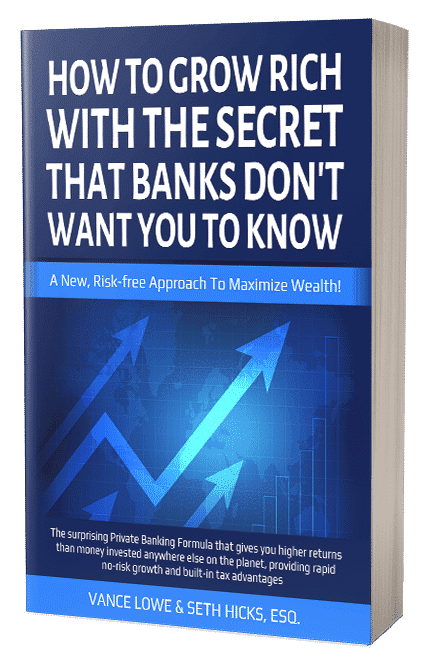
[00:44:58] Seth Hicks Esq.: That’s private [00:45:00] banking strategies.com, private banking strategies.com, and there for visiting our site, we give folks a, a free book. It’s, we like to call it a red pill book. It’s what the banks don’t want you to know. That can help you grow your wealth. And also you can find numerous podcasts. You can find blog articles, and you can basically binge on content until your heart’s content.
[00:45:25] Seth Hicks Esq.: And we, what we want to do is we want to help educate people as to the risk that you’re identifying here on, on, on your show and others, and help them to make a, an educated decision to protect themselves and their family’s assets.
[00:45:41] Host: Awesome. Well, thanks a lot guys. Really appreciate it and talk soon.
[00:45:45] Vance Lowe: Thank you, Tony.
[00:45:46] Vance Lowe: Thanks. Thanks for having us on. I really appreciate it.
[00:45:48] Outro: Did that story feel like it was about you? Do you feel like you are generating a lot of revenue but are not moving forward as fast as you would like? Do you feel [00:46:00] you should be making more progress towards your financial goals? Do you feel stuck? Let us help you get unstuck.
[00:46:07] Outro: Are you ready to take action and get your own private bank? Please call private banking strategies at (817) 200-4777 or visit us at www do. Private banking strategies.com.